There Are 200,000 Semi-Basement Houses in Seoul
Vulnerable to Safety and Security Issues, Requests to Increase Priority Points for Elderly Residents
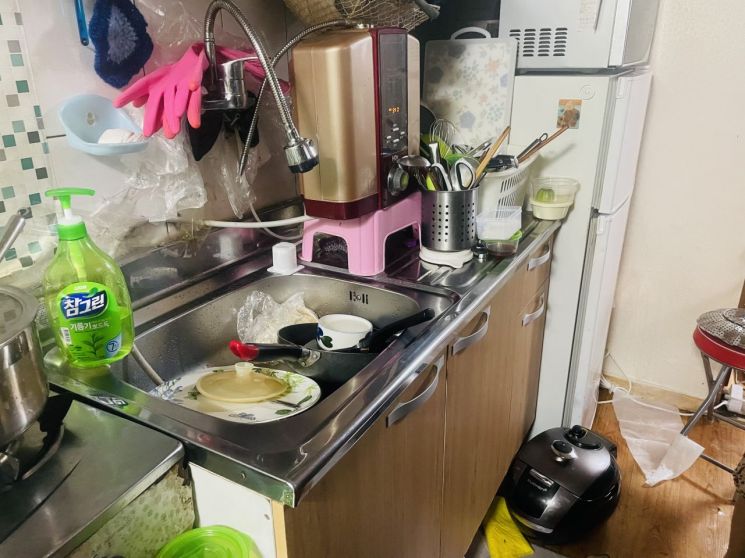 On the 16th, a semi-basement house in Bangbae-dong, Seocho-gu. Due to the cramped space, rice cookers and dishes are scattered here and there.
 Photo by Jang Sehee jangsay@
[Asia Economy Reporters Jang Sehee and Yoo Byungdon] "I have lived in a semi-basement since the 5th grade of elementary school, a total of 9 years until now. Even with government support, it seems difficult to move above ground."
Lee Seonyeong (23), who lives in a semi-basement of a multi-family house in Bangbae-dong, Seocho-gu, Seoul, complained, "I'm worried about the rising deposit and moving costs," adding, "If I spend cash immediately, I won't have money left for living expenses."
Residents of semi-basement homes met on the 16th expressed that even with some government support, it is difficult to cover the remaining costs. Lee said, "For five family members to live together above ground, the price would have to be at least twice the current amount." Currently, the average market price for a semi-basement home in Bangbae-dong is a deposit of 10 million KRW and monthly rent of 400,000 to 600,000 KRW. As of 2020, there are 200,849 semi-basement households in Seoul.
Lee felt a sinking heart upon hearing Seoul City's plan to ban semi-basement housing. She said, "People live in semi-basements because they lack economic power, so I worry when they say they will just eliminate them without consideration."
Vulnerable to Safety and Security Issues: 'Once You Enter a Semi-Basement, It's Hard to Escape'
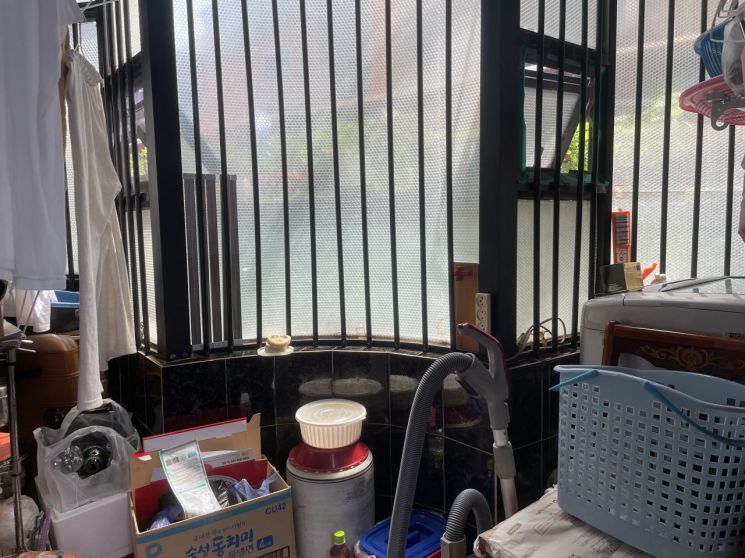 On the 16th, a semi-basement house in Bangbae-dong, Seocho-gu. Since the inside of the house can be seen from outside, bubble wrap was quickly attached./Photo by Byungdon Yoo tamond@
Their living conditions were very poor. The master bedroom and veranda were visible from outside, making them vulnerable to safety and security issues. Due to the nature of semi-basements, lighting and ventilation were inadequate. Even the windows that let in sunlight were all blocked for security reasons. Lee said, "It's so humid that mold grows a lot. When family members speak loudly, passersby sometimes stare."
Jang (69), who lives in a semi-basement with a deposit of 10 million KRW and monthly rent of 500,000 KRW, said, "We moved because my husband's company went bankrupt. Once you enter a semi-basement, it's hard to get out. Realistically, moving above ground would mean a higher deposit, but we have no income now, so it's tough." He added, "The house is so cramped that there's no place to put a dining table, so we eat uncomfortably on the floor," and hoped, "There should be considerations like giving priority points to vulnerable elderly people when supplying housing."
Living Above Ground Is a 'Dream'... Overwhelmed by Deposit, Rent, and Moving Costs
Hwang Yeongmi (31), who lives in Shindaebang-dong where flooding damage was severe during last week's heavy rain, said, "Fortunately, rainwater didn't flow much into where I live, so I wasn't damaged," but added, "Still, seeing the neighborhood devastated on my commute makes me dizzy thinking I could have been affected too." However, Hwang said, "I know the downsides and risks of semi-basements, but if I want to save even a penny, I have no choice," and added, "Even if the government supports 200,000 KRW in monthly rent, I don't know how many people would readily move. I probably won't move immediately either."
Yang (last name withheld), who lives in Sillim-dong, said, "It's not as bad as the houses shown on the news, but water rose to about waist level, so I still can't live at home," and added, "After experiencing the damage firsthand, I want to move, but the deposit issue makes it difficult to move easily right now." He said, "I really want to move above ground," but added, "Compared to semi-basements, deposits and monthly rents are all more expensive above ground, so I'm worried."
Checking real estate prices around Shindaebang Station in Gwanak-gu, Sillim-dong on that day, semi-basement one-room units had deposits ranging from 1 million to 5 million KRW and monthly rents around 350,000 KRW. The above-ground units in the same building were 50,000 to 100,000 KRW more expensive in monthly rent. Also, typical above-ground or two-room listings had deposits soaring above 10 million KRW and monthly rents over 400,000 KRW.
Baek (last name withheld), who operates a one-room unit in Shindaebang-dong, said, "There are two semi-basement units in my house alone, and monthly rent income is 600,000 KRW," and criticized, "If all semi-basement residences are eliminated, I alone would lose 600,000 KRW in monthly income. How will these parts be compensated?"
© The Asia Business Daily(www.asiae.co.kr). All rights reserved.


















