Fair Trade Commission Presidential Report... Strengthening Rights of Investigated Companies
Activation of Deliberation Suspension System... Mandatory for Large-scale Cases
Reduction of Scope for Family and Relatives of Group Heads... Easing M&A Regulations
"Trust Between Government and Market Needed... Innovation in Law Enforcement Methods"
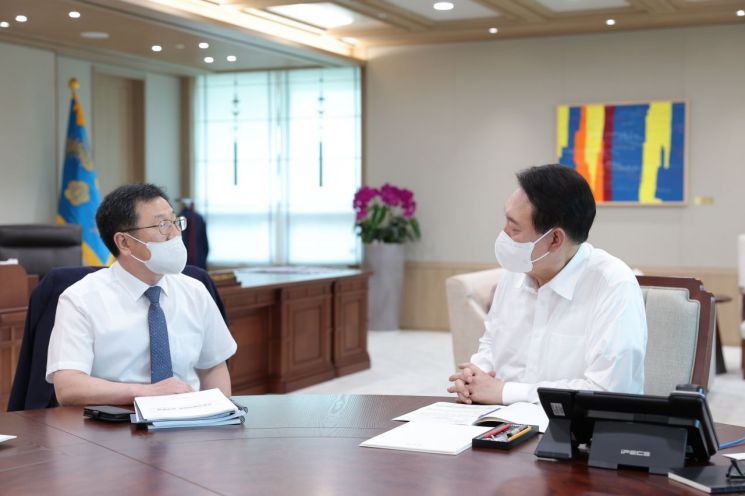 President Yoon receiving a work report from the Vice Chairman of the Fair Trade Commission
(Seoul=Yonhap News) Reporter Ahn Jung-won = On the morning of the 16th, President Yoon Seok-yeol is receiving a departmental work report from Yoon Soo-hyun, Vice Chairman of the Fair Trade Commission, at the presidential office in Yongsan, Seoul. 2022.8.16 [Provided by the Presidential Office. Redistribution and DB prohibited]
jeong@yna.co.kr
(End)
<Copyright(c) Yonhap News Agency, unauthorized reproduction and redistribution prohibited>
[Asia Economy Sejong=Reporter Lee Jun-hyung] The government is establishing an 'objection procedure' to strengthen the rights of companies under investigation by the Fair Trade Commission (FTC). The plan aims to enhance the transparency of FTC investigations through companies' rights to raise objections. The FTC also decided to consider the legalization of the 'Delivery Price Linkage System.'
On the 16th, FTC Vice Chairman Yoon Soo-hyun reported these details to President Yoon Seok-yeol. The FTC briefing lasted about 1 hour and 10 minutes, starting at 10:30 a.m. The briefing covered five core tasks: ▲innovation in fair trade law enforcement ▲promotion of free market competition ▲eradication of unfair market practices ▲strengthening the fair trade foundation for small and medium enterprises (SMEs) ▲establishment of a trading order aligned with consumer common sense. President Yoon instructed Vice Chairman Yoon to "strengthen the transparency and predictability of legal application standards, investigations, and adjudication procedures in law enforcement to establish fair trade order."
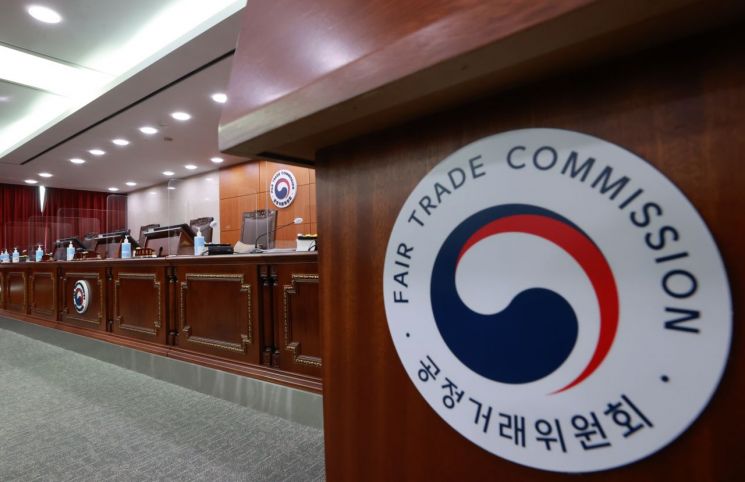
Notification of Investigation Targets and Scope... Expansion of Opportunity to Submit Opinions
The FTC will first introduce an objection procedure during the investigation process. According to the briefing, the FTC must clearly notify the investigated companies of the specific investigation targets and scope. If the FTC requests materials beyond the pre-notified investigation targets and scope, companies will be able to raise objections. If the FTC determines that the submitted materials exceed the pre-notified targets and scope, it plans not to accept those materials as evidence.
The opportunity for companies to submit opinions to the FTC will also increase. The FTC will expand opportunities for investigated companies to officially submit opinions to the FTC even before the deliberation stage. This is interpreted as considering the European Union (EU) practice of frequently hearing companies' opinions through 'case progress meetings.'
The system for resuming deliberations will also be revitalized. Currently, resuming deliberations is decided at the FTC's discretion. Accordingly, the FTC plans to make resuming deliberations mandatory in principle upon request for large-scale cases. Additionally, for penalty cases, reasons for non-prosecution will be specified in the resolution document.
The legalization of the Delivery Price Linkage System will also be considered. The Delivery Price Linkage System is a system that reflects raw material price fluctuations in the delivery payments that subcontractors receive from primary contractors. The FTC's stance is to first utilize currently available policy tools, such as market condition surveys and investigations of legal violations, to create a trading environment where SMEs can receive fair prices. Together with the Ministry of SMEs and Startups, the FTC will distribute subcontract payment linkage contracts and provide incentives such as penalty point reductions to companies using these contracts.
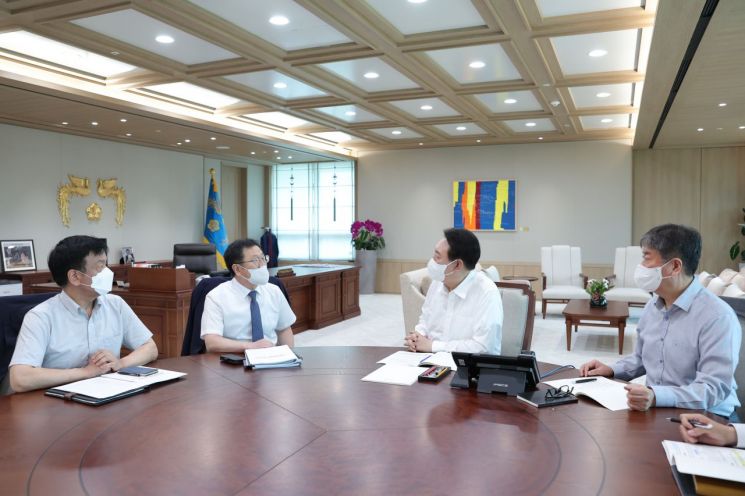 President Yoon receiving a work report from the Vice Chairman of the Fair Trade Commission
(Seoul=Yonhap News) Reporter Ahn Jung-won = On the morning of the 16th, President Yoon Seok-yeol is receiving a departmental work report from Yoon Soo-hyun, Vice Chairman of the Fair Trade Commission, at the presidential office in Yongsan, Seoul. 2022.8.16 [Provided by the Presidential Office. Redistribution and DB prohibited]
jeong@yna.co.kr
(End)
<Copyright(c) Yonhap News Agency, unauthorized reproduction and redistribution prohibited>
Driving Regulatory Reform... Narrowing the Scope of Conglomerate Owners' Relatives
Regulatory reforms to reduce corporate burdens will also be promoted. The FTC plans to significantly adjust the scope of 'special related parties,' including narrowing the range of blood relatives and relatives by marriage of conglomerate owners. Previously, the FTC announced it would amend the Enforcement Decree of the Fair Trade Act to reduce the scope of relatives of conglomerate owners from six degrees of blood relatives and four degrees of relatives by marriage to four degrees of blood relatives and three degrees of relatives by marriage. Additionally, the FTC will expand the grace period for SMEs and venture companies to be included in large business groups and reorganize disclosure systems based on analyses of importance and urgency.
Mergers and acquisitions (M&A) related regulations are expected to be eased. The FTC plans to exempt reporting or expand expedited reviews for M&As with low competition concerns, such as financial investments in venture companies. The M&A review system will also be restructured to allow companies to reflect their own corrective measures during the M&A process. The core change is shifting from the current FTC-designed and imposed corrective measures to a system where companies submit corrective plans and negotiate with the FTC.
However, the 'Online Platform Fairness Act,' which the FTC had prioritized, is likely to be abandoned. In the briefing, the FTC stated it would ensure the innovative growth of the platform economy by supplementing fairness through self-regulation. This is interpreted as an intention not to introduce the Online Platform Fairness Act. Instead, the FTC plans to establish a private-sector-led 'Autonomous Dispute Resolution Organization' and prepare self-regulatory codes and win-win agreements. To enhance the effectiveness of self-regulation, incentives will be provided to platforms that contribute to fostering a culture of fair trade.
Vice Chairman Yoon emphasized the trust relationship between the market and the government. He said, "To establish a fair market economy, there must be trust between the market and the government," and added, "We will innovate law enforcement methods and standards to increase market trust in the FTC." He also stated, "We will focus our capabilities on bold regulatory reforms and eradicating unfair market practices," and "We will also strive to strengthen the fair trade foundation so that SMEs receive fair compensation for their innovation efforts."
© The Asia Business Daily(www.asiae.co.kr). All rights reserved.



















