Heavy Rain and Heatwave Cause Sharp Rise in Vegetable Prices, Increasing Holiday Table Costs
Experts Cite Gwangbokjeol Holiday and School Openings as COVID-19 Spread Factors
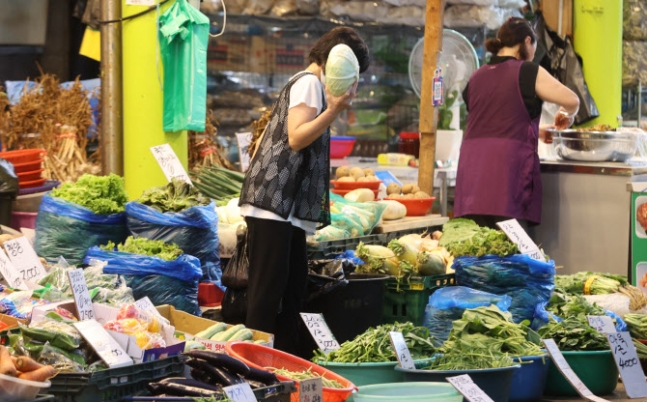 On the 11th, citizens were shopping at a traditional market in downtown Seoul. [Image source=Yonhap News]
[Asia Economy Reporter Han Seung-gon] The Chuseok holiday, the first since the transition to the COVID-19 endemic phase, is approaching, but due to soaring inflation, ordinary people preparing the ancestral rites table are expected to feel considerable burden. Additionally, the resurgence of COVID-19 is also dampening the possibility of fully enjoying Chuseok.
Recently, the prices of fresh summer vegetables have risen sharply, compounded by heavy rain damage, causing the prices of items for the Chuseok (September 9) ancestral rites table to fluctuate about a month ahead. According to the July Consumer Price Trends survey by Statistics Korea on the 15th, fresh vegetable prices last month rose 17.3% compared to June and 26.0% compared to a year ago.
The month-on-month increase rates include lettuce (108.0%), spinach (95.4%), cucumber (73.4%), young radish leaves (65.8%), pumpkin (50.6%), chives (37.1%), napa cabbage (30.4%), and water parsley (25.8%). Potatoes (-9.2%) and paprika (-5.2%) prices rose compared to a year ago but fell compared to the previous month.
As a result, deep sighs are heard among ordinary people ahead of Chuseok. Kim, a company employee in his 30s, said, "My salary remains the same, but prices keep rising, so it's very frustrating," adding, "I think I have to spend this holiday frugally and save."
Park, a self-employed person in his 40s, said, "I am trying to reduce expenses in daily life, but isn't there a lot of money spent during the holidays?" and lamented, "I just sigh."
Meanwhile, the price situation for agricultural, livestock, and marine products is similar. According to the Korea Customs Service's 'Major Agricultural, Livestock, and Marine Products Import Price Status' data, last month, imported beef prices fell 7.7% compared to June but rose 22.0% compared to a year ago. Prices of marine products such as frozen croaker (29.4%), frozen pollock (21.0%), and frozen squid (20.9%), as well as agricultural products like dried radish (50.1%), frozen chestnuts (35.1%), and chestnuts (8.3%), were also higher than a year ago.
Moreover, concerns about supply disruptions of crops are growing due to recent heavy rains in the metropolitan area, Gangwon, and Chungcheong regions. In response, the government plans to issue agricultural, livestock, and marine product discount coupons worth 65 billion won, the largest ever, ahead of Chuseok (September 10) to lower the perceived inflation.
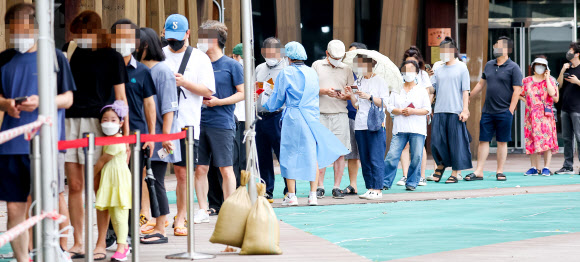 521 COVID-19 Critically Ill Patients, Highest in 108 Days - On the morning of August 15, Liberation Day, citizens waiting for testing at a temporary COVID-19 screening clinic set up at Songpa-gu Public Health Center in Seoul. According to the Central Disease Control Headquarters, the number of new confirmed cases as of midnight was 62,078. However, the number of critically ill patients reached 521, marking the highest figure in 108 days since April 29 (526 patients).
 [Image source=Yonhap News]
◆ Variables in the Epidemic Trend: Liberation Day Holiday and School Reopening for Elementary, Middle, and High Schools
Another worrisome situation is the resurgence phase of COVID-19. After the complete lifting of social distancing, 60,000 new confirmed cases were reported on the 15th due to the resurgence.
The Central Disease Control Headquarters announced that as of midnight that day, 62,078 new COVID-19 cases were added, bringing the cumulative total to 21,418,036.
This is a decrease of 57,525 cases (51.9%) compared to the previous day's announcement (119,603 cases). The number of new cases over the past week from the 9th to that day was 149,866 → 151,748 → 137,204 → 128,714 → 124,592 → 119,603 → 62,078, averaging 124,829 cases per day.
Although the increase in new cases is showing signs of slowing, it is believed that there are quite a few so-called 'hidden infections'?people with COVID-19 symptoms who have not undergone diagnostic testing?due to recent heavy rains, heatwaves, monsoon season, and vacations.
Among the new cases, 396 were imported from overseas, 64 fewer than the previous day (460). Since July 27 last month (534 cases), imported cases had remained above 400, but on this day, they fell below 400. Domestic regional infections excluding imported cases numbered 61,682.
As the epidemic has continued for a long time, the number of critically ill patients has also notably increased. As of midnight that day, the number of critically ill patients in care increased by 9 from the previous day to 521, the highest in 108 days since April 29 (526). On the 15th of last month, the number of critically ill patients was 65, meaning the number has surged 8.02 times in one month.
The number of deaths reported on the previous day (14th) was 50, 7 fewer than the day before (57). Among the deceased, 25 were aged 80 or older, accounting for half; 15 were in their 70s; 8 in their 60s; and 1 each in their 50s and 40s. The cumulative death toll is 25,673, with a cumulative COVID-19 fatality rate of 0.12%.
Meanwhile, experts view the Liberation Day holiday and the reopening of elementary, middle, and high schools at the end of August as variables in the epidemic trend. They predict that even after the resurgence peaks, new cases will continue to occur, forming a 'long tail' pattern.
© The Asia Business Daily(www.asiae.co.kr). All rights reserved.


















