Stagnation Front Movement Speed Increases and Rainfall Duration Prolongs on the South Coast
Over 150mm Rainfall in Chungnam, Jeolla Region, and South Coast of Gyeongnam
Extended Rainfall Duration on South Coast from Morning of 16th to Afternoon of 17th
Rain Forecast Nationwide on 19th-20th Due to Stagnation Front and Low Pressure System
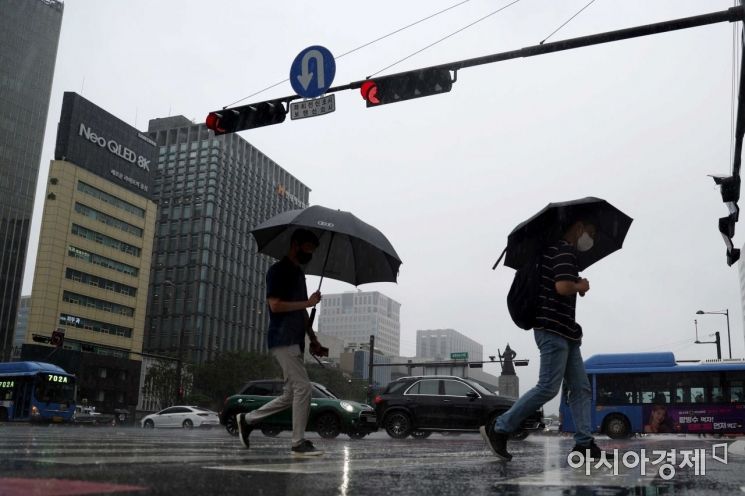 On the 11th, when it rained, citizens hurried on their way to work at Gwanghwamun Intersection in Jongno-gu, Seoul. / Photo by Mun Honam munonam@
[Asia Economy Reporter Han Jinju] As the stationary front moves southward, rain will begin falling nationwide starting from the afternoon of the 15th, beginning in the Seoul metropolitan area.
On the 15th, the Korea Meteorological Administration (KMA) held an impromptu briefing and announced that rain would fall from late afternoon on the 15th until early morning on the 16th in the central region, from early morning to afternoon on the 16th in the southern region, and from the morning of the 16th until the afternoon of the 17th along the southern coast. The start time of precipitation was revised earlier than initially forecasted.
From the 15th to the 17th, heavy rainfall exceeding 150mm is expected in the southern parts of the Chungcheong region, Jeolla region, and the southern coast of Gyeongnam. Nationwide, except for the Yeongdong area of Gangwon Province and the eastern coast of Gyeongsang Province, rainfall of 30 to 100mm is expected, while Gangwon Yeongdong, eastern Gyeongsang, Jeju Island, the five western islands, and Ulleungdo and Dokdo will receive about 10 to 60mm of rain.
In particular, the Chungnam region and Jeolla region are expected to experience heavy rain of around 50mm per hour. The KMA anticipates the strongest rainfall intensity in the Chungcheong region between early morning and morning on the 16th. Currently, a preliminary heavy rain advisory has been issued for the Seoul metropolitan area and other central regions, and it is expected that other areas will also receive preliminary advisories sequentially.
Woo Jin-gyu, a forecast analyst at the KMA, explained, "Rain in the Seoul metropolitan area is expected to stop around midnight after starting late afternoon on the 15th, and in the Gangwon Yeongseo area, rain is expected to cease in the early morning of the 16th. However, in the Gangwon Yeongdong area, easterly winds may bring localized precipitation."
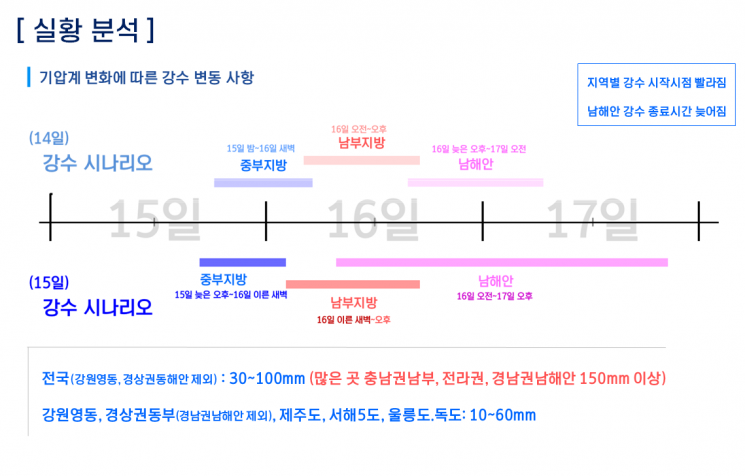
Especially along the southern coast, rain is expected to fall heavily from the morning of the 16th until the afternoon of the 17th, earlier than the previously announced start time of precipitation (afternoon of the 16th). This is because the stationary front forms as cold, dry air from the northwest collides with warm, humid air from the south, and the strength of the cold, dry air weakens while the North Pacific High expands southward. The stationary front remains longer, causing the rain cloud band to move slowly and prolonging the duration of precipitation.
Analyst Woo said, "The southward movement of the stationary front has accelerated, bringing its impact on the central region forward from tonight to late afternoon. As the Tibetan High strengthens and moves southward more quickly, the southern region will be affected by the stationary front starting early morning on the 16th."
Rain is also forecast nationwide on Friday, the 19th, and Saturday, the 20th. As the stationary front moves southward, cold, dry air from the north will descend, and rain will fall due to the influence of a low-pressure system accompanying the stationary front. Rain will begin in the Seoul metropolitan area and Gangwon Yeongseo region from the morning of the 19th and is expected to expand nationwide except for the Gyeongsang region and Jeju on the 20th.
Analyst Woo explained, "Because the front is not narrow north to south, rain may start and end simultaneously nationwide. The North Pacific High's area is broad with significant north-south variation, and the stationary front's variability is large, so precipitation is likely to expand nationwide earlier on the 19th."
© The Asia Business Daily(www.asiae.co.kr). All rights reserved.


















