Submission of written apology for tardiness, deduction of unpaid leave, evaluation reflected
1 in 5 office workers perform tasks during commute
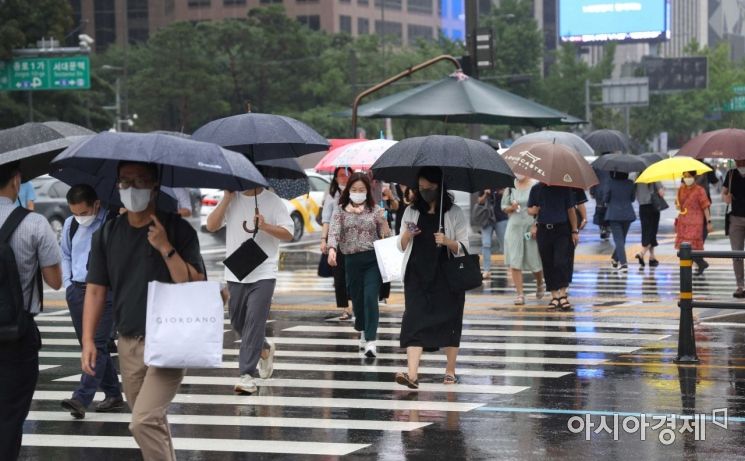 On the 11th, when it rained, citizens hurried on their way to work at Gwanghwamun Intersection in Jongno-gu, Seoul. / Photo by Mun Honam munonam@
[Asia Economy Intern Reporter Kim Gun-chan] It has been revealed that there are cases where employees are subjected to power harassment and bullying, such as being forced to submit a written apology or having paid leave deducted, just for being late by about a minute. A survey also found that one in five office workers work during their commute.
According to the civic group Workplace Power Harassment 119 on the 14th, many cases have been reported where employees were subjected to power harassment and bullying using being late by about a minute due to unavoidable circumstances as an excuse. It was also found that there are cases where disadvantages are imposed even when being late due to natural disasters like recent heavy rain.
On the 8th, when heavy rain poured in the metropolitan area, the Ministry of the Interior and Safety announced that public institutions should adjust their start time to after 11 a.m. They also requested private companies to consider adjusting their start times, but most office workers still had to arrive on time.
Office worker A said he was required to submit a written apology for being "2 minutes late." A said, "I apologized for being 2 minutes late due to heavy rain and entered, but my boss shouted at me asking if I was out having fun and told me to submit a written apology."
Workplace Power Harassment 119 pointed out, "Being late can be a criterion for employee evaluation, and frequent tardiness can be a cause for disciplinary action, but forcing a written apology because of being late can be workplace bullying."
There were also reports of deducting paid leave such as half-day or full-day leave or reflecting it in evaluations due to tardiness. Office worker B said, "The company policy was announced that 'one tardiness deducts half-day leave, two tardiness deducts full-day leave,'" and asked, "Isn't there a legal problem?" Office worker C also appealed, "If you are even one minute late due to public transportation delays or fingerprint recognition errors, you have to write a statement of explanation, and it is inevitable that it is reflected in the year-end evaluation."
Workplace Power Harassment 119 emphasized, "The principle is to deduct wages only for the time corresponding to being late, leaving early, or absence," and "deducting annual leave based on the number of times being late violates the Labor Standards Act."
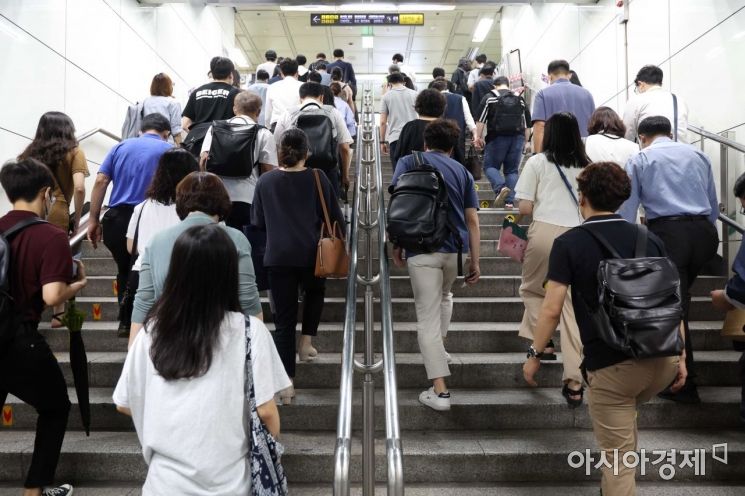 On the 10th, commuters are hurrying at Gwanghwamun Station on Seoul Subway Line 5 during the morning rush. Photo by Moon Honam munonam@
A survey also found that one in five office workers do work-related tasks during their commute. Workplace Power Harassment 119 and the Public Coexistence Solidarity Fund commissioned the public opinion survey specialist agency 'Embrain Public' to conduct a survey from June 10 to 16 targeting 1,000 office workers aged 19 and older nationwide regarding commuting, and announced the results on the 14th.
According to the survey results, one in five office workers (20.4%) were found to do work-related tasks during their commute. The proportion of non-regular workers (25.0%) doing work during commuting was higher than that of regular workers (17.3%), and the proportion of workers in their 30s (27.0%), who are in the early career stage, was higher than that of managers in their 50s (16.5%).
Workplace Power Harassment 119 explained, "Depending on the industry such as office work or sales, there are quite a few office workers who make customer calls or handle complaints during commuting time."
Respondents answered that compensation or consideration for commuting time is necessary (65.2%). The response rate for the need for compensation was higher among those in their 30s (71.4%) than those aged 50 and over (60.6%). Production workers (73.3%) showed more agreement with the need for compensation or consideration than office workers (61.8%), and general employees (69.3%) more than managers (53.8%).
Workplace Power Harassment 119 emphasized, "After experiencing two years of COVID-19, Korean society has become accustomed to telecommuting and video conferencing," and added, "If companies had allowed employees to come in the afternoon or work from home during this heavy rain, office workers would not have wasted 2 to 3 hours on the streets, and work efficiency would have increased along with company loyalty."
© The Asia Business Daily(www.asiae.co.kr). All rights reserved.


















