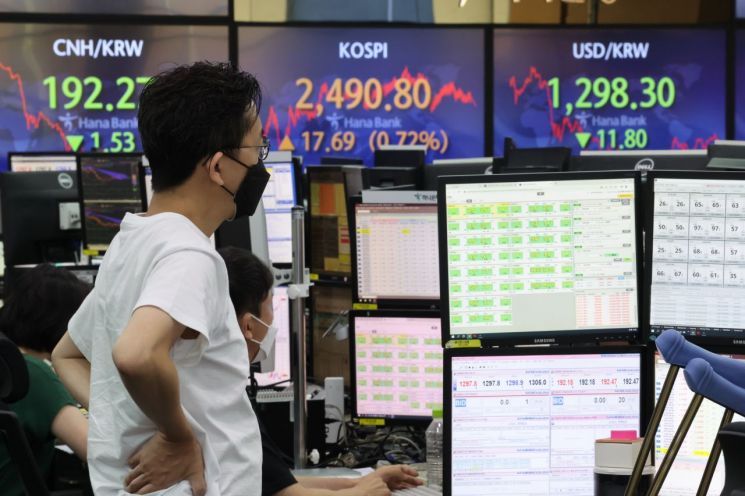
[Asia Economy Reporter Kwon Jae-hee] Growth stocks, which saw a sharp decline in stock prices this year due to the global economic recession and interest rate hikes, have recently rebounded, leading a 'bear market rally.'
According to the Korea Exchange on the 14th, the KRX BBIG K-New Deal Index, composed of 12 stocks from four BBIG (Battery, Bio, Internet, Game) sectors, rose 14.51% from 2000.75 at the end of June to 2291.00 on the 12th.
The index's rate of increase outperformed both the KOSPI (8.37%) and KOSDAQ (11.56%), which also showed a rebound trend during this period.
The current index components include ▲ LG Energy Solution, Samsung SDI, SK Innovation (secondary batteries) ▲ Samsung Biologics, Celltrion, SK Bioscience (bio) ▲ NAVER, Kakao, AfreecaTV (internet) ▲ Krafton, NCSoft, Netmarble (game).
The combined market capitalization of the 12 stocks also increased by nearly 56 trillion KRW over six weeks since early July, from 325.9489 trillion KRW at the end of June to 381.8345 trillion KRW on August 12.
By sector, the 10-stock indices also rose more than 10% during the same period: ▲ KRX Secondary Battery K-New Deal Index (16.70%) ▲ KRX Bio K-New Deal Index (16.19%) ▲ KRX Internet K-New Deal Index (12.13%) ▲ KRX Game K-New Deal Index (11.58%).
Looking at individual stock price trends, LG Energy Solution rose 27.22%. SK Bioscience (25.87%), Krafton (20.32%), Kakao (19.74%), and Celltrion (19.05%) also saw significant gains.
Earlier this year, growth stocks also plunged amid the global stock market downturn.
In the first half of the year, the KRX BBIG K-New Deal Index fell 36.36%. Sector indices saw internet (-50.27%) and game (-48.57%) stocks halved, while secondary batteries (-22.42%) and bio (-24.47%) dropped more than 20%.
The BBIG sectors, recognized as industries leading future growth, emerged as beneficiaries during the low-interest rate and liquidity-driven market following the COVID-19 pandemic, driving the bull market.
However, as the era of ultra-low interest rates ended due to high inflation pressures and aggressive tightening by central banks worldwide, interest rates rose, halting the growth stock rally.
Growth stocks, which focus more on the future than the present, justify higher valuations relative to earnings when interest rates are low because the discount rate on future earnings is lower.
Recently, however, expectations that inflation has peaked, easing monetary policy uncertainties, and a slowdown in the rapid rise of interest rates have prompted growth stocks to attempt a rebound.
In particular, the weakening of crude oil prices, which have driven inflation, is positive news for growth stocks. When oil prices fall, inflation stabilizes, leading to lower interest rates.
Due to the Russia-Ukraine war, crude oil prices once exceeded $130 per barrel in March but have recently dropped to around $90 per barrel.
Labor Analyst Roh Dong-gil of Shinhan Financial Investment explained, "Growth stocks perform better in an environment where market interest rates stabilize. In the past, when supply-side factors caused oil prices to fall, growth stocks and IT (Information Technology) showed favorable results."
Although leading domestic growth stocks have somewhat succeeded in rebounding, their stock prices remain significantly lower compared to last year's peak.
Kakao's closing price on the 12th was 82,500 KRW, only about half of its all-time high of 173,000 KRW recorded intraday on June 24 last year.
NCSoft, which once reached 1,048,000 KRW intraday on February 8 last year, earning the title of 'emperor stock,' closed at 385,000 KRW on the 12th, 63.26% lower than its peak.
© The Asia Business Daily(www.asiae.co.kr). All rights reserved.

















