Democratic Party and Justice Party Support Received by Liu
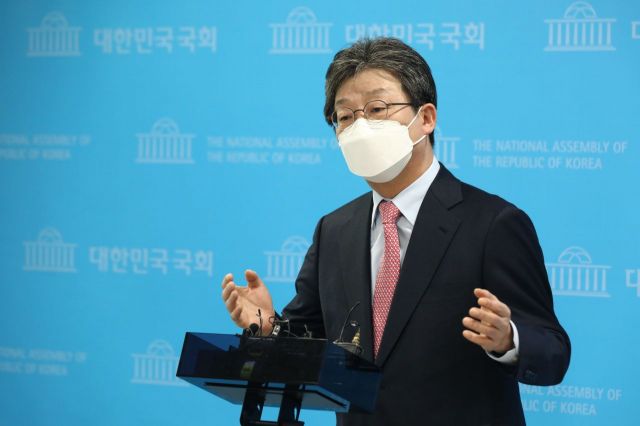 Former lawmaker Yoo Seung-min, who is running in the People Power Party's Gyeonggi Province governor primary, holds a press conference appealing for support at the National Assembly Communication Office on the 19th. Photo by Yoon Dong-joo doso7@
[Asia Economy Reporter Lee Hyun-joo] A somewhat unexpected result emerged in the survey on the suitability of the next leader of the People Power Party. Former lawmaker Yoo Seung-min ranked first. Former leader Lee Jun-seok came in second.
According to the political circles on the 13th, a public opinion research firm, Hangil Research, conducted a survey from the 6th to the 8th targeting 1,006 adults aged 18 and over nationwide (sampling error at 95% confidence level ±3.1 percentage points, response rate 4.6%). Former lawmaker Yoo Seung-min and former leader Lee Jun-seok received 23.0% and 16.5%, respectively.
Following them were lawmaker Ahn Cheol-soo with 13.4%, former lawmaker Na Kyung-won with 10.4%, lawmaker Joo Ho-young with 5.9%, lawmaker Kim Ki-hyun with 4.4%, lawmaker Chung Jin-suk with 2.6%, floor leader Kwon Seong-dong with 2.5%, and lawmaker Jang Je-won with 2.2%, in that order.
The People Power Party views the result as influenced by ‘reverse voting.’ A party official said, “Those who answered ‘poorly’ to President Yoon Suk-yeol’s administration approval rating likely voted for former lawmaker Yoo or former leader Lee,” analyzing the outcome.
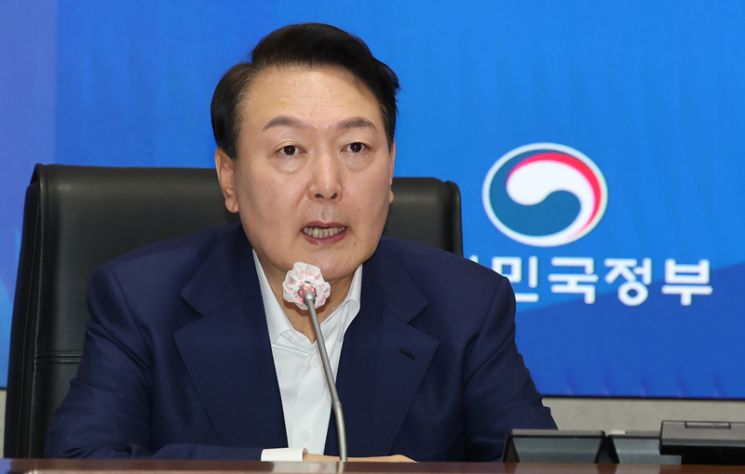
Reverse voting has been a significant point of contention since the People Power Party’s presidential primary process. The issue of including a ‘reverse voting prevention clause’ in the primary rules led to a clash between the camps of Yoon Suk-yeol and Choi Jae-hyung and those of Yoo Seung-min and Hong Joon-pyo. The debate was sharply divided between the argument for preventing reverse voting to avoid unintended results and the argument that reverse voting is inevitable for selecting a candidate with broader appeal. Ultimately, the People Power Party did not directly include a reverse voting prevention rule but compromised by increasing the proportion of party member votes to 20% in the first preliminary primary.
In fact, former lawmaker Yoo received overwhelming support from the Democratic Party supporters (33.2%) and Justice Party supporters (34.4%). He recorded 30.4% support from the moderate group and 33.7% from the progressive group. Yoo also showed strength among the 4050 generation, which tends to support the ‘586’ faction. By age group, Yoo received high support from those in their 40s (27.8%) and 50s (32.6%). This survey was conducted via ARS polling (89.0% mobile, 11.0% landline). For more details, refer to the Central Election Poll Deliberation Commission website.
However, while this poll may be considered reverse voting from the People Power Party’s perspective, it can also be interpreted as a form of public will. It indicates the direction the conservative party should take to persuade those who expressed disapproval of President Yoon Suk-yeol’s administration. Um Kyung-young, director of the Era Spirit Research Institute, said, “People who dislike the People Power Party and support other parties probably did not support candidates with strong People Power Party colors,” but added, “It should be understood as half of the public sentiment.”
© The Asia Business Daily(www.asiae.co.kr). All rights reserved.
![Clutching a Stolen Dior Bag, Saying "I Hate Being Poor but Real"... The Grotesque Con of a "Human Knockoff" [Slate]](https://cwcontent.asiae.co.kr/asiaresize/183/2026021902243444107_1771435474.jpg)

















