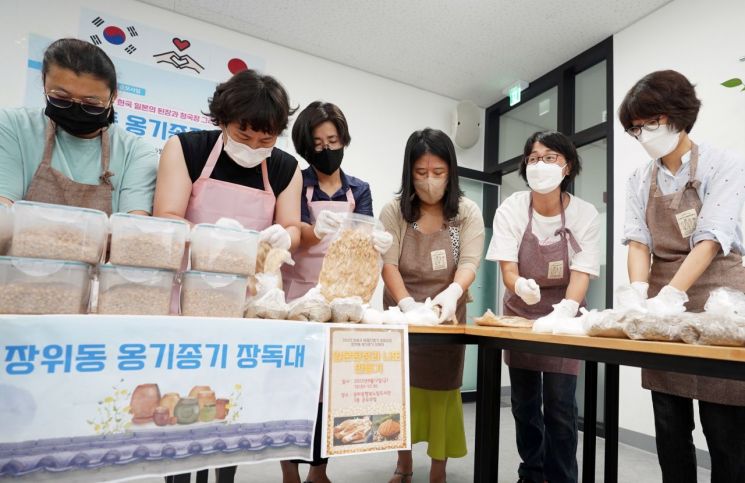
On the 12th, a Friendship Jar Making Event for Korean-Japanese Residents in Seongbuk-gu with 8 Participants, Including 4 Japanese Marriage Immigrants and 4 Local Residents, Held at Jangwi Haengbok Nurim Library 3rd Floor Shared Kitchen
[Asia Economy Reporter Park Jong-il] A special jang (fermented paste) community of residents in Jangwi-dong, Seongbuk-gu (Mayor Lee Seung-ro) is drawing attention.
It is the Peace Gochujang and Friendship Miso Doenjang made by Japanese marriage immigrant residents and local residents living around Jangwi-dong. While making fermented foods from the two countries, they formed a group called “Onggijonggi Jangdokdae” to communicate and understand each other, and were selected through a contest for Seongbuk-gu’s village-making project.
The members of Onggijonggi Jangdokdae eagerly awaited August 12. This is because they were finally able to resume jang making, which had to be temporarily suspended during the COVID-19 pandemic. The venue was the shared kitchen of Jangwi Happiness Nuri Library.
Onggijonggi Jangdokdae’s activities started in 2020, and this year marks the third year. In the beginning, most members were Japanese marriage immigrant residents such as Naito Eiko, Misumi Yuki, and Koyasu Yo, who naturally settled in Jangwi-dong after marrying Korean men. They knocked on the door of the community center with a desire to learn more about their neighbors and Korean jang.
The community center connected the residents’ autonomous association, composed of residents familiar with local circumstances, with the shared kitchen. A resident who had been making jang for over 40 years volunteered to teach how to make doenjang and jangajji (pickled vegetables). Local residents taught Korean foods such as gochujang and jangajji, while Japanese marriage immigrant residents introduced Japanese foods such as miso, natto, and umeboshi rice balls. Through making food in both Korean and Japanese styles, they understood each other’s food cultures and built friendships.
Koyasu Yo, the representative of Onggijonggi Jangdokdae, said, “I regretted not communicating much with neighbors because I focused on raising six children after marrying into Korea, so I proposed this project. Through making Korean jang, I was able to communicate more with neighbors and understand Jangwi-dong more deeply. It also gave me a great opportunity to understand and communicate more deeply with both my birth country and my in-laws’ country, for which I am very grateful.”
One resident said, “There are many marriage immigrant families in Jangwi-dong and Seokgwan-dong, but there were no opportunities to talk or socialize regularly. Through Onggijonggi Jangdokdae, by making healthy fermented foods from Korea and Japan together, I hope that Japan and Korea can build harmony and friendship instead of conflict, and I gained hope that this is possible.”
Lee Seung-ro, Mayor of Seongbuk-gu, said, “Seongbuk-gu is a multicultural city where embassies from over 40 countries are concentrated, and various people such as international students from eight universities, marriage immigrants, and workers live together. We will pay deeper attention and provide customized support so that resident activities like Onggijonggi Jangdokdae in Jangwi-dong, which learn each other’s cultures and share affection, can become even richer.”
© The Asia Business Daily(www.asiae.co.kr). All rights reserved.
![Clutching a Stolen Dior Bag, Saying "I Hate Being Poor but Real"... The Grotesque Con of a "Human Knockoff" [Slate]](https://cwcontent.asiae.co.kr/asiaresize/183/2026021902243444107_1771435474.jpg)
















