Ministry of Education to Pilot Full-Day Elementary Schools Next Year
"Opposing Full-Day Elementary Schools That Shift Private Education and Childcare Burdens to Schools"
"Full-Day Elementary Policy Serves Adults' Convenience Only"
"Local Government Operations Should Be Unified and Dedicated Systems Established"
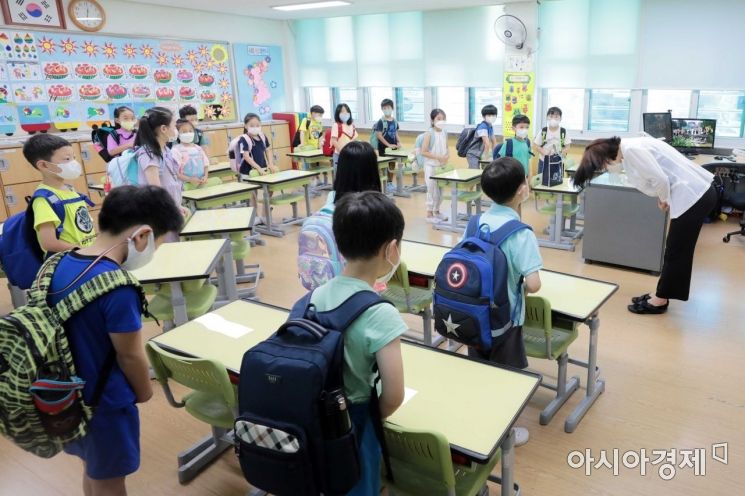 With the 'Plan to Enroll 5-Year-Olds' effectively withdrawn, voices of opposition are also rising against the 'Full-Day Elementary School' system. The photo is not related to the specific content of the article.
[Asia Economy Reporter Kim Jung-wan] As the government has effectively withdrawn the 'Plan to Promote Admission at Age 5,' it announced plans to expand the 'Full-Day Elementary School Program,' which increases after-school courses and care hours. This aligns with the original intent of 'Admission at Age 5' to strengthen the state's responsibility for education and aims to reduce the childcare burden on parents. However, the education sector has opposed this, citing reasons such as 'shifting childcare responsibility.' There are calls for addressing childcare gaps through local governments.
On the 12th, the Korea Federation of Teachers' Associations (KFTA) issued a statement strongly opposing the promotion of full-day elementary schools that shift private education and childcare responsibilities onto schools and teachers. The KFTA emphasized, "Even if education offices or separate public institutions are designated as dedicated agencies, schools and teachers cannot escape being the operators of after-school and childcare programs," adding, "They will inevitably suffer from responsibilities and complaints, making it impossible to focus on student education."
The 'Full-Day Elementary School Program' is one of the measures to strengthen the 'National Education Responsibility System,' a key policy of the Yoon Seok-yeol administration. According to the Ministry of Education, a plan to promote 'Full-Day Elementary Schools,' which extend after-school courses and care hours, will be prepared by October, piloted from next year, and expanded nationwide from 2025. The operating hours of care classrooms will be extended to 7 p.m. this year and 8 p.m. next year. The Ministry of Education is pursuing this plan with the goal of 'reducing the childcare burden on parents.' The after-school programs, which have been mainly curriculum-focused, will be expanded to include AI education, arts, and physical education, thereby also serving a childcare function.
The education sector has voiced opposition. On the 11th, the Korean Teachers and Education Workers Union (KTU) issued a statement urging the withdrawal of the introduction of full-day elementary schools that shift all responsibility onto schools. They argue that schools do not have the facilities or manpower to strengthen care until 8 p.m.
The KTU pointed out, "In areas with high childcare demand, there are often overcrowded classes and large schools, so unless new buildings or expansions are made, the reality is that special rooms must be converted into care classrooms or multi-purpose care classrooms must be increased," adding, "This will ultimately infringe on the regular curriculum and make it impossible to properly operate after-school activities and care, leading to a decline in quality."
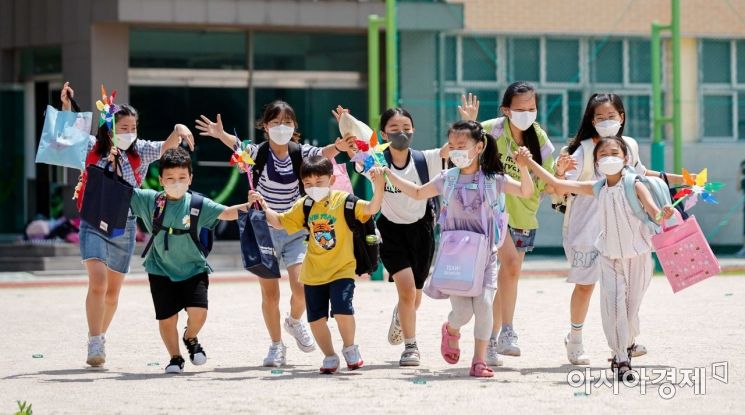 On the 15th of last month, students who started their summer vacation were leaving Cheonggu Elementary School in Jung-gu, Seoul. The photo is not related to the specific content of the article.
The National Elementary School Teachers' Union issued a statement opposing the full-day program on the 9th, questioning, "Is the child at the center of a policy that keeps children for 11 hours?" and criticized, "The full-day elementary program is a policy only for adults' convenience." There are also concerns that after COVID-19, teachers have been mobilized for 'quarantine labor,' and they will now have to take on after-school classes and childcare duties as well.
On the other hand, the National Education Public Officials Union expressed support for the introduction of full-day elementary schools. They stated, "While consultation is needed on the detailed implementation plans of full-day elementary schools, the role of schools demanded by the times should expand beyond learning to supporting educational welfare for children's overall growth," and added, "It is necessary to institutionalize and firmly establish after-school programs within the school system."
There are also opinions that alternatives such as resolving childcare gaps through local governments are necessary. The KFTA urged, "If schools and teachers, who should focus on regular education, are burdened with additional childcare and after-school program operations, neither the expansion nor quality improvement of after-school programs can be expected, and it will interfere with the school's primary educational activities," and called for "unifying operations under local governments and establishing a system dedicated to childcare and after-school programs." The KTU also emphasized, "Childcare is a state responsibility," and stressed, "In the long term, budgets should be expanded under state responsibility, and detailed plans should be made to enable local governments to stably operate care classrooms."
© The Asia Business Daily(www.asiae.co.kr). All rights reserved.
![Clutching a Stolen Dior Bag, Saying "I Hate Being Poor but Real"... The Grotesque Con of a "Human Knockoff" [Slate]](https://cwcontent.asiae.co.kr/asiaresize/183/2026021902243444107_1771435474.jpg)

















