KOSPI Rises Nearly 10% Since July
US S&P 500 and Nasdaq Indices Also Surge
Inflation Peak Confirmed Amid Employment Boom
Expectations for Fed's Easing of Tightening Policy
Jackson Hole Meeting on 26th as First Milestone "Stable Investor Sentiment Until End of August"
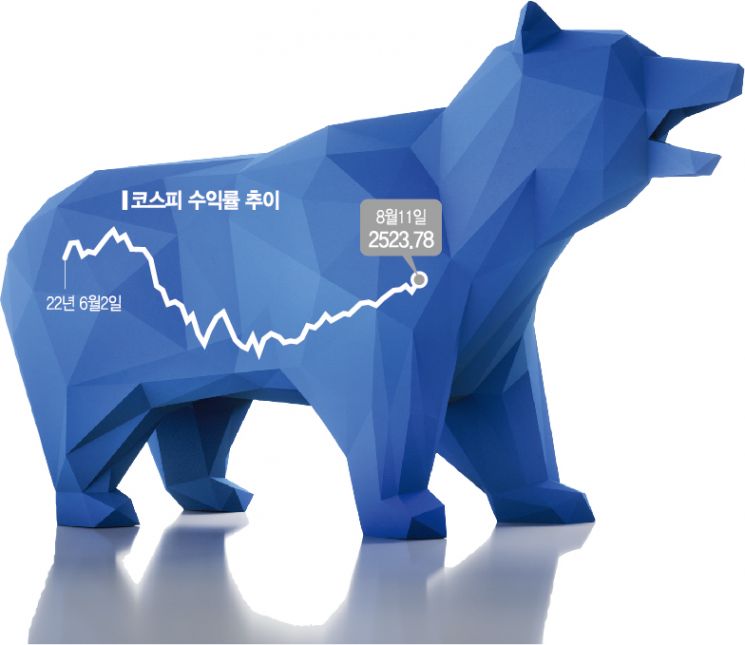
[Asia Economy Reporter Ji Yeon-jin] Since the beginning of this year, the stock market, which had plunged into the basement, has rebounded since last month, continuing its upward trend for over a month. The financial investment industry is emphasizing the possibility of a ‘bear market rally,’ a brief rise in a bear market rather than a sustained uptrend, making it a time when investment strategies to prepare for future volatility are necessary.
According to the Korea Exchange on the 12th, the KOSPI surpassed the 2,500 mark yesterday, rising nearly 10% (9.47%) since last month. During this period, the KOSDAQ index rose 14.07%. The U.S. stock market showed similar trends. The Standard & Poor’s (S&P) 500 index increased by 9.98%, and the Nasdaq index jumped 14.85%. This is due to signs of easing concerns over U.S. monetary tightening and inflation, which had dragged down global stock markets since the beginning of the year.
The U.S. Consumer Price Index (CPI) for July, released on the 10th, rose 8.5%, below the previous month’s increase (9.1%) and market expectations (8.7%). This indicates that U.S. inflation has peaked. Earlier, U.S. nonfarm payrolls for July increased by 520,000, more than double the market forecast. The unemployment rate fell by 0.1 percentage points from the previous month to 3.5%. Ahn Young-jin, a researcher at SK Securities, said, “Better-than-expected earnings, declines in oil prices and interest rates, employment surprises, and inflation peaking support a preference for risk assets,” adding, “Although demand slowdown could formalize into a (economic) recession, a bear market ‘rally’ is currently underway in the trading range.”
However, Yeom Dong-chan, a researcher at Korea Investment & Securities, noted, “There are still factors holding back this rally.” First, international oil prices, which contributed to easing inflation, may rebound ahead of winter, when heating demand in Europe increases. For this reason, the U.S. Federal Reserve (Fed), which has transformed into an ‘inflation fighter,’ may implement three consecutive ‘giant steps’ (75 basis points rate hikes) instead of the market-expected ‘big step’ (50 basis points rate hike) when deciding the benchmark interest rate next month.
Seo Jeong-hoon, a researcher at Samsung Securities, assessed, “The domestic stock market rebound that has continued since mid-last month has sufficient justification, and the possibility of extending the rally has also increased,” predicting, “The KOSPI will settle above 2,500 and may challenge the next resistance level.” However, he added, “Despite the appearance of inflation indices below expectations, it is necessary to pay attention to the Fed’s still cautious stance.”
The continued downward revision of earnings forecasts for domestic companies is also a burden. Over the past month, the KOSPI’s consensus net profit forecasts for the third and fourth quarters of this year have been lowered by 3% and 5.4%, respectively. The annual net profit forecast for next year also dropped by 3.1%. Researcher Yeom Dong-chan said, “The fact that the stock market has already rebounded since July and the possibility of future economic slowdown still exist makes it difficult for investors to maintain a positive outlook,” adding, “However, it is important to remember that in past cases, passing the CPI peak had a positive effect on the stock market, and growth stocks performed relatively better during periods of low corporate earnings growth.”
The market views the Jackson Hole meeting starting on the 26th of this month as the first gateway for the bear market rally. The Jackson Hole meeting is an international forum attended by central bank governors and finance ministers from major countries, which has previously hinted at significant Fed monetary policies. Researcher Ahn Young-jin said, “If no negative news emerges from the Jackson Hole meeting, where the Fed announced the Average Inflation Targeting (AIT) policy two years ago, stable investor sentiment is likely to be maintained until the end of August.”
© The Asia Business Daily(www.asiae.co.kr). All rights reserved.

















