Changed FSC, Detailed Disclosure of Interim Inspection Contents
Influence of Prosecutor-turned-Leader Lee Bok-hyun...Public Opinion Led by FSC
FSC Refines 'Legal Sword'...Banks Contemplate 'Right to Defense'
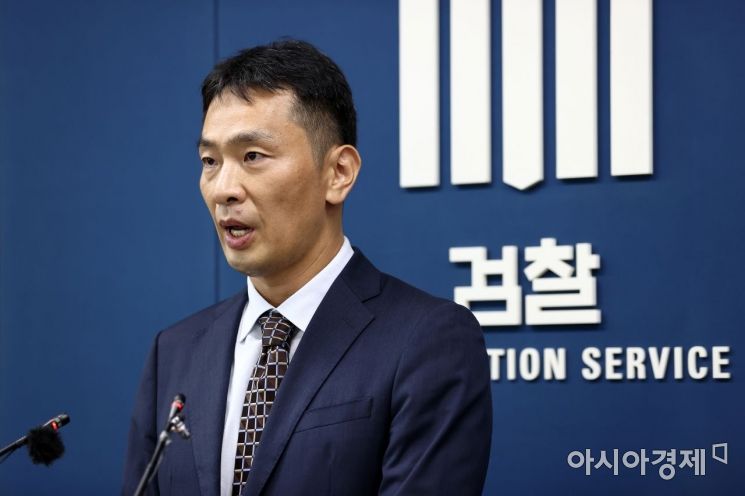 On September 1, 2020, at the Seoul High Prosecutors' Office press room, Lee Bok-hyun, then Chief Prosecutor of the Economic Crime Division at the Seoul Central District Prosecutors' Office (currently Governor of the Financial Supervisory Service), announced the investigation results of the 'Samsung Group Illegal Merger and Accounting Fraud Case.' / Photo by Moon Ho-nam munonam@
[Asia Economy Reporter Song Seung-seop] Since the appointment of Director Lee Bok-hyun, a former prosecutor, the Financial Supervisory Service (FSS) has transformed its working style into a ‘prosecutorial style.’ The previously closed-off FSS, which used to keep tight-lipped on major issues, has begun to lead public opinion by disclosing interim results to the media. Financial companies are now pondering ways to exercise their right to defense amid intensified attacks against banks.
On the 11th, the FSS announced that it would appeal the second-instance ruling that it lost in the ‘disciplinary action cancellation lawsuit’ against Sohn Tae-seung, Chairman of Woori Financial Group. The related press release contained five pages detailing the reasons for the appeal, the legitimacy of the sanctions, directions for system improvement, and internal control regulations. It included not only the first and second-instance rulings involving Chairman Sohn but also a comparative analysis of the first-instance ruling in a similar lawsuit involving Ham Young-joo, Chairman of Hana Financial Group.
The Changed FSS Publicizes Interim Inspection Details in 'Detail'
Within the financial sector, the FSS’s detailed disclosure of appeal contents is considered unprecedented. Typically, when a lawsuit arises with a private financial company, the FSS issues only brief statements. Even when deciding to appeal, it usually only announces whether or not it will appeal. Particularly, interpretations of court decisions or precedent analyses, which could be sensitive, have rarely been disclosed.
On the same day, a Q&A session held at the FSS headquarters in Yeongdeungpo-gu, Seoul, after the distribution of materials also reflected this changed stance. The session was directly conducted by Lee Jun-soo, Deputy Director in charge of Banks and Small and Low-Income Finance. Department heads such as the Director of the General Banking Inspection Bureau and the Legal Office Chief also attended. This contrasts with September 17 of last year, when former FSS Chairman Jung Eun-bo was in office and the Public Relations Director alone handled questions after deciding to appeal the same case.
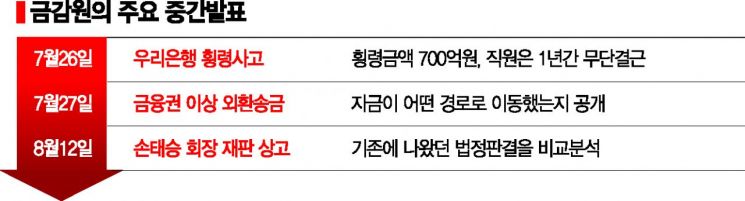
The same approach was evident when the FSS announced interim results regarding the Woori Bank embezzlement incident on the 26th of last month and the abnormal foreign remittance controversy involving Shinhan and Woori Banks on the 27th. For two consecutive days, Deputy Director Lee Jun-soo personally disclosed detailed inside information. It was revealed that the embezzlement amount was nearly 70 billion KRW, much higher than initially reported, and that Woori Bank failed to notice despite the employee’s unauthorized absence for a year. During the Q&A, if additional answers were required, attending department heads stood up to provide further explanations directly to reporters.
It is even rarer for the FSS to disclose ongoing inspection matters midway. This is because sanctions are imposed based on inspection results, which are sensitive issues. The FSS often does not confirm whether an agenda has been submitted to the Sanctions Review Committee, and even after the sanction level is decided and the disciplinary subject is notified, the details remain undisclosed. To learn detailed inspection contents and sanction results, one had to wait for the public disclosure issued several months after the final sanction resolution.
The Influence of Prosecutor Lee Bok-hyun... FSS Begins to Lead Public Opinion
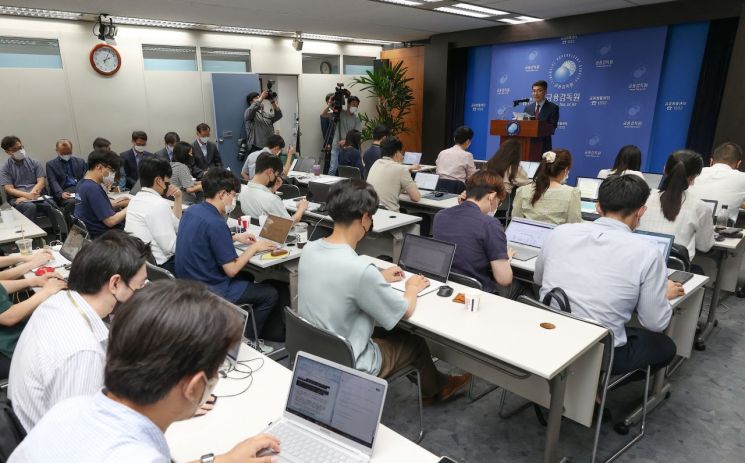 On the 27th of last month, Lee Joon-su, Deputy Governor of the Financial Supervisory Service, is briefing on the "Progress of Bank Inspections Related to Large Overseas Remittances" at the Financial Supervisory Service press room in Yeouido, Seoul. [Image source=Yonhap News]
The FSS explained that the changed communication method aims to transparently inform the media and the public about issues of high interest. However, within the financial sector, the dominant interpretation is that this is due to Director Lee Bok-hyun’s influence. Director Lee is a former chief prosecutor of the Seoul Northern District Prosecutors’ Office. During investigations, prosecutors or public relations prosecutors announce interim results to the media. This is because public interest tends to wane if the investigation period is prolonged. By sharing investigation results in a favorable direction, prosecutors can gauge public opinion or solidify support from the prosecution leadership.
Some inside the FSS believe this reflects Director Lee Bok-hyun’s strong will. Among the FSS’s sanctions, some require approval from the Financial Services Commission (FSC). As the FSS is supervised by the FSC, it has been reluctant to disclose inspection and sanction details. Even when the police or prosecutors are investigating cases, they often remain silent to avoid influencing the investigation. The reason why this working style is considered impossible without Director Lee, who is classified as a close aide to President Yoon Seok-yeol, is due to these internal and external evaluations.
Among FSS employees, there are also positive voices regarding the changed communication method. One FSS official said, “When unclear rumors start circulating during inspections, related departments had to verify their accuracy, causing significant work loss. It is good for employees that major details are now disclosed in detail.”
Financial Companies Deeply Ponder ‘Right to Defense’ as FSS Sharpens Its ‘Legal Blade’
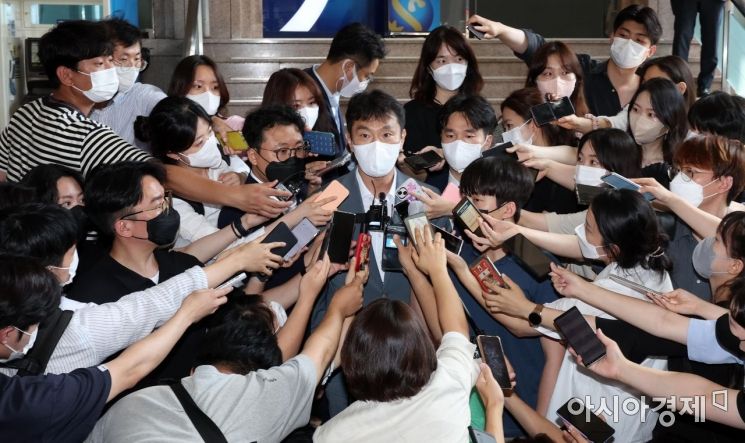 Financial Supervisory Service Governor Lee Bok-hyun is answering questions from reporters after completing an on-site visit related to the financial sector's support program for vulnerable borrowers at Shinhan Bank Namdaemun Branch in Jung-gu, Seoul, on the 14th of last month. Photo by Kim Hyun-min kimhyun81@
On the other hand, the financial sector is in a difficult position regarding the changed working style of the FSS. It is hard to find clear countermeasures when public opinion is formed according to the FSS’s logic. Unlike the equal status relationship between prosecutors and defense attorneys in court, the FSS is the inspection and supervisory authority over financial companies. Even after trials end, financial companies must continue to undergo inspections by the FSS, making it virtually impossible to publicly refute allegations.
There are also complaints that the banks’ brand images are damaged. A financial sector official said, “Even if we win in court, the public will likely judge the financial company as at fault during the process of interim result announcements. The abnormal foreign remittance incident has not yet fully revealed who sent or received the money, so it was bewildering that this was disclosed.”

Separately, the FSS has announced plans to refine its own ‘legal capabilities.’ Unlike the financial sector, which hires five to six prestigious law firms, the FSS usually hires only one or two, leading to frequent disadvantages in court. Recently, the FSS established the ‘Regulations on Legal Counsel and Litigation Affairs’ and enabled increasing the remuneration of litigation agents with the approval of the FSS Director.
At a press conference the previous day, when asked whether there are plans to enhance legal response capabilities following consecutive losses in the first and second trials, Deputy Director Lee Jun-soo said, “We are working to increase the acceptance of sanctions.”
© The Asia Business Daily(www.asiae.co.kr). All rights reserved.



















