Samsung Plans to Gradually Expand Investment in Vietnam Going Forward
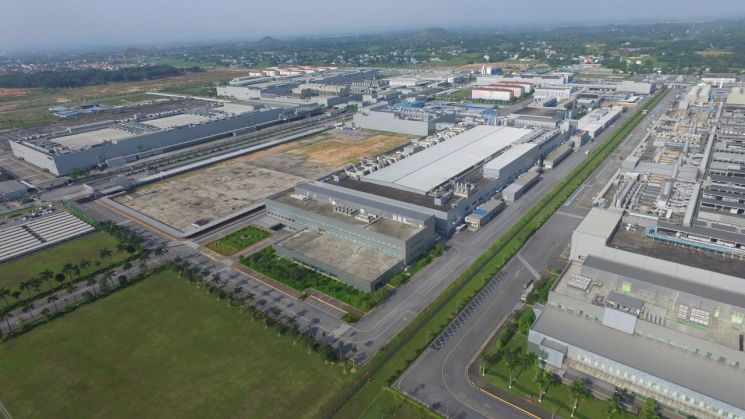
[Asia Economy Reporter Park Sun-mi] Samsung will begin producing semiconductor components in Vietnam starting July next year. This marks the first time Samsung semiconductor components will be produced in Vietnam. The move aims to significantly expand the production capacity of high value-added next-generation semiconductor package substrates (FCBGA), and by establishing the production base in Vietnam instead of China, Samsung can avoid the uncomfortable situation amid the US-China hegemonic competition over semiconductor supply chains.
◆ Next-generation semiconductor package substrate production in Vietnam = According to the industry on the 16th, Samsung plans to fully operate the semiconductor component production plant in Vietnam, invested through its affiliate Samsung Electro-Mechanics, starting July next year. The Vietnamese government also announced on its website that Samsung is building an FCBGA production facility within the Yen Bin Industrial Complex in the northern Thai Nguyen Province and is testing the FCBGA process for mass production at this site.
Samsung Electro-Mechanics first revealed its plan to build an FCBGA production facility in Vietnam in December last year. At that time, Samsung Electro-Mechanics announced through a public disclosure that it would lend 1.0137 trillion KRW, equivalent to 17.2% of its equity capital, to its Vietnamese subsidiary to be used as investment funds for package substrates.
Subsequently, in February this year, it disclosed an additional investment of 321.1 billion KRW for package substrate investment funds. More than 1.3 trillion KRW will be invested in the Vietnam production plant, which accounts for about 70% of the total 1.9 trillion KRW Samsung Electro-Mechanics announced for domestic and overseas FCBGA production facility construction since the end of last year. Earlier this month, Samsung Electronics MX Division President No Tae-moon visited Vietnam and met with Prime Minister Pham Minh Chinh to discuss investment in Vietnam, bringing the schedule for starting semiconductor component production in July next year to the surface.
The exact FCBGA production capacity of the Vietnam plant has not yet been disclosed. The sales proportion of package substrates for Samsung Electro-Mechanics (as of Q2) is 22%, which is lower than components (46%) and optical communications (32%). However, the industry expects that with the high-performance semiconductor trend and market growth, demand for package substrates will increase, and from the second half of next year when Vietnam production becomes full-scale, the sales proportion of high value-added package substrates could rise significantly.
◆ Vietnam emerging as an alternative to de-Chinaization... playing a role beyond simple assembly to advanced product production base = Package substrates connect highly integrated semiconductor chips to the main board, transmitting electrical signals and power. They are mainly used in CPUs (Central Processing Units) and GPUs (Graphics Processing Units), which require high performance and high-density circuit connections. Package substrates needed for high-performance fields such as big data and artificial intelligence (AI) are the most technically challenging among substrate products, involving fine circuit implementation, large area scaling, and increased layering, making it difficult for latecomers to enter the business.
In particular, Vietnam has emerged as an alternative market for global companies seeking to de-Chinaize, which adds significance to Samsung producing semiconductor components in Vietnam rather than China.
While Intel operates a large-scale semiconductor assembly and testing plant in Vietnam, and Samsung Electronics runs home appliance and smartphone factories, most factories in Vietnam are engaged in simple assembly and testing processes, which differ greatly from the technically demanding and high value-added FCBGA production. Moreover, Samsung Electronics has plans to develop Vietnam as the R&D hub of Southeast Asia, having invested 220 million USD (about 290 billion KRW) since 2020 to establish a research and development (R&D) center in Hanoi, Vietnam, aiming to open it next year.
Meanwhile, as Vietnam takes on the role of the "world's factory" replacing China, Samsung's dependence on China is gradually decreasing.
Samsung Electronics stopped operations at its Shenzhen telecommunications equipment plant and Tianjin smartphone plant in 2018, withdrew from the Huizhou smartphone plant in 2019, and closed the Suzhou PC plant in 2020. Currently, it only operates a memory semiconductor plant in Xi'an, China, and home appliance and semiconductor assembly and testing plants in Suzhou.
Samsung plans to gradually expand its investment in Vietnam. President No Tae-moon stated in response to the Vietnamese government's request for increased investment, "Samsung Vietnam's exports in the first half of this year reached 34.3 billion USD, an 18% increase compared to the same period last year, and the export target for this year is 69 billion USD," adding, "We plan to invest an additional 3.3 billion USD in Vietnam."
© The Asia Business Daily(www.asiae.co.kr). All rights reserved.

















