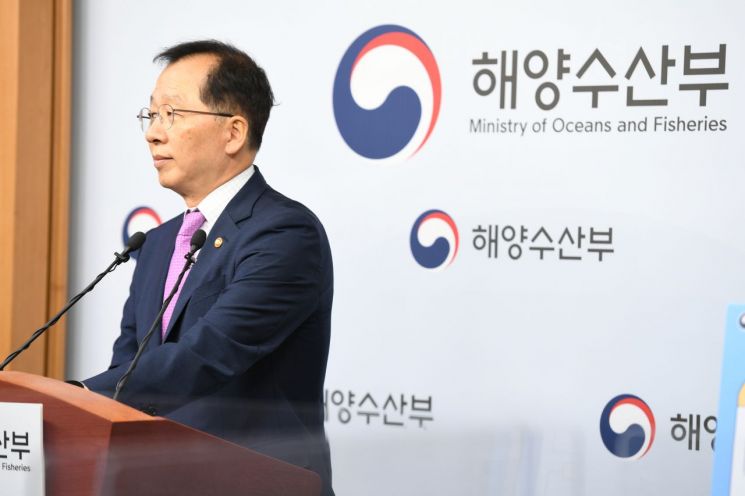
 Cho Seung-hwan, Minister of Oceans and Fisheries, is giving a preliminary briefing on work reports at the Government Complex Sejong on the 10th.
[Asia Economy Sejong=Reporter Dongwoo Lee] The government has begun creating conditions for the privatization of the national shipping company HMM by gradually reducing its publicly held shares. Additionally, to prevent depletion of fishery resources, the Total Allowable Catch (TAC) system will be expanded to cover 60% of domestic seafood production.
On the 11th, Cho Seung-hwan, Minister of Oceans and Fisheries, reported these plans to President Yoon Seok-yeol at the presidential office in Yongsan, Seoul, under the title "New Government Ministry of Oceans and Fisheries Work Plan."
The Ministry of Oceans and Fisheries plans to shift the shipping market to be market-driven and redefine the role of public institutions. Based on HMM’s business normalization achievements, conditions will be created for the mid- to long-term transfer of private management rights. For privatization, the current 74.1% public institution shareholding will be gradually reduced.
Minister Cho stated, "Since HMM is currently profitable, the government and public institutions cannot continue to hold shares indefinitely," adding, "We will create conditions for privatization by gradually reducing public institution shareholdings."
Furthermore, the scope of TAC, which was about 29% of total seafood production last year, will be expanded to 60% by 2027. TAC sets the total allowable catch for each fish species as a measure to protect sustainable fishery resources. The ministry also plans to promptly complete six smart aquaculture clusters under construction domestically and produce high value-added products such as Atlantic salmon starting in 2025. Additionally, modernization of aging fishery wholesale markets and improvements to the seafood distribution system are included.
To promote private ship investment, the ministry will introduce a "tax lease system" that provides tax benefits to ship investors and plans to expand the size of ship funds managed by policy financial institutions from the current $2.1 billion to $3.6 billion. In preparation for an economic downturn, a specialized leasing company for ship purchase and rental will be established by 2026.
Automation of port facilities will also be accelerated. Utilizing domestic technology, a fully automated port testbed will be established at Gwangyang Port by 2026, and Busan Port’s Jinhae New Port will be developed into a smart mega port by 2029. High value-added port services such as LNG bunkering facilities and ship repair yards will be introduced at major domestic ports. A cargo storage facility exclusively for export companies will operate at Busan Port.
To address the disappearance of fishing villages, the ministry will improve living convenience nationwide. The "Fishing Village New Vitality Promotion Project" will support fishing villages categorized as hub-type, self-reliant, and settlement-maintenance types. Detailed plans will be announced next month. With a total project budget exceeding 40 billion KRW, the ministry aims to promote private investment in fishing village areas to improve living standards. To support stable fishery management for fishermen, a basic fisheries public payment will be provided to small-scale fishermen starting next year.
The ministry plans to focus on fostering promising future marine industries to create a market worth 15 trillion KRW. In preparation for the "endemic" era, infrastructure such as hub-type marina facilities and marine healing centers will be expanded to revitalize marine leisure. By next year, a comprehensive plan for complex marine leisure tourism cities will be established, and fishing complex towns will be developed to stimulate fishing village economies.
Countermeasures against the discharge of contaminated water from Fukushima, Japan, have also been prepared. To continuously monitor the inflow of contaminated water into Korean waters, the number of radiation measurement points will be expanded from the current 45 to 52, with 26 of these points being measured approximately every two months. Additionally, over 5,000 inspections annually will be conducted on about 100 seafood species, with expanded origin verification items and strengthened import traceability to prevent mislabeling of Japanese seafood origins.
Minister Cho said, "To realize the new government’s marine and fisheries policy vision of 'A Leap-forward Marine Economy and a Vibrant Marine Community,' we will pursue four major strategies and 12 core tasks," adding, "We will focus organizational capabilities on discovering new growth engines in the marine new industry sector to increase the national economic contribution of the marine and fisheries field."
© The Asia Business Daily(www.asiae.co.kr). All rights reserved.

















