[Asia Economy reporters Choi Seok-jin, legal affairs specialist, and Kim Hyung-min] Ahead of the implementation next month on the 10th of the so-called ‘Geomsu Wanbak (Complete Removal of Prosecutorial Investigation Authority) Law,’ which reduces the scope of direct investigations by prosecutors through amendments to the Prosecutors’ Office Act and the Criminal Procedure Act, the Ministry of Justice has moved to expand the scope of prosecutors’ direct investigations through revisions to related presidential decrees.
On the 11th, the Ministry of Justice announced that it plans to publicly notify the partial amendment bill of the presidential decree titled ‘Regulations on the Scope of Crimes for Prosecutors’ Investigation Initiation’ and the abolition bill of the Ministry of Justice decree titled ‘Enforcement Rules on the Scope of Crimes for Prosecutors’ Investigation Initiation’ from the 12th to the 29th.
If the amendment bill passes, the scope of direct investigation initiation by prosecutors, which was scheduled to be reduced to 28 specific offenses from next month due to crimes being reclassified as ‘corruption crimes’ and ‘economic crimes,’ is expected to be significantly expanded.
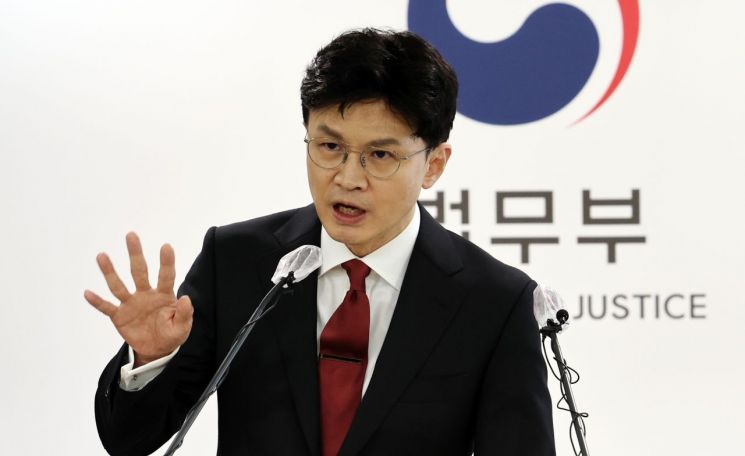
At a briefing held in the Ministry of Justice briefing room on the 3rd floor of the Government Complex Gwacheon that afternoon, Minister of Justice Han Dong-hoon stated, “Both the current and amended Prosecutors’ Office Act delegate the scope of important crimes for which prosecutors can initiate investigations to presidential decrees, allowing the government to set the specific scope. It is clear from the wording of the law that ‘important crimes’ specifically defined by the government, in addition to the corruption and economic crimes listed as examples, are included in the scope of investigation initiation.”
He continued, “The current enforcement decree excessively restricts the scope of prosecutors’ investigation initiation without reasonable standards, which will lead to a weakening of the nation’s crime response capabilities. To minimize harm to victims and related parties, we have supplemented the law within the delegated scope in accordance with the legal framework.”
With the implementation of the Geomsu Wanbak Law, the crimes for which prosecutors can directly initiate investigations will be reduced from the current six major crimes (corruption, economic, public official, election, defense industry, and large-scale disaster crimes) to ‘important crimes such as corruption and economic crimes as defined by presidential decree,’ crimes committed by police officers and officials of the Corruption Investigation Office for High-ranking Officials, and crimes directly related to such crimes or crimes referred by judicial police officers.
However, in the partial amendment bill of the ‘Regulations on the Scope of Crimes for Prosecutors’ Investigation Initiation’ (Investigation Initiation Regulations) disclosed by the Ministry of Justice on this day, the ‘corruption and economic crimes’ explicitly stated as the scope of direct investigation by prosecutors under the Geomsu Wanbak Law were redefined. The bill defines corruption and economic crimes that the Geomsu Wanbak Law did not clearly specify and reclassifies crimes from other laws and regulations that bear the characteristics of corruption and economic crimes. This is seen as a circumvention that increases the number of crimes subject to investigation without significantly undermining the legislative intent of the Geomsu Wanbak Law.
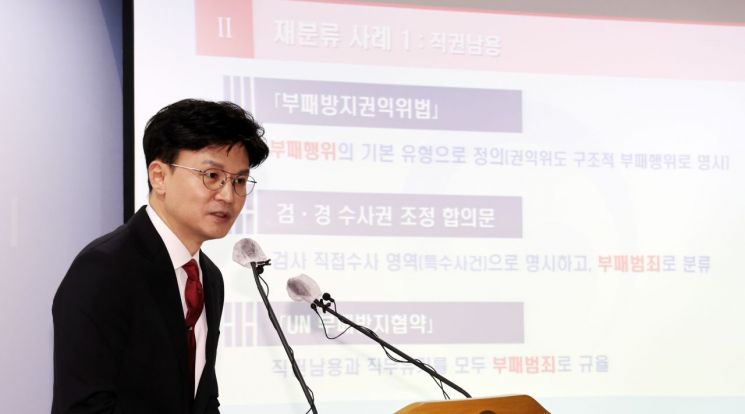
First, the amendment bill includes ‘abuse of authority’ and ‘forgery of official documents’ among public official crimes as typical types of corruption crimes alongside bribery, and includes ‘vote buying and inducement’ and ‘donation acts’ among election crimes as representative types of money politics, thereby allowing prosecutors to investigate them as ‘corruption crimes.’
The amendment bill also defines ‘drug trafficking-related crimes’ and ‘organized crimes for economic crimes’ such as violent organizations extorting ordinary citizens, corporate-style organized crime groups, and voice phishing as ‘economic crimes,’ enabling prosecution investigation.
Additionally, the amendment bill designates crimes that disrupt judicial order and crimes for which prosecutors are requested to file complaints or investigations under individual laws as ‘important crimes,’ allowing prosecutors to directly investigate them.
False accusation and perjury are defined as ‘crimes disrupting judicial order.’ This addresses the current legal issue where prosecutors cannot investigate false accusation charges even when police have dismissed cases.
Crimes for which national agencies request prosecutors to file complaints or investigations are also made subject to investigation.
The amendment bill also specifically defines the concept and scope of ‘direct relevance,’ which was criticized as unfair during the legislative process. Related cases sharing perpetrators, criminal facts, or evidence can be continuously investigated by prosecutors.
The Ministry of Justice also plans to abolish the ‘Enforcement Rules on the Scope of Crimes for Prosecutors’ Investigation Initiation,’ which divides the scope of investigation by rank and amount. Under the current enforcement rules, prosecutors can only investigate bribery cases involving public officials of grade 4 or higher, improper solicitation involving amounts over 50 million won, and illegal export/import of strategic materials involving amounts over 5 billion won.
This amendment bill will apply to investigations initiated after the enforcement date of the amended Prosecutors’ Office Act on the 10th of next month. The Ministry of Justice stated, “Through public notification and consultation with related agencies, we will widely gather opinions from all sectors to ensure that institutional supplements and preparations for law enforcement minimize any national crime response gaps or public harm that may arise from the implementation of the amended Prosecutors’ Office Act.”
At the end of the briefing, Minister Han said, “The Ministry of Justice will widely listen to opinions from all sectors of society through public notification and consultation on this amendment bill of the enforcement decree and seriously consider the feedback. We will make every effort to supplement the system and prepare for the law’s enforcement so that any national crime response gaps or public harm caused by the implementation of the amended law on September 10th are minimized.”
He added, “We have filed a constitutional review petition claiming that the amended law is unconstitutional and invalid, but please understand that we are making thorough preparations to minimize legal gaps and public harm that could arise if the law is enforced before a constitutional decision is made.”
Finally, Minister Han said, “When the new Prosecutors’ Office Act takes effect on September 10th, it will have a direct and tangible impact on the public because it concerns the criminal justice system. I earnestly ask for your interest and advice on the enforcement decree that the government is preparing in response to this law.”
© The Asia Business Daily(www.asiae.co.kr). All rights reserved.
![Clutching a Stolen Dior Bag, Saying "I Hate Being Poor but Real"... The Grotesque Con of a "Human Knockoff" [Slate]](https://cwcontent.asiae.co.kr/asiaresize/183/2026021902243444107_1771435474.jpg)












