[Asia Economy, reporter Yoo Inho] In the aftermath of the South Korea-China foreign ministers’ meeting held in Qingdao, China, on August 9, the issue of the "Three No’s (3불)-One Restriction (1한)" concerning THAAD (Terminal High Altitude Area Defense) has emerged, causing a backlash between the two governments.
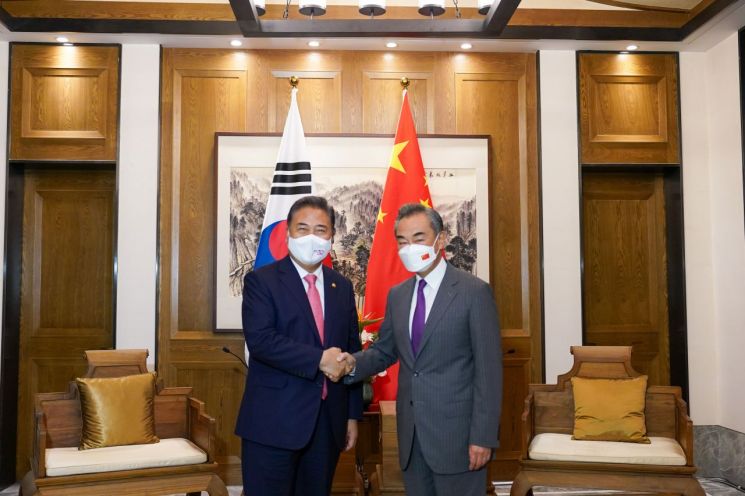
Both the South Korean and Chinese governments are refusing to back down from their existing positions regarding THAAD, raising concerns that this could negatively impact bilateral relations ahead of the 30th anniversary of diplomatic ties between the two countries on August 24.
It was China that brought up the "Three No’s-One Restriction" issue related to THAAD. On August 10, the day after the foreign ministers’ meeting, the Chinese Ministry of Foreign Affairs, during its regular briefing, not only reiterated the "Three No’s" (no additional THAAD deployments, no participation in the U.S. missile defense system, and no trilateral military alliance with the U.S. and Japan), but also mentioned the "One Restriction," referring to operational limits on the THAAD system already deployed in South Korea, thereby increasing pressure on Seoul.
At the briefing, Wang Wenbin, spokesperson for the Chinese Ministry of Foreign Affairs, explained China’s position regarding THAAD and the meaning of "addressing security concerns appropriately," which was stated during the previous day’s meeting. He said, "The U.S. deployment of THAAD in South Korea clearly undermines China’s strategic security interests, and China has repeatedly expressed its concerns to South Korea."
Wang continued, "The South Korean government has made a formal policy pledge of the Three No’s-One Restriction to the international community, and China attaches great importance to this position. Based on mutual understanding, China and South Korea have managed the THAAD issue smoothly and in stages," he asserted.
This is the first time that the Chinese government has described the "One Restriction"-meaning operational limits on the THAAD system already deployed in South Korea-as a formal external declaration by Seoul. The "Three No’s" refer to no additional THAAD deployments, no participation in the U.S. missile defense (MD) system, and no trilateral military alliance among South Korea, the U.S., and Japan.
The Chinese mention of the "Three No’s-One Restriction" marks a departure from the stance shown during the foreign ministers’ meeting. While other areas of the August 9 meeting were conducted in a relatively amicable atmosphere, there was no change in China’s position regarding THAAD.
However, the South Korean government’s position remains firm. Seoul maintains that the "Three No’s" policy announced during the Moon Jae-in administration was neither an official agreement nor a promise between the governments, and that, as it concerns South Korea’s security sovereignty, it cannot fully accept China’s demand to adhere to it "under any circumstances."
The same applies to the "One Restriction" issue. The results of the 2017 bilateral consultations on improving South Korea-China relations, which China claims included an agreement on THAAD, do not mention any operational restrictions on the THAAD system already deployed in South Korea.
The results of those consultations clarified that "the THAAD system deployed in South Korea is not aimed at any third country and does not undermine China’s strategic security interests, in accordance with its original deployment purpose."
While China appears to interpret this statement as the "One Restriction," the South Korean government’s position is that it did not constitute a concrete promise to limit operations.
The Ministry of Foreign Affairs emphasized, in response to China’s claim that South Korea had made a formal pledge of the "Three No’s-One Restriction," that this referred to statements made by the previous administration, and clarified that "this was not something mentioned by our government during the recent meeting."
The Ministry added, "During the meeting, we reminded China once again that even the previous administration had stated publicly that the so-called 'Three No’s' were neither a promise nor an agreement. We emphasized that the more China continues to raise this issue, the more it will worsen mutual perceptions between the peoples of both countries and act as an obstacle to bilateral relations."
Furthermore, "During the recent meeting, both sides confirmed their differences regarding the THAAD issue, but agreed that it should not become an obstacle affecting bilateral relations," the Ministry stressed.
Meanwhile, it has been reported that the Chinese Ministry of Foreign Affairs initially used the term "pledge" (宣誓) to describe South Korea’s "Three No’s-One Restriction" policy regarding THAAD, but later changed it to "declare" (宣示), which means "to make widely known."
According to diplomatic sources, the Chinese Ministry of Foreign Affairs originally posted on its website that "the South Korean government has made a formal pledge of the Three No’s-One Restriction policy to the international community..." in Wang Wenbin’s briefing Q&A, but later revised it to "policy declaration."
At a regular briefing on the same day, Deputy Spokesperson An Eunju of the Ministry of Foreign Affairs also remarked, "China’s claim that South Korea officially declared the Three No’s-One Restriction policy appears to refer to the previous administration’s public statements."
As a result, some interpret China’s change from the stronger term "pledge" to the milder "declaration" as a reflection of the South Korean government’s position.
An official from the Ministry of Foreign Affairs stated, "China’s continued mention of the Three No’s-One Restriction requires a strong response, but the use of the milder term 'declaration' instead of the language of agreement or promise shows that our position has been accepted."
© The Asia Business Daily(www.asiae.co.kr). All rights reserved.

















