[Financial Innovation from a Bank Research Director]
Interview with Han Donghwan, Head of KB Financial Group Management Research Institute
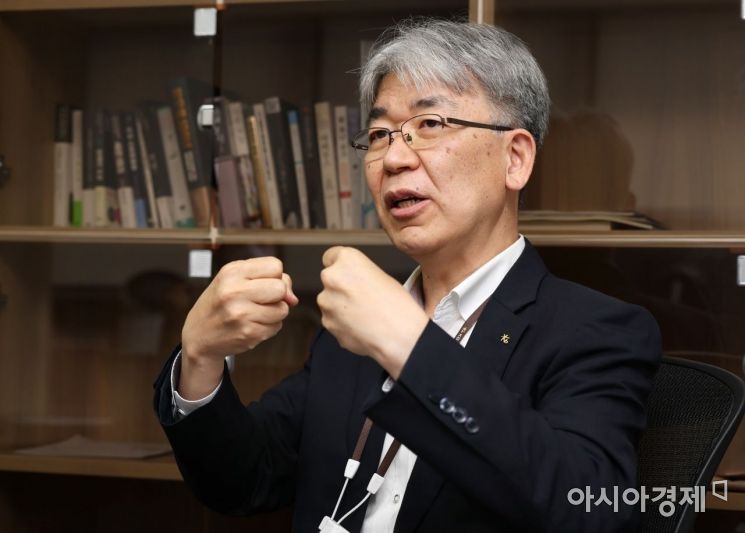
Han Dong-hwan, head of the KB Financial Group Management Research Institute, emphasized in an interview with Asia Economy on the 11th that "innovation in financial companies must occur in areas closely connected to finance." Representative sectors include real estate, automobiles, and healthcare. If the regulation limiting subsidiary investments to 15% is lifted, KB Financial Group is highly likely to acquire promising companies in these fields.
Regarding the financial innovation promoted by the Financial Services Commission, Han expressed concerns that it could lead to a monopoly of financial intermediary platforms by big tech companies. Following open banking, which allows viewing and transferring funds between different banks through bank apps, the Financial Services Commission is expanding open banking to open finance, covering all financial services including insurance. He said, "Big tech companies could exploit this to easily enter the financial sector while evading regulations." On the introduction of financial product brokerage services through online platforms, he also worried, "If Naver or Kakao jump in, banks could become dependent on big tech."
Regarding the virtual asset market, he stated, "Using trustworthy banks and financial platforms will protect (virtual asset investment) customers," and added, "It is necessary to benchmark U.S. regulations on virtual assets."
"The first acquisition by each company will indicate the innovation direction of the financial holding company"
Financial innovation should occur in adjacent fields where banks excel
- If the separation between finance and industry is relaxed, the subsidiary investment limit capped at 15% will be lifted. What acquisition targets is KB Financial Group interested in?
▲ The first acquisition will serve as a gauge to understand each financial company's philosophy and strategic direction. Looking at JP Morgan, they acquired payment companies and asset management firms. JP Morgan could establish these themselves, but since it's complicated to create from scratch, they chose to acquire easily. KB Financial Group already has KB Real Estate. It provides real estate price information and is a platform adjacent to finance. Real estate can expand into businesses related to finance, including home repairs. They may consider such areas.
It does not seem desirable for finance to imitate big tech. KB should target people who need financial services. We are looking for areas closely connected to finance, and that is 'space.' For humans, fixed space is real estate, and mobile space is mobility. KB Capital created the used car platform 'ChaChaCha,' and such mobility sectors can also be expanded.
The next important area is healthcare, where trust is crucial. High-net-worth individuals even ask our PBs (Private Banking) for hospital information. They ask such questions because they trust PBs. Currently, KB Insurance has established a subsidiary, KB Healthcare. Although it is before full launch, they are incubating an app called 'Ocare.' It provides consultations on diet, diagnoses health status, and connects users to hospitals. In the future, acquiring or collaborating with companies that develop medicines or treatments could create a remarkable platform.
- One of the demands in the capital market sector is to increase trustable assets. The core is to allow comprehensive wealth management services.
▲ Unspecified money trusts, which pooled multiple people's assets like funds, have long disappeared. Now, only specified money trusts exist, where banks manage funds deposited by customers according to the management methods and conditions designated by the customers. Banks are requesting to allow trust assets, which currently must be entrusted separately, to be pooled and entrusted together. By pooling assets including cash, securities, movable property, real estate, and leasehold rights, financial companies can manage comprehensively and earn fee income. It is also convenient for financial consumers. Comprehensive wealth management services such as will-substitute trusts, where elderly parents entrust all their assets to a bank and designate beneficiaries in advance to inherit the income rights after death, can be activated.
- Banks are also very interested in the virtual asset market.
▲ Currently, the coin market is a speculative playground. It is too risky to entrust virtual assets to exchanges. The exchanges make all the money while individuals suffer losses. Consumer protection has been completely lacking. Even securities exchanges are heavily regulated. Using already well-regulated financial platforms for virtual asset trading would provide much better customer protection and bring good digital assets to the market. Already, Kookmin Bank has invested in 'Korea Digital Asset (KODA),' a comprehensive digital asset management company. Issuing coins should follow the same procedures as issuing securities. Regulations applied at the issuance stage should benchmark the U.S. If trustworthy financial companies enter, it can be a win-win situation.
- What changes will the digital universal bank bring?
▲ Like Toss, where you can access banking and securities just by entering the bank app, digital universal banking allows seamless access to affiliated company apps such as Kookmin Bank, insurance, cards, real estate, automobiles, and securities. The key is to design a user interface (UI) that allows customers to comfortably move between different areas. Another necessity is information sharing among affiliates. Due to information leakage incidents during the old card scandal, sharing has been blocked until now. To provide integrated, customized product recommendations to customers using affiliate information, these regulations need to be lifted. Solving these issues is meaningful for integrating affiliate services into a single app. Currently, regulations are strict by industry, so significant adjustments are needed.
- The financial authorities are promoting the introduction of 'open finance' as a financial innovation.
▲ Open finance could be exploited by big tech companies like Naver or Kakao to easily enter the financial sector while evading regulations. Big tech companies easily went public by leveraging expectations of benefits, but looking at how their stock prices have dropped to half of last year's market capitalization after insiders sold their shares, we can see what big tech might do next. For open finance to be meaningful to customers, customer protection measures are most important. I believe the application of the Financial Consumer Protection Act is a crucial infrastructure. Otherwise, only big tech will profit, and banks will lose their core data.
- The government is considering introducing financial product brokerage services through online platforms, making banks nervous.
▲ If such platforms emerge, there is an expectation that deposit interest rates will rise, but if deposit rates rise, loan interest rates will also increase. The expected benefits for the public will be minimal, while Naver or Kakao will monopolize the brokerage platform, earning fees from both businesses and consumers. In this case, banks will inevitably become dependent on platform companies. In financially advanced countries like Singapore and Japan, there are no big tech companies in finance. If Korea does not consider the impact of big tech on finance, it will face problems other countries have not experienced. Japan opened a private financial intermediary platform at the end of last year, but due to strict regulations, niche fintech companies that supported banks have only registered without much activity. There is no overseas case where a platform used by the majority of the population was opened as a financial intermediary platform. Big tech and fintech are distinctly different and should be distinguished. Big tech is benefiting from regulations relaxed for fintech.
Interview by: Jeong Jae-hyung, Head of Finance Department
Summary by: Shim Na-young, Reporter
© The Asia Business Daily(www.asiae.co.kr). All rights reserved.