Gangnam Severance Professors Gong Taeyoung and Yoo Jesung Team
Bundled Treatment Performance Rate 1.36 Times Higher at Night Than During the Day
Medical Staff Relative to Patients Is a Variable
"Expansion of Medical Staff and Customized Improvements Needed"
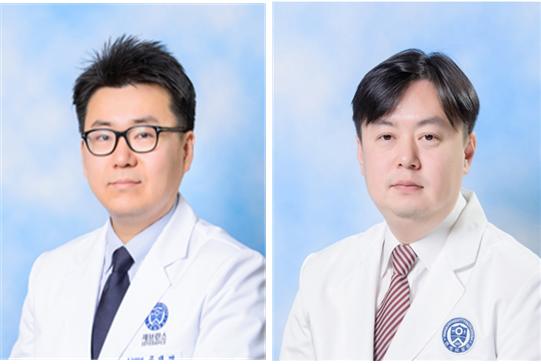 Professor Tae-Young Gong (left) and Professor Je-Sung Yoo, Department of Emergency Medicine, Gangnam Severance Hospital.
[Asia Economy Reporter Lee Gwan-joo] A domestic research team has found that the core treatment for sepsis patients, the 'sepsis bundle therapy,' is performed better at night than during the day. This result is noteworthy as it contrasts with other studies that generally show lower quality of care during nighttime.
The research team led by Professor Gong Tae-young of the Department of Emergency Medicine at Gangnam Severance Hospital (Professors Gong Tae-young and Yoo Je-sung, Korean Shock Society) announced on the 11th that their multicenter observational study examining the difference in completion rates of sepsis bundle therapy between day and night confirmed this finding.
Sepsis has a high mortality rate and requires rapid treatment. Sepsis bundle therapy refers to the simultaneous execution of lactate measurement, blood culture tests, administration of antibiotics and fluids, and vasopressor administration in sepsis patients.
The team conducted the study on 2,049 patients with septic shock who visited emergency medical centers at 11 tertiary university hospitals nationwide from November 2015 to December 2017. They divided the patients into day and night groups based on their time of arrival at the emergency medical center to verify whether sepsis bundle therapy was appropriately performed within the golden time.
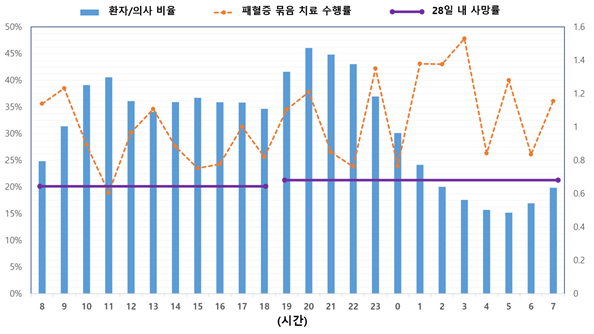
As a result, sepsis bundle therapy during nighttime showed a 1.36 times higher completion rate compared to daytime. The research team confirmed that this outcome is related not simply to prognosis differences between day and night but to the ratio of medical staff to patients. The total number of patients and emergency medical center visits tended to be higher during the day than at night. During the hours from midnight to 8 a.m., when the number of patients per medical staff member decreases, the completion rate of sepsis bundle therapy (average 36%) increased, whereas from 9 a.m. to 6 p.m., when the number of patients per medical staff member is higher, the overall completion rate was lower (average 28%).
Professor Gong explained, “Many domestic and international studies have reported that the quality of care for severe emergency diseases at night is lower compared to daytime, but this appears to stem from the reduced amount of medical resources and the lack of specialized medical staff for these severe emergency conditions at night. This study should not be simply interpreted as sepsis treatment being more effective at night. In areas where standardized treatment methods like sepsis bundle therapy are established, the number of medical staff relative to patients has a greater impact than the advanced expertise of the medical personnel.”
He added, “In the operation of intensive care units and the improvement of emergency medical systems, increasing medical staff is as important as enhancing expertise. Tailored improvements suited to individual treatment fields are necessary rather than simple and uniform enhancements.”
The results of this study were published in the academic journal of critical care medicine, Critical Care.
© The Asia Business Daily(www.asiae.co.kr). All rights reserved.
![Clutching a Stolen Dior Bag, Saying "I Hate Being Poor but Real"... The Grotesque Con of a "Human Knockoff" [Slate]](https://cwcontent.asiae.co.kr/asiaresize/183/2026021902243444107_1771435474.jpg)

















