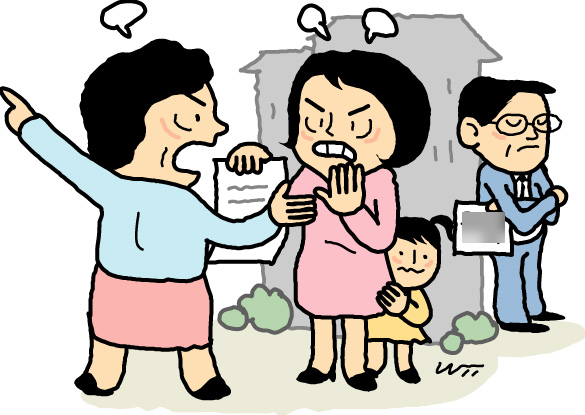
[Asia Economy Reporter Ryu Tae-min] Office worker A, who lives in Seongbuk-gu, Seoul, recently heard that the house he was living in under a jeonse lease had been seized. The tax authorities decided to seize all these houses after the multi-homeowner B, who owns the house, was hit with a comprehensive real estate tax bomb and failed to pay the taxes. Having lived there for less than half a year and with plenty of time left before the jeonse contract ends, he is losing sleep worrying that he might not be able to get his jeonse deposit back as the landlord’s property is going to auction.
Cases like A’s, where tenants are threatened with the return of their jeonse deposits due to ‘empty-can jeonse’ situations, are increasing recently. In particular, multi-homeowners hit with tax bombs are unable to return the money. Especially with taxes such as comprehensive real estate tax and property tax, which often have priority over the deposit, even if the house is sold at auction, tenants frequently suffer losses by not being able to fully recover their deposits.
Forced Auction Cases Up 1.5 Times... Deposit Returns Also Surge
According to Gigi Auction, a court auction specialist company, the number of forced auction cases filed by tenants and the Korea Housing & Urban Guarantee Corporation (HUG) in the first half of this year totaled 983. This is about 324 cases (49%) more than the 659 cases in the first half of last year. Among these, villas (multi-family and row houses) accounted for 493 cases, an increase of 202 cases (69.4%) from 291 cases in the first half of last year. For apartments, the number rose from 286 to 316 cases during the same period, and for mixed-use residential complexes, from 82 to 174 cases.
As forced auctions continue, the amount of damage caused by tenants not being able to get their deposits back is also increasing. According to HUG, the amount of jeonse deposit return guarantee insurance claims in the first half of this year (January to June) reached 340.7 billion KRW, marking a record high for a half-year period. This surpasses the 251.2 billion KRW in the first half and 327.8 billion KRW in the second half of last year. Currently, jeonse deposit return guarantee insurance products are offered by HUG, the Korea Housing Finance Corporation (HF), and SGI Seoul Guarantee.
Last month, the amount and number of jeonse deposit return guarantee insurance claims were 87.2 billion KRW (421 cases), both the highest monthly figures ever recorded. If the landlord fails to return the jeonse deposit after the contract period expires, these institutions pay the deposit to the insured (tenant) on their behalf (subrogation) and later exercise their right of recourse to claim the amount from the landlord.
Jeonse Deposits Ranked Behind Taxes... Tenants Face Difficulty in Returns
Typically, for ‘empty-can houses’ where the jeonse rate exceeds 80%, if the landlord fails to repay the mortgage loan on time, the house goes to auction, and if sold, part of the proceeds is returned to the tenant’s jeonse deposit. The problem arises when the jeonse price exceeds the sale price, making it impossible to even subscribe to jeonse deposit return guarantee insurance, increasing the damage. Choi Eun-young, director of the Korea Urban Research Institute, explained, “Recently, as sale prices have fallen and jeonse prices have risen, nearly 40% of houses nationwide are at risk of tenants losing their jeonse deposits.”
Even if tenants have registered their residence and obtained a certified date, they cannot be assured of safety. If the landlord has unpaid taxes such as comprehensive real estate tax or property tax, the jeonse deposit is ranked behind these taxes. According to the Framework Act on National Taxes, national taxes take precedence over other claims.
Moreover, houses with complex debt relationships such as bonds are more likely to be repeatedly passed over in auctions. The more auctions fail, the lower the starting price becomes, resulting in a lower final bid price. After deducting taxes, the amount returned as the jeonse deposit is practically very little.
Attorney Cho Jo-seong of Law Firm Rowin advised, “To reduce such damage, it is safer to find and contract properties eligible for jeonse deposit insurance. If you cannot recover through insurance, you should quickly seek other options such as bidding for the house at auction.”
© The Asia Business Daily(www.asiae.co.kr). All rights reserved.

















