Nuclear Research Development Fund... Rate Frozen for 25 Years
US Department of Energy Nuclear R&D Nears 2 Trillion This Year
[Asia Economy Reporter Oh Hyung-gil] Although the Yoon Seok-yeol administration is advocating for the restoration of the nuclear power industry ecosystem, the research and development (R&D) fund in the nuclear power sector has been in deficit for several years.
There are calls to expand the scale of fund formation urgently as the development of new nuclear power plants, including Small Modular Reactors (SMRs), is critical for carbon neutrality.
According to the Korea Energy Economics Institute on the 13th, the Nuclear Research and Development Fund (Nuclear Fund) was established in 1996 to promote the development of the nuclear industry and to ensure a stable system for research and development. Korea Hydro & Nuclear Power, the operator of power reactors, forms the fund by applying a rate of 1.2 KRW/kWh to the power generation volume from two years prior while operating the reactors.
The fund started with 89.1 billion KRW in 1997, and by 2021, a total of 4.0839 trillion KRW had been accumulated. However, total expenditures amounted to 4.0667 trillion KRW, leaving a net accumulation of only 17.2 billion KRW as of the end of last year.
In particular, in 2021, the fund income was 177.3 billion KRW, whereas the expenditure was 212.8 billion KRW, marking a deficit for the second consecutive year following 2020.
Since the fund income is solely determined by nuclear power generation volume, the capacity and utilization rate of nuclear power facilities play a significant role.
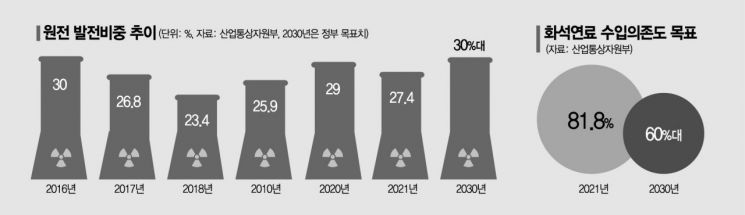
The nuclear power facility capacity has approximately doubled from 10.3 GW in 1997, when the nuclear research and development account was first established, to 23.25 GW last year. Additionally, the nuclear power utilization rate, which averaged over 80% in the 1990s, dropped to a low of 66.5% in 2018 but has recently risen back to 90%.
Considering the time lag in reflection, it is expected that the fund formation amount will increase as the utilization rate improves.
However, this is still far below the levels of other countries.
The United States, currently operating 93 commercial nuclear reactors, allocated 1.655 billion USD (approximately 2.17 trillion KRW) for the Department of Energy’s nuclear R&D budget in fiscal year 2022, a 10% increase from the previous year.
The U.S. has focused investments on continuous use of light-water reactors through safety enhancements, license renewals, and support, as well as basic research on SMR technologies. Recently, it has concentrated on demonstration and deployment of advanced reactors and commercialization of advanced nuclear fuel cycle technologies. Moreover, the U.S. nuclear R&D budget has shown a continuous upward trend regardless of the administration.
France is known to allocate 59.2% of its total energy technology R&D budget to nuclear technology. Since 2011, it has imposed a storage tax to secure funds related to radioactive waste.
Japan’s nuclear technology R&D investment accounts for about 36.3% of its total energy technology budget, and it levies local taxes such as nuclear fuel tax, handling tax on nuclear fuel and nuclear materials, and spent nuclear fuel tax.
Professor Cho Hong-jong of Dankook University’s Department of Economics pointed out, "The fund rate standard has not changed since 1997 and remains the same to this day," adding, "It is time to devise measures for the formation and securing of nuclear R&D funds that reflect new environmental changes such as economic growth, inflation, and carbon neutrality."
He continued, "To secure resources necessary for expanding domestic nuclear R&D investment, increasing the rate and diversifying income sources should be considered first," and added, "In the long term, methods of raising funds in the form of earmarked taxes can also be considered."
© The Asia Business Daily(www.asiae.co.kr). All rights reserved.


















