2022 Q2 COVID-19 National Mental Health Survey
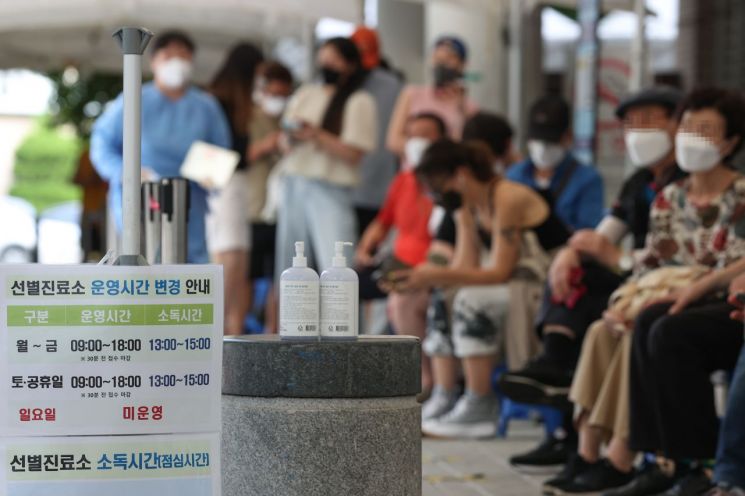
[Asia Economy Reporter Kim Young-won] The number of people feeling depressed has decreased since the social distancing measures were lifted. However, the rate of suicidal thoughts was found to be higher than at the beginning of the COVID-19 pandemic.
On the 10th, the Ministry of Health and Welfare announced the results of the "2022 Q2 COVID-19 National Mental Health Survey" at the Central Disaster and Safety Countermeasures Headquarters meeting. This survey has been conducted quarterly since March 2020, and this round surveyed 2,063 adults aged 19 to 71.
The survey results showed that the depression risk group, defined as those scoring 10 or higher out of 27 points on depression-related indicators, was 16.9%, the lowest since the survey began. The depression risk group peaked at 22.8% in March last year and maintained the 18% range from Q2 last year through Q1 this year. Before COVID-19 occurred in Korea in 2019, the rate was 3.2%.
Park Hyang, head of the Central Disaster Management Headquarters' quarantine team, explained, "We believe this is the result of gradual daily life recovery such as the lifting of social distancing," adding, "However, compared to 2019 before COVID-19, the depression risk group is still about five times higher."
In particular, the depression risk group was 22.1% among those whose income decreased, nearly twice as high as the 11.5% in groups with increased or unchanged income. By household type, single-person households showed a higher rate at 23.3% compared to multi-person households at 15.6%.
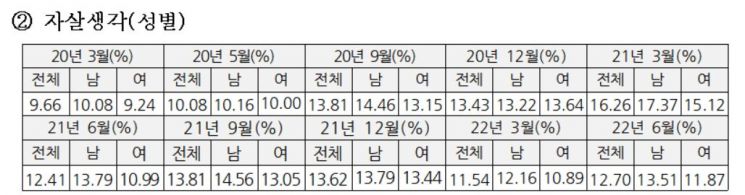
On the other hand, the rate of suicidal thoughts increased to 12.7% in this survey, up from 11.5% in Q1. This is also higher than the 9.7% recorded in Q1 2020, the early stage of the COVID-19 outbreak. The suicidal thought rate in 2019 was 4.6%, about one-third of the current result.
The rate of suicidal thoughts among men was 13.5%, higher than the 11.9% among women. Contrary to the general trend where women tend to have higher rates of suicidal thoughts, this survey consistently showed men having higher rates than women.
Similar to the depression risk group, those with decreased income also showed higher rates of suicidal thoughts. The rate was 16.1% among those with decreased income, about 7 percentage points higher than the 9.2% in groups with increased or unchanged income.
Fear and anxiety about COVID-19, as well as stigma perception related to COVID-19 infection, all decreased. In particular, the stigma perception score dropped by about 2 points from 8.1 in Q1 to 6.2 out of 15 points.
Although the rates of depression and suicidal thoughts have increased since the COVID-19 outbreak, awareness of mental health services remained low. While 60.2% expressed willingness to use such services, awareness was only 12.0%.
The survey research team explained, "Fear and anxiety have appropriately decreased over time, but the reduction in depression is relatively low," adding, "This means that more time and effort are needed to reduce the public's feelings of depression."
The team further emphasized, "Due to accumulated realistic problems such as income reduction and isolation during the COVID-19 period, there is concern about further deterioration of mental health or increased suicide risk. Therefore, active support for economically and socially vulnerable groups is necessary."
© The Asia Business Daily(www.asiae.co.kr). All rights reserved.

![Clutching a Stolen Dior Bag, Saying "I Hate Being Poor but Real"... The Grotesque Con of a "Human Knockoff" [Slate]](https://cwcontent.asiae.co.kr/asiaresize/183/2026021902243444107_1771435474.jpg)















