The Operations Committee Has Traditionally Been Led by the Ruling Party Floor Leader
The Chairperson's Term Is One Year, and Members Are Composed of the Floor Leader Group, etc.
There Are Precedents of Giving Up Running for Supreme Council Member When Elected as Standing Chairperson
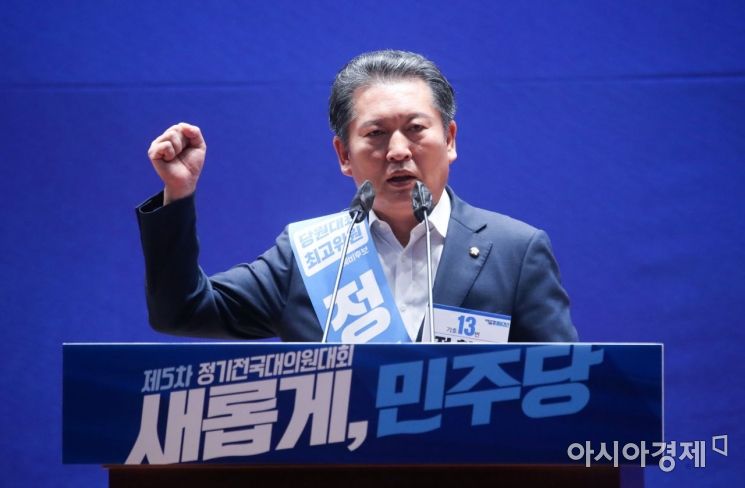 Candidate Jeong Cheong-rae, who ran for the party's Supreme Council member, is presenting his policy speech at the preliminary primary election for the Democratic Party's party leader and Supreme Council member held at the National Assembly Members' Office Building on the 28th. Photo by Yoon Dong-joo doso7@
[Asia Economy Reporter Naju-seok] Rep. Jung Cheong-rae, who has stirred controversy by challenging for the Supreme Council while serving as a standing committee chairman in the National Assembly, faced criticism from Kwon Seong-dong, the floor leader of the People Power Party, who raised issues of fairness by mentioning the concurrent holding of the chairmanship of the National Assembly Steering Committee. Critics argue that this comparison is unreasonable as it disregards the customary practice in the National Assembly where the ruling party floor leader traditionally holds the Steering Committee chairmanship.
As of the 10th, in the Democratic Party’s Supreme Council race, Rep. Jung is leading with a cumulative vote share of 38.40% (25,542 votes) in two rounds of regional voting by party members, making him a strong candidate to enter the Supreme Council. If Rep. Jung, already elected as the chairman of the National Assembly Science, Broadcasting, Technology, and Communications Committee, also secures a Supreme Council seat, he would be able to hold both a standing committee chairmanship and a party position concurrently. This has led to criticism both inside and outside the party, citing the established practice of avoiding concurrent holding of standing committee chairmanships and Supreme Council positions. The core criticism is that of overambition.
In response, Rep. Jung has pushed back, saying, "Kwon Seong-dong, the People Power Party floor leader, can serve as a standing committee chairman (chairman of the National Assembly Steering Committee), so why can’t I?" He also argued that there are no party bylaws or National Assembly regulations prohibiting the concurrent holding of major party positions and standing committee chairmanships, countering the political convention that has avoided such overlaps. Instead, he cited Kwon’s example, using the precedent of the Steering Committee chairmanship to argue that concurrent holding should not be problematic.
However, within political circles, it is pointed out that the longstanding convention has been for the ruling party floor leader to serve as the Steering Committee chairman, and criticizing the political practice of not holding both a standing committee chairmanship and a major party position simultaneously based on this precedent is seen as forced.
In fact, the Steering Committee, which can be concurrently held with general standing committees, has unique characteristics in many respects. According to Article 39-2 of the National Assembly Act, the representative member of a negotiation group (floor leader) is required to be a member of the Steering Committee. Except for the Intelligence Committee, the Steering Committee is the only standing committee whose member assignment by law is explicitly defined. Typically, standing committee assignments are decided by the floor leader for negotiation groups and by the Speaker of the National Assembly for non-negotiation groups.
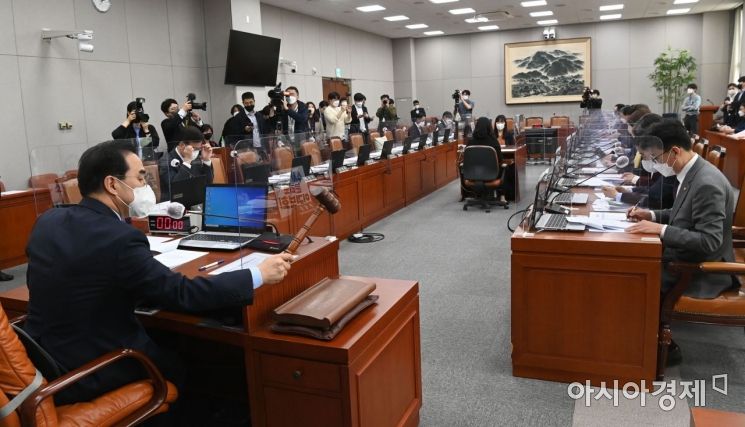 Park Hong-geun, Chairman of the National Assembly Steering Committee, is presiding over the full meeting of the Steering Committee held at the National Assembly on the 29th. On this day, the Steering Committee passed a resolution to establish the Special Committee on Judicial Reform (Sage Special Committee) as a National Assembly special committee to discuss the launch of the Serious Crime Investigation Agency (Jungsucheong), with the People Power Party absent. Photo by Yoon Dong-joo doso7@
Historically, except for very few cases, it has been an unwritten rule that the ruling party floor leader serves as the Steering Committee chairman. The exception was during the latter half of the 20th National Assembly when the ruling and opposition parties switched, and former floor leader Kim Seong-tae of the Liberty Korea Party served as the opposition floor leader while also chairing the Steering Committee. For this reason, in the recent latter half National Assembly organization negotiations following the regime change, it was tacitly accepted between the ruling and opposition parties that the ruling party floor leader would chair the Steering Committee.
Moreover, unlike general standing committees, the Steering Committee is tailored to the floor leader of the negotiation group. For example, while the term for National Assembly standing committees is set at two years by law, the chairman and members of the Steering Committee change annually in line with the floor leader’s term. The composition of the Steering Committee is also filled by the floor leader group of the negotiation group. This practice is so established that the National Assembly Steering Committee manual states, "The term of the floor leader group (one year) is generally matched, and improvements have been made annually." It is also customary for the Steering Committee’s secretary to be held by the National Assembly’s chief deputy floor leader.
In contrast, for general standing committees, the chairmanship is decided through organization negotiations between negotiation groups in the first and second halves of the term, and then distributed among senior members (usually three-term lawmakers) within the floor. Because the position of standing committee chairman is scarce, not all three-term lawmakers become chairmen. In some cases, if there are many applicants, the chairman is elected through a party meeting or shared on a yearly basis as a political compromise. However, even then, some three-term lawmakers may not get the opportunity to chair a committee.
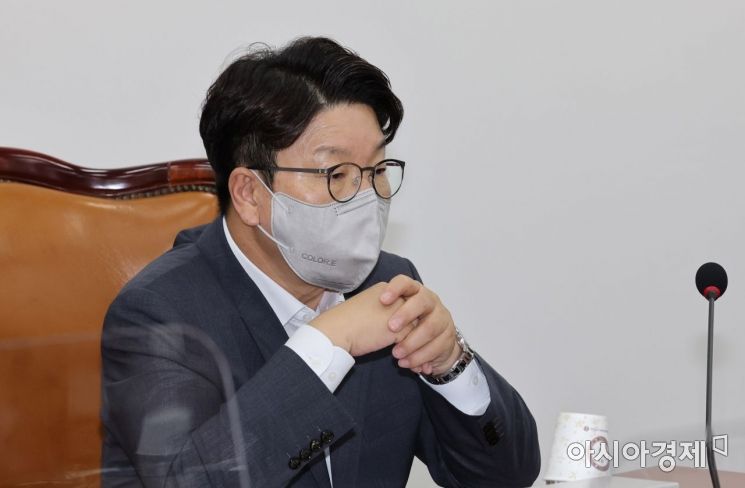 Kwon Seong-dong, Acting Leader of the People Power Party, is attending a virtual parliamentary meeting held at the National Assembly on the 9th. Photo by Yoon Dong-joo doso7@
The convention of not concurrently holding a standing committee chairmanship and a major party position largely stems from the principle of fair distribution of opportunities. The underlying intention is to share opportunities for public attention and authority more broadly. Many criticisms from within the party regarding Rep. Jung’s actions relate to this point.
However, there are aspects of Rep. Jung’s argument that deserve attention. One argument against concurrently holding the Supreme Council membership and a standing committee chairmanship is that the chairman is expected to maintain "political neutrality." Rep. Jung counters this by saying, "They say that holding a major party position related to party duties can compromise neutrality, but isn’t the floor leader also a major position?" In practice, the Steering Committee chairmanship has sometimes been biased toward one party or operated in a partisan manner rather than maintaining neutrality. This has led to efforts to either utilize or block the social authority and discretionary power granted to the chairman, which has been another underlying factor in the organization negotiations. The fierce competition over the Legislative and Judiciary Committee, the Public Administration and Security Committee, and the Science, Broadcasting, and Communications Committee during the recent latter half National Assembly organization negotiations was for this very reason.
© The Asia Business Daily(www.asiae.co.kr). All rights reserved.



















