Seoul Sensitive to Housing Prices, Sharp Increase in Business Closures in Gyeonggi Area with New Towns
Pressure and Stress from Collusion by Women's Associations
Government Crackdowns Nearly Absent as Housing Prices Decline
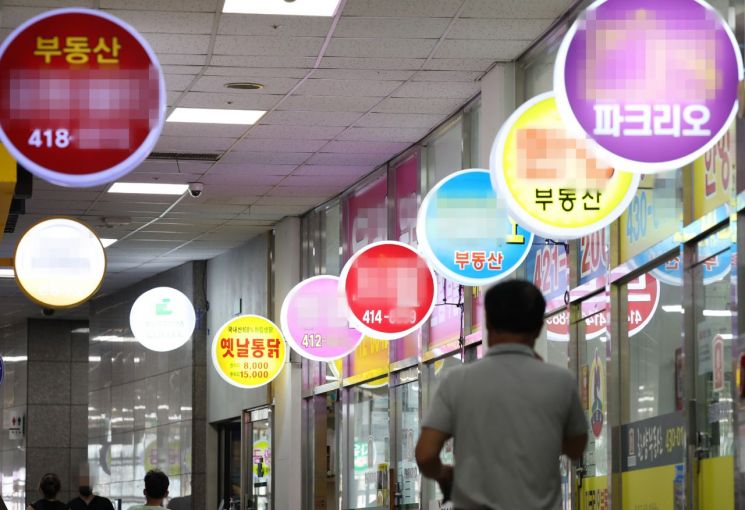 As the real estate market has recently stagnated, cases of collusion pressure from women's associations and local communities targeting real estate agencies have been rapidly increasing. Many licensed real estate agents are experiencing stress due to this, leading to closures and temporary suspensions of their businesses. The photo shows a cluster of real estate agencies in a commercial building in Seoul. [Image source=Yonhap News]
[Asia Economy Reporter Cha Wanyong] Last month, multiple real estate agencies located in Dongtan, Ansan, and Incheon in Gyeonggi Province simultaneously ceased operations. The main reason for these closures was deteriorating performance due to the real estate market slump. Additionally, pressure and stress caused by local apartment complex women's associations frequently visiting and preventing sales below a certain price threshold also had a significant impact.
According to industry sources on the 11th, licensed real estate agents operating in new towns and large apartment complexes are packing up. Particularly, business closures of real estate agencies are notably occurring in Seoul, which is highly sensitive to housing prices, the Gyeonggi area where many new towns have been developed, and large regional cities that have seen abundant supply in recent years.
According to the Korea Association of Realtors' "2022 Status of Licensed Realtors' Openings, Closures, and Suspensions," during June alone, nationwide real estate agencies recorded 1,249 openings, 1,148 closures, and 81 suspensions. Closures increased by 57.9% compared to May (727 cases), surpassing 1,000 for the first time this year.
By region, closures were high in Seoul (314 locations), Gyeonggi (341 locations), Busan (81 locations), Daegu (65 locations), and Incheon (82 locations). These areas share the commonality of having almost no transactions due to the transaction freeze that has continued since the end of last year, and difficulty in finding urgent sale properties likely to be transacted.
Some point out that the interruption of urgent sale transactions was largely influenced by the women's associations within the complexes. Because apartments are evaluated with similar asset values, a single or a few transactions can set the overall market price for the complex, leading the women's associations to exert pressure to defend against price declines directed at real estate agencies.
Especially, compared to the real estate market downturns in 2006 and 2012, the women's associations' movements have become more covert and systematic, pressuring real estate agencies. In the past, collusion efforts targeting residents were mainly conducted through banners, elevator notices, and internet cafes, but since 2020, when the government began large-scale crackdowns on price collusion, the collusion channels of women's associations have shifted to real estate agencies.
For example, in some areas, women's associations of each complex regularly monitor listings and prices at local real estate agencies and prohibit brokerage of transactions below a certain price.
Real estate agencies say they cannot ignore the influence of these women's associations, fearing social ostracism in their communities if they mediate urgent sale properties.
A representative from the Korea Association of Realtors stated, "As the real estate market has stagnated recently, cases of collusion pressure from women's associations and local communities targeting real estate agencies have sharply increased," adding, "Many licensed realtors are experiencing stress from this, leading to ongoing closures and suspensions."
The representative continued, "While these activities somewhat subsided after the government began cracking down on price collusion that fueled rapid housing price increases in 2020, investigations and crackdowns have nearly ceased recently as housing prices have declined," and "Due to excessive collusion pressure from women's associations and others, licensed realtors are feeling a crisis regarding their right to livelihood."
© The Asia Business Daily(www.asiae.co.kr). All rights reserved.

















