4·5nm Process Chipset Market Share at 60%, Surpassing TSMC's 40%
3nm Mass Production Also Started Ahead of TSMC
[Asia Economy Reporter Park Sun-mi] Although the market share gap between TSMC, the global No.1 foundry (semiconductor contract manufacturing), and Samsung Electronics, the No.2, is widening, their fundamentals are completely different. Samsung Electronics holds a larger market share and leads in technology in advanced process nodes compared to TSMC. This achievement is considered even more meaningful given that it was accomplished despite disadvantages in various areas such as taxation, investment incentives, and labor costs.
According to market research firm Counterpoint Research on the 10th, Samsung Electronics’ chipset shipments made with 4nm and 5nm processes accounted for 60% of the market share in the first quarter of this year, surpassing TSMC’s 40%. Just a year ago, Samsung’s market share was only 8.6%, far behind TSMC’s 91.4%, but the ranking quickly reversed.
A synergy effect has occurred as a significant portion of Samsung Electronics’ mid-range and higher smartphones are equipped with chips made using the 5nm process, and the impact of Qualcomm Snapdragon 8 Gen 1 being manufactured with Samsung’s 4nm process since the end of last year also contributed to the increase in Samsung’s foundry market share.
Samsung Electronics’ technological edge is further demonstrated by its earlier start of 3nm mass production compared to TSMC. In June, Samsung began mass production of the world’s first 3nm foundry process applying Gate-All-Around (GAA) technology, has already secured multiple major customers, and is in discussions with numerous clients for orders. Samsung is also developing the 2nd generation 3nm GAA process with a goal of mass production in 2024.
In contrast, TSMC’s 3nm mass production plans have encountered setbacks. According to major foreign media, Intel, a key customer, canceled a large portion of its 3nm orders placed with TSMC due to issues with new CPU product design and process verification, causing delays in TSMC’s 3nm production schedule. As a result, TSMC’s capital expenditure for next year is expected to be significantly reduced from initial plans.
Of course, when looking at the entire foundry market, Samsung Electronics still lags far behind TSMC.
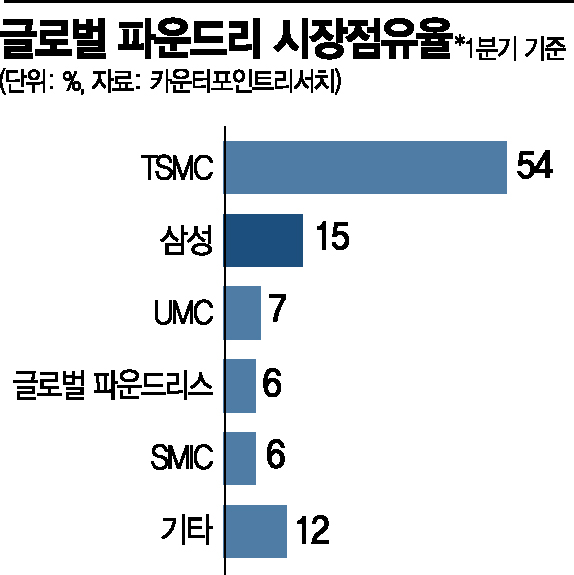
Based on Counterpoint Research’s data for the first quarter of this year, TSMC holds an overwhelming 54% share of the foundry market, followed by Samsung (15%), UMC (7%), GlobalFoundries (6%), and SMIC (6%). TSMC, with nearly 40 years of foundry experience, has secured a large market share in less technology-intensive processes compared to Samsung Electronics, which officially started its foundry business in 2017, resulting in a much higher overall market share. Moreover, TSMC’s scale in revenue and workforce is about three times larger than Samsung’s.
Industry experts say that considering Samsung’s foundry scale, workforce, and experience, competing with TSMC in overall market share is difficult, but when focusing solely on advanced process nodes supported by cutting-edge technology, Samsung has a good chance of winning.
Market research firm Omdia predicts that foundry revenue from 3nm processes will begin this year, surpass 5nm process revenue in 2024, and grow at an average annual rate of 85% through 2025. The forecasted foundry revenue by process node in 2025 is $25.45 billion for 3nm and below, $19.27 billion for 5nm, $15.454 billion for 7nm, and $100 million for 10nm.
Since foundry demand is expected to remain robust, centered on advanced processes, and profitability is more favorable than legacy processes, Samsung Electronics’ focus on advanced process strategies is seen as well-aligned. A semiconductor industry insider said, “Samsung is making unprecedented investments in response to the intensifying competition among global fabless companies to secure advanced process production capacity. Samsung’s technological superiority in advanced processes compared to TSMC poses a significant threat to TSMC, which has long dominated market share.”
© The Asia Business Daily(www.asiae.co.kr). All rights reserved.
![Clutching a Stolen Dior Bag, Saying "I Hate Being Poor but Real"... The Grotesque Con of a "Human Knockoff" [Slate]](https://cwcontent.asiae.co.kr/asiaresize/183/2026021902243444107_1771435474.jpg)
















