Heavy Rain in the Seoul Metropolitan Area and Gangwon Yeongseo Until the Morning of the 10th
Heavy Rain in Chungcheong Region and Northern Jeonbuk from Noon on the 10th to the 11th
Strong Rain in Southern Chungcheong, Jeonbuk, and Northern Gyeongbuk on the 12th
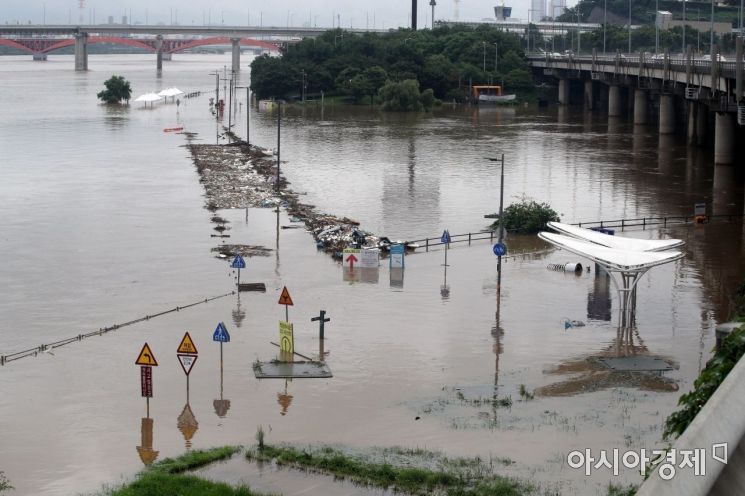 On the 9th, when record-breaking heavy rain fell, the walkway near the Anyangcheon confluence in Hangang Park, Seoul, was submerged due to the rising water level. Photo by Kim Hyun-min kimhyun81@
[Asia Economy Reporter Han Jinju] As the stationary front remains near the Seoul metropolitan area, another heavy downpour is expected over the metropolitan area and the Yeongseo region of Gangwon Province from the 9th through the morning of the 10th.
On the 9th, the Korea Meteorological Administration (KMA) held an ad-hoc briefing and forecasted that as the stationary front moves northward from the 9th to the morning of the 10th, heavy rain with hourly rainfall of 50 to 100mm will fall mainly over the metropolitan area and the Yeongseo region of Gangwon Province. From the afternoon of the 10th to the 11th, as the stationary front moves southward again, heavy rain will fall mainly over the Chungcheong region and northern Jeonbuk.
Forecast analyst Woo Jin-gyu said, "The stationary front that had been lingering over southern Gyeonggi and northern Chungcheong will move northward, temporarily settling over the metropolitan area and the Yeongseo region of Gangwon." He added, "As night falls, the lower-level jet stream will strengthen, which may intensify the rain cloud bands."
Currently, heavy rain warnings are in effect for Seoul, Gyeonggi Province, Incheon, and Gangwon Province (northern mountainous areas of Gangwon, Hongcheon plains, Cheorwon, Wonju, Hoengseong, and Pyeongchang plains). The accumulated rainfall (mm) from the 8th to 7 PM on the 9th is as follows: KMA (Seoul) 476.5, Gwangju (Gyeonggi) 431.0, Sanbuk (Yeoju) 425.0, Okcheon (Yangpyeong) 416.0, Cheongil (Hoengseong) 277.0, Cheorwon Jangheung 219.5, Sidong (Hongcheon) 217.5, Myeonon (Pyeongchang) 207.5, Seoul 161.5, among others.
From the afternoon of the 10th, as dry air from the north strengthens, the stationary front will move southward, bringing heavy rain to the Chungcheong region and northern Jeonbuk. During this period, the metropolitan area will temporarily experience a lull, but from the afternoon of the 11th, the stationary front will move northward again, bringing heavy rain to the metropolitan area and the Yeongseo region of Gangwon.
From the 9th to the 11th, the areas expected to receive the heaviest rainfall are southern Gyeonggi, central and southern inland and mountainous areas of Gangwon, and northern Chungcheong, with some places receiving over 350mm of rain. Additionally, the metropolitan area, central and southern inland and mountainous areas of Gangwon, Chungcheong region, northwestern inland areas of Gyeongbuk, and northern Jeonbuk are expected to receive 100 to 200mm. Northern inland and mountainous areas of Gangwon, the eastern coast of Gangwon, southern Jeonbuk, and northern Gyeongbuk are expected to receive 50 to 150mm; southern Gyeongbuk 30 to 80mm; Jeonnam region (on the 10th) 5 to 40mm; and Gyeongnam region (on the 11th) 5 to 40mm.
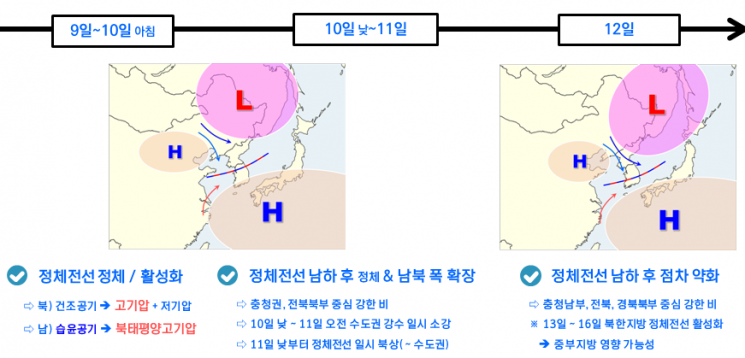
From the 12th, the stationary front will move southward, bringing heavy rain mainly to southern Chungcheong, Jeonbuk, and northern Gyeongbuk. Forecast analyst Woo said, "As the stationary front moves southward, the damage is likely to expand in the southern regions," and urged, "All regions including Chungcheong, Jeonbuk, and Gyeongbuk should be especially prepared for damage caused by heavy rain such as flooding, road congestion, property damage, and embankment collapse."
This rainfall is caused by a blocking low-pressure system that disrupts airflow, inducing cold and dry air from the west to move southward, while hot and humid air from the south flows in, creating very strong rain cloud bands. The cloud bands are narrow north-south and long east-west, moving up and down north-south, causing heavy rain. In particular, the cloud band formed mainly over southern Gyeonggi, covering half of Seoul the previous afternoon, remained stationary for a considerable time, resulting in concentrated heavy rainfall.
Due to the heavy rain the previous day, the Korea Meteorological Administration's location in Dongjak-gu, Seoul recorded a maximum hourly rainfall of 141.5mm. This figure is from the Automatic Weather Station (AWS) and is not an official rainfall record. It is comparable to the record for the highest hourly rainfall ever recorded. The highest hourly rainfall on record is 145mm at Juam on July 31, 1998, and the highest hourly rainfall in Seoul is 118.6mm on August 5, 1942. Compared to the rainfall during the Umyeonsan disaster from July 26 to 28, 2011, this is even higher than the hourly rainfall (113mm) recorded in the Namhyeon area.
© The Asia Business Daily(www.asiae.co.kr). All rights reserved.
![Clutching a Stolen Dior Bag, Saying "I Hate Being Poor but Real"... The Grotesque Con of a "Human Knockoff" [Slate]](https://cwcontent.asiae.co.kr/asiaresize/183/2026021902243444107_1771435474.jpg)

















