Corporate tax rates 5 percentage points higher and average wages 49 million KRW more annually
Major countries worldwide implement large-scale support policies to foster the semiconductor industry
[Asia Economy Reporter Kim Pyeonghwa] Domestic semiconductor companies, including Samsung Electronics, are evaluated to have a less favorable business environment compared to overseas advanced companies.There is a demand for expanded support such as corporate tax reductions and workforce development to strengthen the global competitiveness of domestic companies.
Even with a 22% Corporate Tax Rate, Still Higher than Taiwan
According to the Korea Economic Research Institute (KERI) on the 10th, Taiwan's TSMC, the world's number one foundry (semiconductor contract manufacturing) market player, has a more favorable business environment than Samsung Electronics, the second-ranked company.
TSMC recorded sales of $17.529 billion (22.8666 trillion KRW) in the first quarter of 2022. It held a 53.6% share of the global foundry market in that quarter, ranking first. Samsung Electronics recorded sales of $5.328 billion (6.9504 trillion KRW) in the same quarter, with a 16.3% market share. In terms of sales scale, TSMC's is about one-third of Samsung's.
The two companies also showed differences in workforce size. TSMC had 65,152 employees, which is three times the number of employees in Samsung Electronics' semiconductor foundry division (20,000).
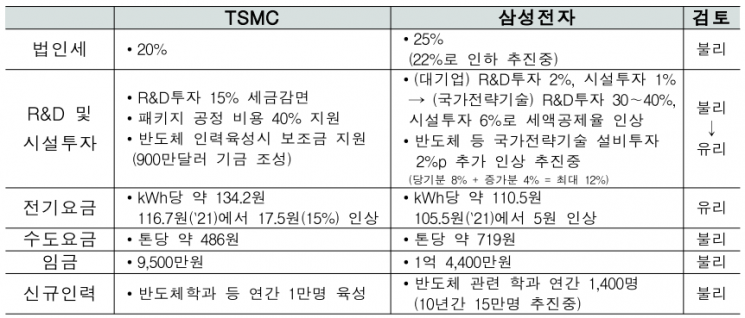 Comparison Table of Competitive Factors between Samsung Electronics and TSMC [Table Source=Korea Economic Research Institute]
KERI pointed out that Samsung Electronics is at a disadvantage in factors such as ▲taxation ▲workforce development ▲wages while competing with TSMC. A representative example is that the highest corporate tax rate in Korea is 25%, which is 5 percentage points higher than Taiwan's 20%. Although the government recently proposed a tax reform plan to lower the corporate tax rate to 22%, it is still higher than Taiwan's.
Unlike Taiwan, which nurtures 10,000 semiconductor talents annually through semiconductor departments, Korea only produces 1,400 per year, which is also a disadvantage. The Korean government announced semiconductor-related workforce development plans in July to improve this. Although the goal is to nurture 150,000 talents over 10 years, KERI forecasts that Samsung Electronics will continue to face difficulties in workforce supply for the time being.
Samsung Electronics' average wage in 2021 was 144 million KRW, which is 49 million KRW higher than TSMC's 95 million KRW. This means a significant labor cost burden. Domestic electricity rates are 110.5 KRW per kilowatt-hour (kWh), lower than Taiwan's 134.2 KRW, but water rates are 223 KRW higher per ton, indicating partial difficulties in infrastructure.
Recently, the enactment of laws and policies supporting research and development (R&D) and facility investments in the domestic semiconductor industry is a positive factor. The National Assembly passed the National Advanced Strategic Industry Special Act, a semiconductor support law, in January, raising the tax credit rates for R&D and facility investment costs to a maximum of 40% and 6%, respectively. The government announced a strategy to achieve semiconductor superpower status in July and said it would increase the tax credit rate for equipment investment in national strategic technologies by an additional 2 percentage points. TSMC receives a 15% tax credit for R&D investment and 40% support for packaging process costs.
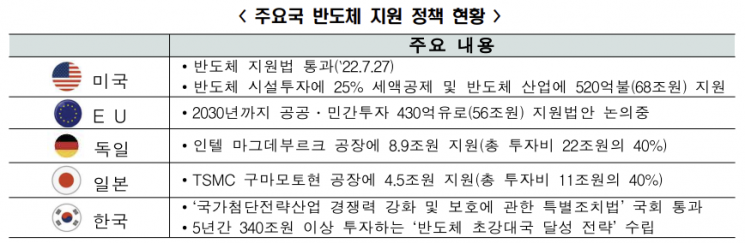 Status Table of Semiconductor Support Policies in Major Countries [Table Source=Korea Economic Research Institute]
"A Drastic Semiconductor Leadership Strategy at the Level of Major Countries is Needed"
KERI emphasized that since the semiconductor industry is a core sector determining national competitiveness, the government must actively foster the industry. As countries around the world are fighting to secure leadership in the semiconductor industry by investing heavily in production facilities, R&D, and human resource development, a drastic strategy to secure industrial leadership is necessary.
In July, the United States passed a semiconductor support law in the Senate, providing $52 billion (67.834 trillion KRW) in support for the domestic semiconductor industry, establishing a large-scale support policy. Germany and Japan each decided to support 40% of the total investment cost for building semiconductor factories domestically. The European Union (EU) is discussing the EU Semiconductor Support Act, which will provide 43 billion euros (57.4592 trillion KRW) in public and private investments by 2030.
In 2021, when TSMC faced difficulties in industrial water supply due to drought, the Taiwanese government worked to keep the factory operating normally. The government directly persuaded farmers near semiconductor factories to cooperate, using agricultural water as industrial water.
Lee Gyuseok, a senior researcher at KERI, said, “To respond to the semiconductor technology hegemony competition, domestic companies need at least the level of infrastructure support provided to overseas advanced companies,” adding, “For this, it is urgent to reduce corporate taxes, improve tax credit rates for R&D and facility investments, expand workforce development support, and ease regulations.”
© The Asia Business Daily(www.asiae.co.kr). All rights reserved.
![Clutching a Stolen Dior Bag, Saying "I Hate Being Poor but Real"... The Grotesque Con of a "Human Knockoff" [Slate]](https://cwcontent.asiae.co.kr/asiaresize/183/2026021902243444107_1771435474.jpg)

















