[Asia Economy Reporter Kim Young-won] As the scale of reinfection cases has grown to about 1 in 20 confirmed cases in the past week, the authorities have urged people to follow quarantine rules and complete their vaccinations.
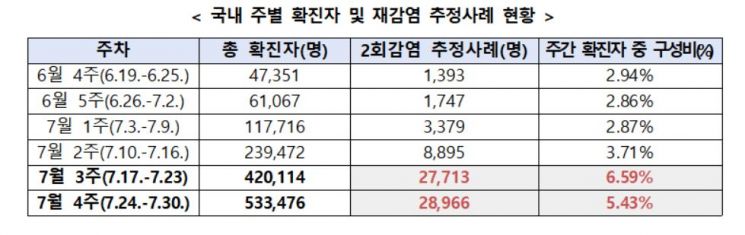
According to the Central Disease Control Headquarters on the 9th, the estimated reinfection cases in the third week of last month were 27,713, and in the fourth week, 28,966. This is about three times the size of the second week of last month (8,895).
The proportion of reinfections among confirmed cases reached 6.59% in the third week and 5.43% in the fourth week of last month. This means that 1 in 20 confirmed COVID-19 cases was infected two or more times. Since the fifth week of June, when the current resurgence began, it is the first time that the weekly proportion of estimated reinfections among confirmed cases has exceeded 4%.
The health authorities analyzed that various factors contributed to the increase in reinfections. Lim Sook-young, head of the Central Disease Control Headquarters' situation team, said, "The increase in reinfections appears to be the result of a combination of factors, including the cumulative increase in initial infections, the dominance of highly transmissible variants such as BA.5, and the waning effect of natural or vaccine immunity over time."
She added that completing COVID-19 vaccination reduces the likelihood of reinfection and urged timely completion of vaccination. According to the risk analysis of factors related to estimated reinfection cases by the Korea Disease Control and Prevention Agency, the risk of reinfection decreases as the number of vaccinations increases. Compared to the unvaccinated group, those who completed the second dose had a 48% lower risk of reinfection, and those who completed the third dose had a 74% lower risk.
By infection period, the risk of reinfection was 3.97 times higher during the Omicron (BA.1) wave and 10.34 times higher during the Omicron (BA.2) wave compared to the Delta wave.
The health authorities forecast that, due to the rapid increase in initial infections during the Omicron dominance period from February to April, the number of estimated reinfection cases is likely to steadily increase over the next 2 to 3 months.
© The Asia Business Daily(www.asiae.co.kr). All rights reserved.

















