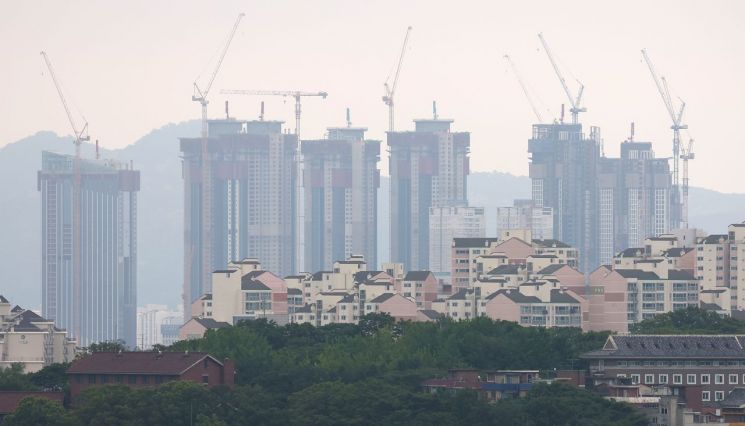
 As the real estate market freezes, funds related to real estate project financing (PF) are not circulating in the market. The real estate market is expected to suffer from a shortage of new supply for the time being.
 [Image source=Yonhap News]
Land Transaction Volume in the First Half of This Year Decreases by 27.1% Compared to the Same Period Last Year
Developers Reassess Projects and Take a Conservative Approach
New Pre-sale Guarantee Amount Also Shows Clear Monthly Decline
[Asia Economy Reporter Cha Wanyong] The flow of funds in the real estate market is drying up. As the real estate market freezes, funds related to real estate project financing (PF) are not circulating in the market, and the market is expected to suffer from a shortage of new supply for the time being.
According to the Ministry of Land, Infrastructure and Transport and others on the 9th, the total land transaction volume nationwide (including land attached to buildings) in the first half of this year was about 1,271,000 parcels (966.3㎢), down 27.1% (about 473,000 parcels) compared to the same period last year. Compared to the second half of last year (about 1,553,000 parcels), it also decreased by 18.2% (about 282,000 parcels).
This is analyzed to be due to a reduction in 'bridge loan' lending for land purchases amid growing concerns about unsold properties caused by interest rate hikes and soaring raw material prices.
Securities firms handling real estate PF are also raising the hurdles for loan screening. Recently, one securities firm rejected PF loan applications from the Daegu area three times. These were projects that would have easily passed screening last year, but this year, due to a sharp increase in unsold properties in Daegu and unfavorable macroeconomic conditions, the risk was judged to be high.
Given this situation, securities firms are also struggling recently to form lending syndicates related to PF. Securities firms play the role of raising funds from lenders such as banks and insurance companies in real estate PF and providing funds to developers as borrowers, but recently it has become difficult even to form proper lending syndicates. The increase in unsold properties and rising construction costs are also burdensome factors.
A securities firm official explained, “With interest rates rising sharply, the funding cost has nearly doubled compared to last year. Lending syndicates need to exit bridge loans through PF financing, but cases moving on to PF are rare, making it difficult to recruit lenders.”
Major developers are also adopting a cautious stance by delaying projects. This is because they cannot guarantee success in the sharply cooled pre-sale market amid soaring raw material prices. In fact, even the domestic 'Big 3' developers?DS Networks, Shinyoung, and MDM?are hesitant to proceed with projects. DS Networks and MDM had planned two projects each for the second half of this year but are taking a conservative approach by reassessing market conditions and project feasibility. Shinyoung did not schedule any projects for the second half of this year.
A developer official said, “Although project costs have increased significantly due to recent raw material price hikes and interest rate increases, pre-sale prices have remained flat, making it difficult to proceed with projects. We will take a conservative approach to the market for the time being.”
As PF loans decrease and developers take a conservative approach to projects, the amount of new pre-sale guarantees issued by the Housing and Urban Guarantee Corporation (HUG) is also showing a clear downward trend. The new pre-sale guarantee amounts this year were 5.2666 trillion KRW in January, 5.3007 trillion KRW in February, 4.5453 trillion KRW in March, 4.1844 trillion KRW in April, 5.7043 trillion KRW in May, and 3.899 trillion KRW in June, continuously decreasing. Pre-sale guarantees are a system that allows people who have paid deposits and interim payments to receive refunds if the developer goes bankrupt. Construction companies that sell 30 or more housing units to the general public are required to subscribe to pre-sale guarantees.
Meanwhile, according to the Ministry of Land, Infrastructure and Transport and industry sources, among the nationwide planned housing pre-sale volume this year, 173,000 units were actually sold in the first half, and 238,000 units (58%) remain for the second half. Many of these were postponed to the second half due to concerns about project feasibility deterioration caused by rising raw material prices and unsold risks due to interest rate hikes.
© The Asia Business Daily(www.asiae.co.kr). All rights reserved.

















