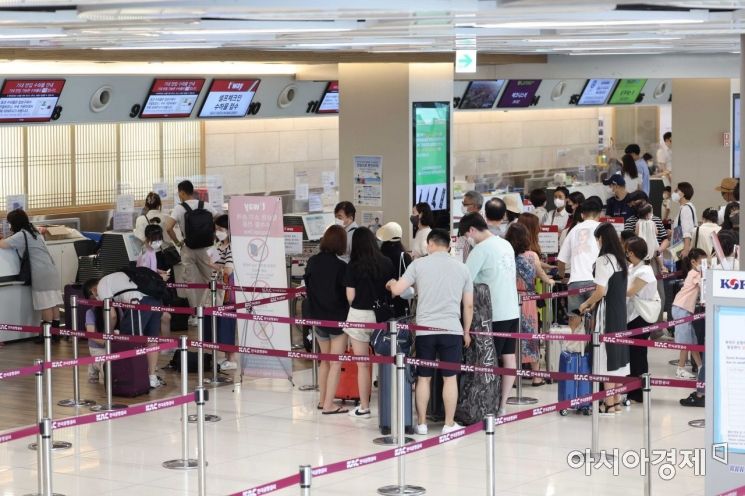
[Asia Economy Reporter Yoo Hyun-seok] Although international passenger traffic is increasing as air routes reopen, domestic low-cost carriers (LCCs) are not benefiting. Unlike the rapid growth in passengers traveling to Southeast Asia, the increase in Japan?a market that accounts for a high sales proportion?is minimal due to strict entry procedures and other reasons.
According to the aviation industry on the 9th, the combined passenger count of Jeju Air, Jin Air, and T'way Air last month was 1.75 million. This represents a 1.9% increase compared to the end of the previous month and a 10.2% increase year-on-year. The trend of increasing international passengers was steep. During this period, the number of international passengers reached 270,000, a surge of 2517.4% compared to the same period last year. It also increased by 164.8% compared to the previous month. On the other hand, domestic passengers numbered 1.48 million, a 6.4% decrease year-on-year.
This increase is thanks to the government's easing of quarantine measures. In June, the government lifted the mandatory 7-day quarantine for arrivals from overseas due to a decrease in COVID-19 cases. Restrictions on the number of aircraft arrivals per hour (slot restrictions) and curfew regulations at Incheon International Airport were also lifted. However, there are differences by route. Last month, the regional route shares for the three airlines were 11% Japan, 72% Southeast Asia, and 17% Oceania. As of July 2019, before the COVID-19 outbreak, the shares were approximately 40% Japan, 50% Southeast Asia, 8% Oceania, and 2% others.
The slow recovery of the Japan route is a disappointment for LCCs because it accounts for a significant portion of their sales. Japan was the most visited overseas destination by Koreans from 2001 to 2018. Before COVID-19, over 7 million Korean tourists traveled to Japan annually. An LCC official said, "Japan accounts for more than 20% of the total sales of LCCs, making it the second highest after Southeast Asia."
The delayed recovery of the Japan route is attributed to still strict entry procedures. Although Japan has allowed tourism, group tours are restricted. The entry process takes 2 to 3 weeks, and the requirement to obtain a visa is also cited as a deterrent to visiting Japan. This is expected to intensify competition among LCCs. NH Investment & Securities researcher Jung Yeon-seung explained, "Passenger demand recovery on short-haul major routes such as Japan and China remains slow," adding, "There are concerns about intensified competition on Southeast Asia routes where LCC supply capacity is increasing."
© The Asia Business Daily(www.asiae.co.kr). All rights reserved.
![User Who Sold Erroneously Deposited Bitcoins to Repay Debt and Fund Entertainment... What Did the Supreme Court Decide in 2021? [Legal Issue Check]](https://cwcontent.asiae.co.kr/asiaresize/183/2026020910431234020_1770601391.png)
















