Forum on the Automobile Industry Association Held
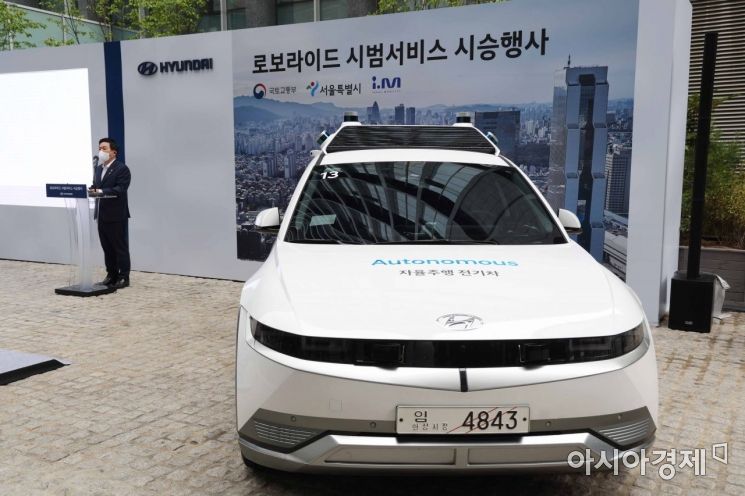 A test drive event for the autonomous vehicle 'RoboRide' was held last June at the Hyundai AutoEver headquarters. Photo by Moon Honam munonam@
[Asia Economy Reporter Kiho Sung] There has been a claim that legal and institutional improvements, such as safety standards, must be made in advance for the commercialization of Level 4 autonomous vehicles. The argument is that institutional delays could hinder the pace of technological advancement, so preparations should be made proactively.
Jo Iji, Senior Researcher at Hyundai Mobis, attended the 'Policy Forum for the Development of the Autonomous Vehicle Industry' held by the Korea Automobile Industry Association (KAIA) on the 9th at the Automobile Hall, and stated in his presentation, “South Korea has been steadily establishing laws and systems related to autonomous vehicles, such as Level 3 safety standards and the Autonomous Vehicle Act, but to secure a leading position in the autonomous vehicle market, more investment and active collaboration between the government and companies are necessary.”
Researcher Jo emphasized, “For continuous improvement rather than one-time efforts, systematic research on autonomous vehicle operation considering various conditions (weather, external pedestrian safety, etc.) should be conducted and used as foundational data to ensure safety.” He also argued, “In addition to the current considerations, it is necessary to review ethical issues, protection of external pedestrians, data utilization and privacy protection, and measures to ensure safety and reliability throughout the autonomous vehicle’s life cycle.”
Hyunseong Shin, Officer at the Ministry of Land, Infrastructure and Transport, said in his presentation, “In preparation for the era of fully autonomous vehicles, we will promptly establish a Level 4 autonomous vehicle performance certification system and actively expand infrastructure such as communication and high-precision road maps.” He added, “In particular, we will support the creation of autonomous mobility services by significantly expanding pilot operation zones where the private sector can freely demonstrate autonomous driving technology and provide transportation services.”
Jung Manki, Chairman of KAIA, stated in his greeting, “South Korea’s technology is lagging behind leading countries like the United States and China in Level 4 autonomous vehicles.” He pointed out, “For example, Hyundai only began pilot autonomous vehicle services in the Gangnam district in June, and other companies’ pilot projects are limited to ‘route-based’ operations on fixed routes, so urgent regulatory relaxation and institutional improvements are needed to expand research and development (R&D) and accumulate driving data to reduce the gap with leading countries.”
Chairman Jung continued, “To achieve the commercialization of Level 4 public transportation by 2025 and full commercialization by 2027, bold government support measures are necessary, including expanded public-private investment and the establishment of large-scale autonomous vehicle pilot operation areas.”
© The Asia Business Daily(www.asiae.co.kr). All rights reserved.

















