7 Deaths and 6 Missing in Seoul and Gyeonggi, 107 Displaced Households, 751 Flooded Houses and Shops
Line 7 Isu Station Flooded, Sillim Line Operating Without Stops... Traffic Controls on Nodeul-ro Yeoui Sangryu∼Hangang Bridge Both Directions, Dongbu Expressway, and More
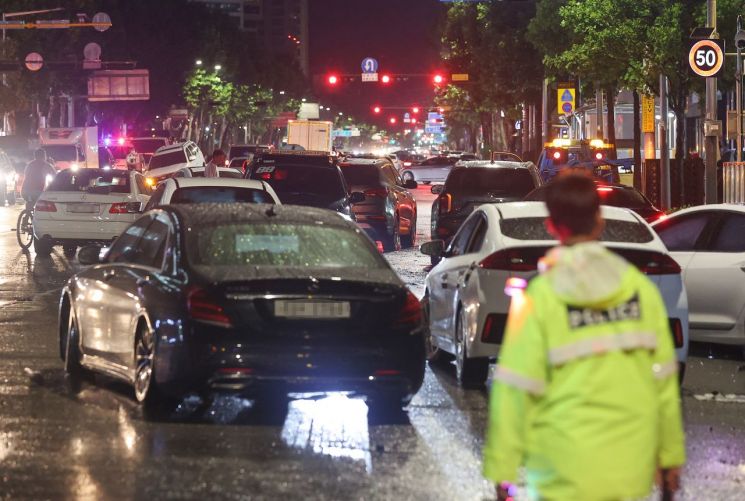
[Asia Economy Reporter Lim Cheol-young] Seven people have died and six are missing due to record-breaking heavy rain centered around the Seoul metropolitan area for the first time in 80 years, causing continuous casualties and disruptions such as subway operation delays. As of 1 a.m. on the 9th, the Ministry of the Interior and Safety raised the Central Disaster and Safety Countermeasures Headquarters (CDSCH) emergency level from Level 2 to Level 3 and upgraded the crisis alert from 'Warning' to 'Severe'.
According to the CDSCH, as of 6 a.m. on the same day, the human casualties from the heavy rain in the metropolitan area were recorded as 7 deaths (5 in Seoul, 2 in Gyeonggi) and 6 missing persons. Additionally, there were facility damages such as landslides, embankment collapses, and subway track flooding. Twenty-six riverside parking lots and 45 riverside areas are currently under control.
In Gwanak-gu, Seoul, three people trapped in a semi-basement due to flooding at 9:07 p.m. on the 8th reported but ultimately died. Two were identified as 46 years old, and one was 13 years old. Earlier, at 6:50 p.m. in Dongjak-gu, Seoul, a 60-year-old district office employee who was clearing fallen street trees due to heavy rain was presumed to have died from electric shock. Also, at 5:40 p.m. in Dongjak-gu, one person died due to house flooding.
In Gwangju, Gyeonggi Province, one person was found dead under the debris of a collapsed bus stop, and another was confirmed dead due to landslide burial on a road slope. Missing persons include four in Seoul, such as in the underground shopping mall passage in Seocho-gu, and two in Gwangju, Gyeonggi, swept away by rapid currents caused by river flooding.
The number of disaster victims is also increasing. In Seoul, Incheon, and Gyeonggi, 163 people from 107 households have been affected, and 155 people from 102 households have not returned home. The number of temporarily evacuated households is 165 households with 273 people, with about 260 people still unable to return home. Damage to houses and commercial buildings includes 751 cases (Seoul 684, Incheon 54, Gangwon 2, Gyeonggi 1), retaining wall collapses 3 cases (Incheon 1, Seoul 2), and soil erosion 5 cases (Seoul 4, Gyeonggi 1).
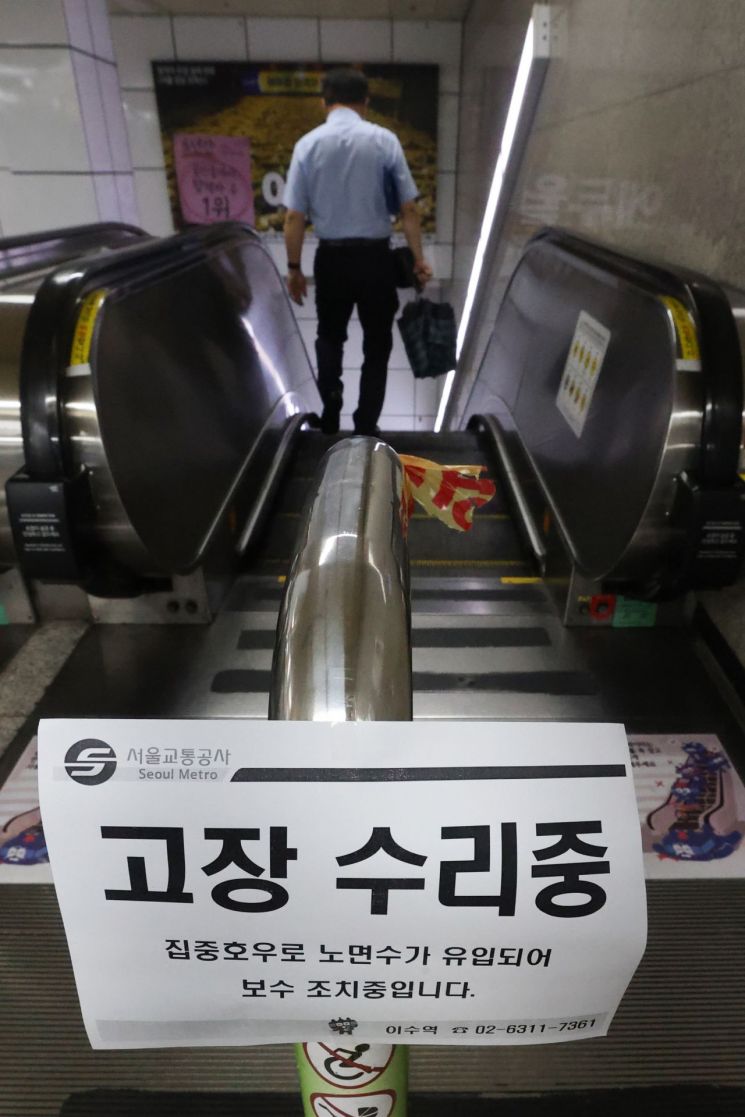
Earlier, subway operations were also disrupted. Following flooding at Isu Station on Line 7 the previous day, leaks occurred at Samsung Station and Sadang Station on Line 2, as well as Daechi Station on Line 3, Sangdo Station and Gwangmyeongsageori Station on Line 7. The newly opened Sillim Line operated without stopping due to flooding at Seowon Station. After Yeongdeungpo Station in Seoul was flooded, southbound operations on Line 1 were completely suspended, and flooding at Oryu Station on the Gyeongin Line caused train delays.
Meanwhile, as very heavy rain exceeding 50 to 100 mm per hour accompanied by thunder and lightning is expected mainly in the metropolitan area, the CDSCH upgraded the emergency level from Level 2 to Level 3 at 1 a.m. and raised the crisis alert level from 'Warning' to 'Severe'. Lee Sang-min, head of the CDSCH, instructed related ministries, local governments, and affiliated organizations to strengthen emergency work systems and focus all efforts on preparing for heavy rain.
The Seoul Metropolitan Government, where damage is concentrated, is operating disaster prevention situation rooms in all 25 districts. Mayor Oh Se-hoon returned urgently to City Hall at 9:55 p.m. the previous day, visited the Flood and Wind Disaster Countermeasures Situation Room, received reports on flooding damage caused by the heavy rain, and encouraged the staff on duty.
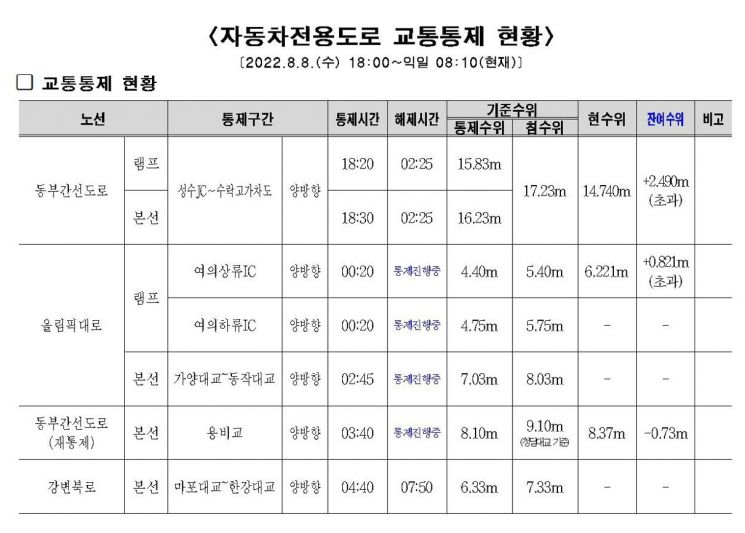
Due to road flooding caused by the heavy rain, Seoul city has been controlling traffic in both directions on Nodeul-ro from Yeoui upstream to Hangang Bridge since 7:07 a.m. today. The number of general city roads under two-way control has increased to eight, including Eonju-ro Gaepo Underpass and Yangjae-daero under Yangjae Bridge. The urban expressways under two-way control include Banpo-daero Jamsugyo, Olympic-daero from Yeoui downstream to Yeoui upstream, Dongbu Expressway from Seongsu Junction to Gunja Bridge, and the Inner Circular Road section from Seongdong to Majang.
© The Asia Business Daily(www.asiae.co.kr). All rights reserved.
![Clutching a Stolen Dior Bag, Saying "I Hate Being Poor but Real"... The Grotesque Con of a "Human Knockoff" [Slate]](https://cwcontent.asiae.co.kr/asiaresize/183/2026021902243444107_1771435474.jpg)













