Road Controls in the Seoul Metropolitan Area: 10 Locations in Seoul, 70 in Gyeonggi, 2 in Incheon
Subway Line 9 Operating Only Regular Trains... Some Sections Suspended
Fatal Accidents Overnight: 7 Dead, 6 Missing
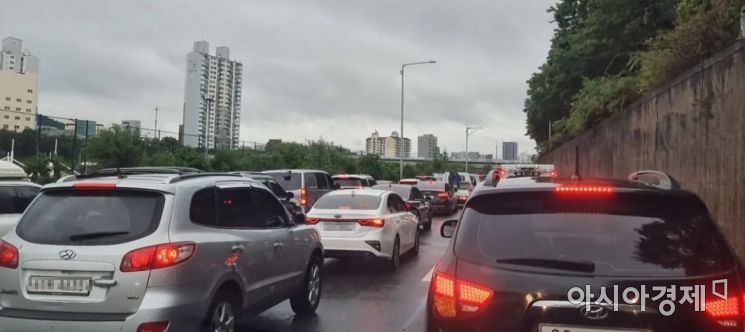 On the morning of the 9th, when record-breaking heavy rain poured down, the roads around Jangpyeonggyo Bridge in Gwangjin-gu, Seoul, were congested with vehicles heading to work. Photo by a reader
[Asia Economy Reporters Yoo Byung-don and Jang Se-hee] Due to the record-breaking heavy rain that fell overnight, many roads, especially in the southern part of the Han River in Seoul, have been flooded, causing traffic restrictions and raising concerns about chaos during the morning commute.
According to Seoul City and the Central Disaster and Safety Countermeasures Headquarters (CDSCH), due to concentrated heavy rain in the upper Han River area, both directions of the Gangbyeonbuk-ro from Mapo Bridge to Hangang Bridge have been completely closed since 4:40 a.m. on the 9th. Earlier, from 2:45 a.m., the Olympic-daero section from Yeomchang IC to the National Cemetery was also fully closed.
The same applies to the Dongbu Expressway from Seongsu JC to Gunja Bridge and the Naebu Circular Road from Majang Ramp to Seongdong IC. As the Han River water level rose sharply, Olympic-daero is also closed between Yeomchang IC and the National Cemetery. The Jamsu Bridge under Banpo Bridge is also closed to vehicles in both directions. The Dongbu Expressway is closed in the direction from Seongsu to Uijeongbu.
The National Police Agency reported that 10 roads in Seoul are currently closed. In addition, 82 roads in the metropolitan area are closed, including 60 locations such as Gwangmyeong Intersection in southern Gyeonggi, 10 locations such as Guri Wangsukcheon Road in northern Gyeonggi, and 2 locations including the underpass of Gyeongin Expressway in Incheon.
Seoul Subway Line 9 has suspended express train operations due to flooding recovery work on some station tracks and is operating all trains as local trains. Train operations are only running between Gaehwa Station and Noryangjin Station, and between Sinnonhyeon Station and Central Veterans Hospital Station. The section between Noryangjin Station and Sinnonhyeon Station is suspended due to flooding at Dongjak Station and Gubanpo Station. Fortunately, all lines from 1 to 8 operated by Seoul Metro, as well as the Ui-Sinseol Line and Sillim Line, are operating normally from the first train.
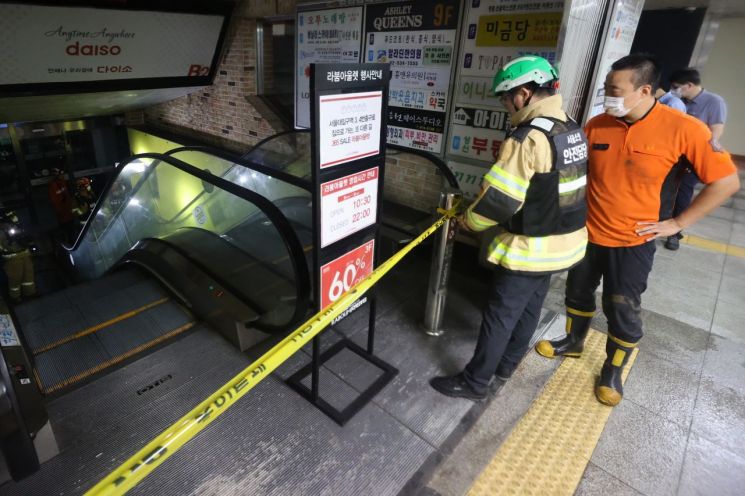
Accordingly, confusion is expected to continue during the morning commute following the "desperate escape" chaos during the previous evening rush hour. Office worker Kim (40) said, "I have to go from Suwon to Gangnam Station, but the interval between express buses is delayed by about 10 minutes compared to usual," adding, "Subway stations are flooded in many places, so I am worried about the commute."
Some companies in the Gyeonggi area have decided to suspend shuttle bus operations between Seoul and their offices for the day. Son, an employee at a game company in Pangyo (31), said, "I received a text message saying shuttle bus operations are suspended due to road conditions," and added, "There has been no notice about switching to remote work yet, so I set out for work, but I feel helpless."
Previously, in Sindaebang-dong, Dongjak-gu (Korea Meteorological Administration), 141.5 mm of rain fell in one hour until 9:05 p.m. the previous day, with hourly rainfall exceeding 100 mm mainly in southern Seoul. This surpassed the previous highest hourly rainfall record in Seoul of 118.6 mm (August 5, 1942) for the first time in 80 years. According to the Korea Meteorological Administration, as of 6 a.m. on the 9th, rainfall in the central region was Seoul 421.0 mm, Okcheon (Yangpyeong) 392.0 mm, Sanbuk (Yeoju) 385.5 mm, and Gyeonggi Gwangju 385.5 mm.
As a result, various incidents and accidents caused by flooding occurred throughout the metropolitan area. Water leakage occurred at Samsung Station, Sadang Station, Seolleung Station on Line 2, Daechi Station on Line 3, Sangdo Station and Isu Station on Line 7, and Gwangmyeong Intersection Station. Line 9’s Dongjak Station was flooded and closed, and Line 1’s Yeongdeungpo Station suspended all southbound operations.
As rain concentrated in the Gangnam area around 8 p.m., hundreds of vehicles were submerged, causing chaos. Around 8 p.m., rainwater rose more than 30 cm on the road lanes near Gangnam Station on Subway Line 2, overflowing onto sidewalks, and rainwater backflowed through manholes near the Shinbundang Line.
Many underground shopping areas at Gangnam Station and Express Bus Terminal Station were flooded, and some stores in COEX Mall in Samseong-dong and Pamier Station in Banpo-dong were submerged. Users shared damage situations and future countermeasures on online communities and social networking services (SNS).
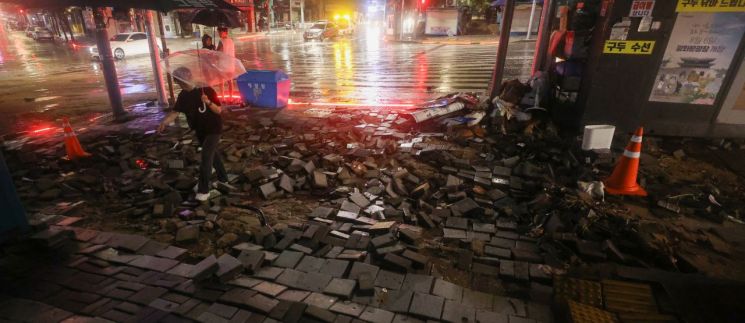
There were also casualties due to the heavy rain. The CDSCH reported that as of 6 a.m. on the 9th, the human toll from this heavy rain was 7 dead (5 in Seoul, 2 in Gyeonggi), 6 missing (4 in Seoul, 2 in Gyeonggi), and 9 injured (Gyeonggi).
In Dongjak-gu, Seoul, a 60-year-old district office worker died from electric shock while clearing fallen street trees caused by heavy rain around 6:50 p.m. the previous day. In Gwanak-gu, three people trapped in a semi-basement due to flooding reported at 9:07 p.m. were eventually found dead. In Gwangju, Gyeonggi, one person was found dead under debris from a collapsed bus stop, and another died from landslide burial on a road slope. Missing persons include four in Seoul, such as in the underground shopping passage in Seocho-gu, and two in Gwangju, Gyeonggi, swept away by rapid river flooding.
Due to the rapid river currents, 88 people were rescued by emergency responders, and 313 reports of obstacle removal such as fallen street trees were made. Additionally, 751 houses and commercial buildings were flooded in Seoul, Incheon, Gangwon, and Gyeonggi areas, with property damage including 4 retaining wall collapses, 5 landslides, 2 vehicle damages, 8 vehicle floods, 2 embankment failures, and 5 slope failures.
In Seoul, Incheon, and Gyeonggi areas, 107 households and 163 disaster victims have been displaced, staying in nearby schools, gymnasiums, and lodging facilities. Furthermore, 165 households and 273 people temporarily evacuated to prevent damage.
© The Asia Business Daily(www.asiae.co.kr). All rights reserved.



















