10 Policy Goals... 25 Policy Tasks and 80 Implementation Tasks
Expansion of High School Equalization and Establishment of Semiconductor Meister High School 추진
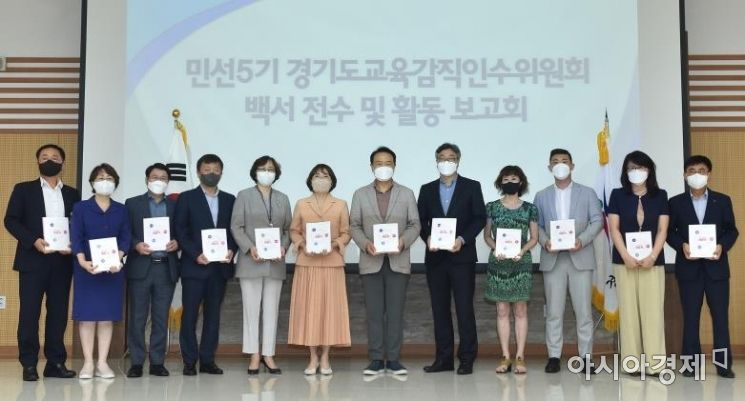 Gyeonggi Provincial Office of Education Superintendent Transition Committee, White Paper Delivery and Activity Results Report Meeting [Gyeonggi Provincial Office of Education]
[Asia Economy Reporter Ra Young-cheol] Gyeonggi-do's education policies will be reorganized to be 'self-directed' under Superintendent Im Tae-hee's administration.
The Gyeonggi-do Superintendent of Education Transition Committee held a white paper delivery and a report meeting on the committee's activities on the 8th, stating, "We have set 10 policy goals and published a white paper that includes detailed contents and implementation schedules of 25 policy tasks and 80 promotion tasks."
The 10 major policy goals are ▲ AI (Artificial Intelligence)-based education ▲ Glocal (Global + Local) convergence talent development ▲ Student-tailored vocational and career education ▲ Education that leaves no one behind ▲ Active support for teachers ▲ Restructuring of innovative education ▲ Resolution of political and ideological bias ▲ Strengthening of care, early childhood education, and after-school programs ▲ Protection of health for students and staff ▲ Establishment of a future-oriented educational administrative system.
Among these, to foster glocal convergence talents, the IB (International Baccalaureate) program will be introduced to establish an educational system that pursues learners' self-directed growth. IB is an internationally certified school education program developed and operated by the non-profit educational foundation IBO headquartered in Switzerland.
To strengthen the DQ (Digital Quotient) capabilities of students and teachers, a DQ curriculum will be developed and schools focusing on this education will be operated.
In the field of student-tailored vocational and career education, the establishment of semiconductor Meister high schools will be promoted in semiconductor cluster industrial complex areas such as Yongin to intensively nurture semiconductor personnel.
In particular, policies promoted by progressive superintendents over the past 13 years will be revised or restructured into 'Future Schools.' 'Future Schools' are school support systems that enhance the professionalism of classes and focus on Gyeonggi education aligned with new goals and visions.
Dream Schools, Dream Universities, and Mongsil Schools will be integrated into a 'Future Education Platform' through public-private-academic cooperation networks.
High school equalization will be expanded with the intention of providing students with the right to choose schools so they can receive education suited to their talents and aptitudes.
Additionally, the white paper includes plans to expand care for elementary school students, introduce an efficient school violence management system, and promote the establishment of education support offices in all cities and counties.
The transition committee published a white paper summarizing about 50 days of activities from June 13 to the end of last month and delivered it to Superintendent Im Tae-hee on the day.
The white paper production involved about 230 people divided into 10 subcommittees, including Transition Committee Chairman Lee Joo-ho, two other committee members, professional members, working members, and external advisory members.
Chairman Lee Joo-ho said, "I hope the educational directions and implementation tasks proposed by the transition committee will become education that satisfies students, teachers, and parents."
Superintendent Im said, "In the process of designing and implementing the proposed contents, we will create a process where any resident of the province can present opinions and engage in sufficient discussion."
© The Asia Business Daily(www.asiae.co.kr). All rights reserved.

















