Ministry of Land, Infrastructure and Transport's '2021 Survey on Mobility Convenience for Transportation-Disadvantaged' Results
1 in 3 People in the Total Population... Increased Need for Policy Implementation
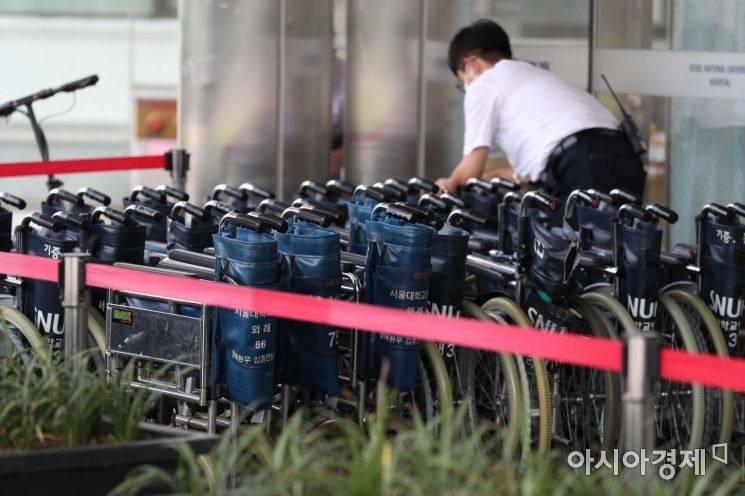 A staff member is organizing wheelchairs at Seoul National University Hospital in Jongno-gu, Seoul. Photo by Moon Honam munonam@
As the domestic population peaked and began to decline, the number of transportation-vulnerable individuals has significantly increased. Transportation-vulnerable individuals refer to people who experience difficulties in mobility in daily life, including persons with disabilities, the elderly, pregnant women, people accompanied by infants and young children, and children.
According to the results of the "2021 Transportation-Vulnerable Mobility Convenience Survey" announced by the Ministry of Land, Infrastructure and Transport on the 8th, as of the end of last year, the number of transportation-vulnerable individuals in Korea was estimated at 15.51 million, about 30% of the total population (approximately 51.64 million), meaning about 3 out of 10 people.
The survey is conducted annually under Article 25 of the "Act on the Promotion of Mobility Convenience for Transportation-Vulnerable Persons" to serve as basic data for establishing policies to improve mobility convenience for transportation-vulnerable individuals. The 2021 survey was conducted nationwide for the first time in five years since 2016.
By category, following the aging trend, the elderly (65 years and older) accounted for the highest proportion at about 8.85 million (57.1%), followed by children (20.7%, 3.21 million), persons with disabilities (17.1%, 2.64 million), companions of infants and young children (12.5%, 1.94 million), and pregnant women (1.7%, 260,000).
The number of transportation-vulnerable individuals increased by about 800,000 compared to 2016 (14.71 million). While the total domestic population decreased by about 60,000 (0.1%) during the same period, the number of transportation-vulnerable individuals increased significantly (about 7%). The need and urgency for policies promoting mobility convenience for transportation-vulnerable persons are inevitably increasing.
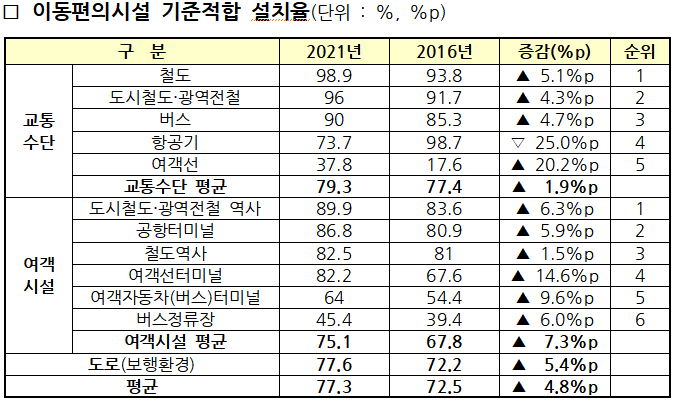
In 2021, the standard compliance installation rate of mobility convenience facilities for transportation means, passenger facilities, and roads (pedestrian environments) nationwide was surveyed at 77.3%. This is an increase of 4.8 percentage points compared to the previous survey in 2016.
By category, the standard compliance installation rate was highest for transportation means such as buses, railways, and aircraft at 79.3%, followed by passenger facilities such as bus terminals, urban railway stations, and airports at 75.1%, and roads (pedestrian environments) such as sidewalks and overpasses at 77.6%.
The best standard compliance rates among transportation means and passenger facilities were railway vehicles (98.9%) and urban/metropolitan railway stations (89.9%), respectively, and most mobility convenience facility compliance rates increased compared to 2016.
However, the 2021 standard compliance rate for aircraft was 73.7%, showing a significant decrease (-25.0 percentage points) compared to the 2016 survey. This is believed to be due to the increase in low-cost carriers (LCCs), which have relatively lower compliance rates compared to full-service carriers (FSCs), and the increase in the number of such aircraft.
On the other hand, the 2021 standard compliance rate for passenger ships was the lowest among transportation means and passenger facilities at 37.8%, but it increased by 20.2 percentage points compared to 2016 (17.6%) due to government initiatives such as the installation of mobility convenience facilities on passenger ships.
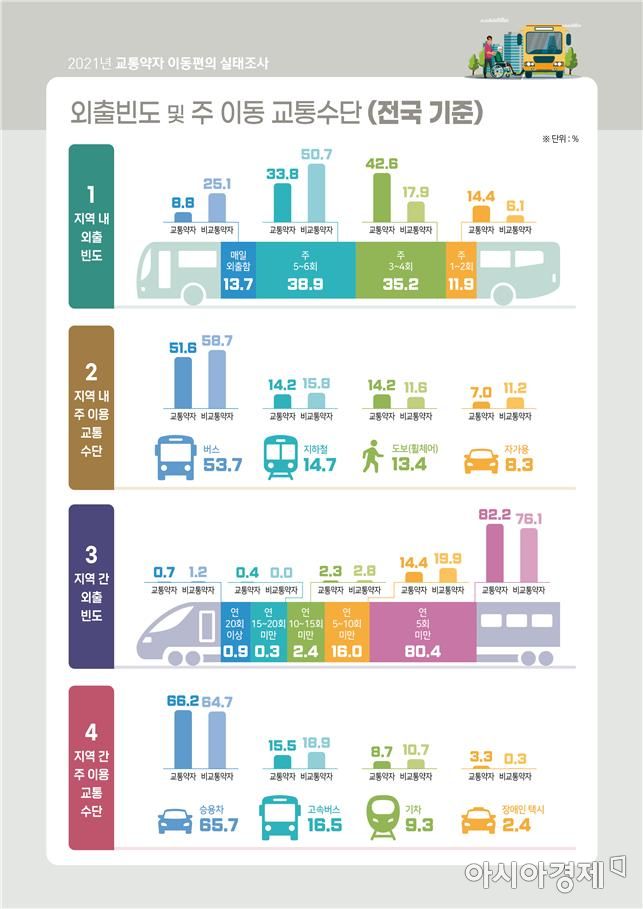
Regarding the usage status of transportation means by transportation-vulnerable individuals during travel, the highest response rate for intra-regional travel was public transportation such as buses (51.6%) and subways (14.2%), while for inter-regional travel, private cars (66.2%) were most commonly used.
However, usage patterns varied somewhat by type of transportation-vulnerable individual. For intra-regional travel, the elderly had a high proportion of walking (17.3%) in addition to public transportation, whereas persons with disabilities had higher usage rates of disability taxis (10.7%) and special transportation means (7.1%) compared to other transportation-vulnerable groups.
For inter-regional travel, the elderly used private cars (57.9%) as well as public transportation such as intercity and express buses (24.7%) and trains (12.3%) frequently. Persons with disabilities, however, showed high usage rates of private cars (63%), public transportation (intercity and express buses 10.7%, trains 8.1%), as well as disability taxis (8.1%) and special transportation means (5.3%).
Meanwhile, a satisfaction survey on mobility convenience facilities was conducted among 3,000 general users and transportation-vulnerable individuals who have experience using passenger facilities and transportation means. The overall satisfaction score was 70.6 points, an increase of 7.6 points compared to 63.0 points in 2016. Satisfaction by transportation means was highest for railways at 80.2 points, followed by urban/metropolitan railways at 79.0 points, and aircraft at 76.7 points.
In the previous survey, aircraft had the highest satisfaction score (70.0 points), but in the 2021 survey, it ranked third, likely due to restrictions on aircraft use caused by the COVID-19 pandemic.
Yoon Jin-hwan, Director General of Comprehensive Transportation Policy at the Ministry of Land, Infrastructure and Transport, stated, "While the total domestic population is decreasing, the population of transportation-vulnerable individuals continues to increase," adding, "We will actively recommend that relevant transportation administrative agencies improve any deficiencies to ensure that transportation-vulnerable individuals do not experience inconvenience in mobility."
© The Asia Business Daily(www.asiae.co.kr). All rights reserved.
![Clutching a Stolen Dior Bag, Saying "I Hate Being Poor but Real"... The Grotesque Con of a "Human Knockoff" [Slate]](https://cwcontent.asiae.co.kr/asiaresize/183/2026021902243444107_1771435474.jpg)


















