[Asia Economy Reporter Kim Daehyun] The number of criminal retrial petitions and related acquittals in courts nationwide has surged.
According to the Supreme Court on the 9th, the total number of retrial applications received by courts nationwide last year (based on first-instance criminal trial cases) was 1,688, an increase of 572 from the previous year (1,116). This is a different trend from the continuous decline after recording 2,056 in 2016. The number of 'acquittal cases' related to this also sharply increased to 426 last year, compared to around 100 cases annually.
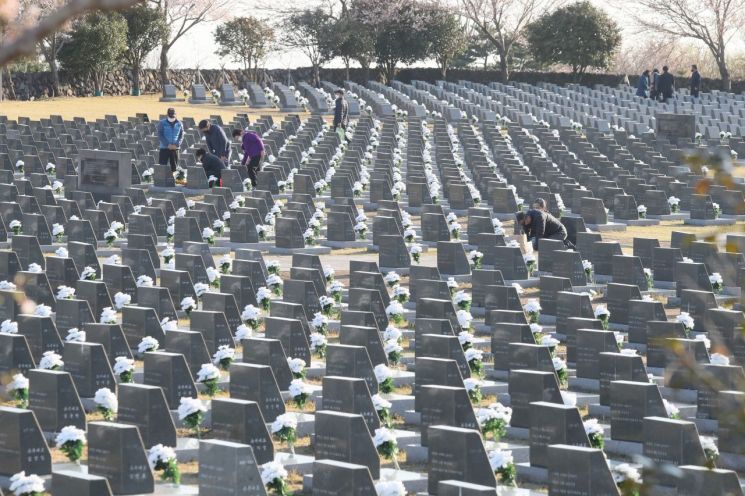
The legal community analyzes that this change is largely influenced by retrials related to the Jeju 4·3 Incident. The requirements and procedures for retrials have long been criticized for being excessively strict and complicated. A court administration official said, "Acquittals in retrials have increased due to the 4·3 Incident. The charges include crimes of rebellion under the Criminal Act and violations of the National Defense Security Act," adding, "81% of the cases acquitted in retrials at the first instance are related to the 4·3 Incident."
In particular, in March last year, the Criminal Division 2 of Jeju District Court (Presiding Judge Jang Chansu) acquitted 335 prisoners who were wrongfully imprisoned due to the 4·3 Incident. Except for two surviving prisoners, most of the trials were attended by their bereaved families. At that time, the court stated, "During a period when the state had not yet established a complete identity, the defendants lost their lives amid extreme ideological conflicts, and their families lived trapped under the collateral punishment system," adding, "We hope that this burden will be lifted so that they can sit together comfortably and share affection in the future." The court further said, "We also hope this day will be a pledge to prevent such incidents from happening again."
The trend of increasing criminal retrial petitions and acquittals is expected to continue this year. Earlier, the amendment to the 'Special Act on the Investigation of the Jeju 4·3 Incident and the Restoration of Honor for Victims (4·3 Incident Act)' was passed by the National Assembly in March last year. Prisoners who were sentenced through military trials during the 4·3 Incident can now restore their honor through special retrials and receive compensation for damages. Subsequently, the Committee for the Investigation of the Jeju 4·3 Incident and the Restoration of Honor for Victims recommended the Ministry of Justice to file a batch ex officio retrial petition for all 2,530 prisoners according to the amendment. To support retrial petition work, the Ministry of Justice established the 'Jeju 4·3 Incident Ex Officio Retrial Recommendation Joint Task Force' under the Gwangju High Prosecutors' Office. The Jeju District Court also newly established the Criminal Division 4-1 and 4-2 as dedicated retrial divisions for the 4·3 Incident earlier this year. The presiding judge of the dedicated divisions is Chief Judge Jang Chansu, who has been handling retrial cases of this incident for over two years since 2020.
The 'Jeju 4·3 Incident' refers to the armed conflict and suppression between the armed forces of the South Korean Labor Party and government troops from the shooting incident during the March 1st Independence Movement Day ceremony in 1947 until the lifting of the Hallasan mountain curfew on September 21, 1954, during which many civilians were sacrificed. It is tentatively reported that between 14,000 and 30,000 people were killed or went missing.
© The Asia Business Daily(www.asiae.co.kr). All rights reserved.
![Clutching a Stolen Dior Bag, Saying "I Hate Being Poor but Real"... The Grotesque Con of a "Human Knockoff" [Slate]](https://cwcontent.asiae.co.kr/asiaresize/183/2026021902243444107_1771435474.jpg)
















