Cost Estimate Results for Representative Proposal by Jeong Woo-taek, People Power Party
'Wealthy Tax Cut' Controversy Likely Hard to Quell
[Asia Economy Reporter Lee Ji-eun] A cost estimate has revealed that simplifying the corporate tax brackets into three stages and lowering the top tax rate to 22% could result in a tax revenue decrease of up to 30 trillion won over five years. The government previously announced a tax reform plan to reduce the top corporate tax rate from the current 25% to 22% and simplify the tax brackets, which is expected to ignite debates over "tax cuts for the wealthy" alongside claims that "corporate investment will increase significantly" during the regular National Assembly session.
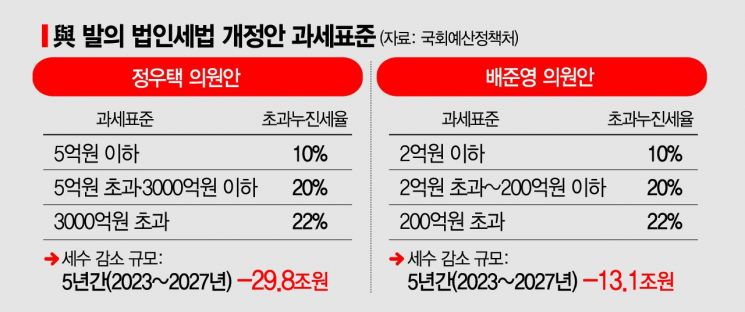
On the 8th, the National Assembly Budget Office analyzed the partial amendment bill to the Corporate Tax Act, which was jointly proposed by Representative Jeong Woo-taek of the People Power Party, and estimated that simplifying the corporate tax base brackets from four stages to three stages (under 500 million won, over 500 million won to 300 billion won, and over 300 billion won) and lowering the nominal top tax rate from 25% to 22% would reduce corporate tax revenue by a total of 29.8 trillion won over five years from next year through 2027.
The reduction in corporate tax revenue under the amendment is estimated at 600 billion won in the first year, 6.8 trillion won in 2024, 7.1 trillion won in 2025, 7.5 trillion won in 2026, and 7.8 trillion won in 2027, averaging about 6 trillion won annually. However, this differs from the government's proposed tax brackets, which are divided into under 500 million won (10%), over 500 million won to 20 billion won (20%), and over 20 billion won (22%).
Additionally, the Budget Office also estimated the cost of a Corporate Tax Act amendment bill proposed by Representative Bae Jun-young of the same party, projecting a tax revenue decrease of 13.1 trillion won over the next five years. Representative Bae's proposal lowers the top tax rate to 22% but divides the tax base into three stages: under 200 million won (10%), over 200 million won to 20 billion won (20%), and over 20 billion won (22%).
The Budget Office's cost estimates indirectly confirmed the tax revenue decrease under the government's plan. Earlier, the government projected that tax revenue could decrease by about 13 trillion won over five years on a net basis, which included reductions in income tax, comprehensive real estate tax, and other tax revenues.
As the scale of the tax cuts has been concretely confirmed, the controversy over "tax cuts for the wealthy" is expected to intensify during future National Assembly discussions. The opposition Democratic Party has already labeled the government's tax reform plan as a "tax cut for the wealthy."
In Representative Jeong's bill, small businesses with a tax base under 200 million won would see no change in taxes, while companies with a tax base over 300 billion won would experience the largest tax reductions. Similarly, in Representative Bae's bill, companies with a tax base under 300 billion won would see no tax changes, with tax reductions applying only to large corporations with a tax base over 300 billion won. This lends weight to criticisms that only large corporations are receiving tax cuts, as claimed by the opposition.
© The Asia Business Daily(www.asiae.co.kr). All rights reserved.
![Clutching a Stolen Dior Bag, Saying "I Hate Being Poor but Real"... The Grotesque Con of a "Human Knockoff" [Slate]](https://cwcontent.asiae.co.kr/asiaresize/183/2026021902243444107_1771435474.jpg)
















