Despite Growth Stagnation, Germany's Unemployment Rate Hits 40-Year Low: 'Low Growth and Low Unemployment Are Global Phenomena'
Labor Force Declines Due to Aging Population... Labor Shortage Continues as Foreign Worker Inflow Decreases Amid COVID-19

[Asia Economy Reporter Park Byung-hee] Recently in the United States, there has been intense debate over whether the economy is in a recession as GDP declines while job growth continues. However, the Wall Street Journal (WSJ) analyzed on the 7th (local time) that the phenomenon of job growth amid economic slowdown is a global trend observed in major advanced countries, attributing it to aging populations.
The U.S. economy entered a technical recession, which typically means two consecutive quarters of GDP decline, as GDP shrank in both the first and second quarters of this year. However, President Joe Biden, Treasury Secretary Janet Yellen, and Federal Reserve Chair Jerome Powell argue that the low unemployment rate and significant job growth indicate that the economy is not in a recession.
According to the employment report released by the U.S. Department of Labor on the 5th, nonfarm payrolls increased by 528,000 last month. This was more than double the market expectation of 250,000 compiled by Bloomberg. The unemployment rate also hit a record low of 3.5%, the lowest since 1969. An unemployment rate of around 3-4% is generally considered full employment.
WSJ described the current situation as a "jobful recession," contrasting it with the "jobless recovery" that followed the 2008 global financial crisis.
After the 2008 global financial crisis, despite rapid economic growth recovery due to government stimulus measures, the labor market remained in recession. Now, conversely, jobs are increasing even as growth slows.
This is also true for Germany. Although Germany's economic growth rate stagnated in the second quarter, its unemployment rate remains at the lowest level in 40 years. The Eurozone unemployment rate is at an all-time low, and New Zealand’s GDP declined in the first quarter of this year, but its current unemployment rate is 3.3%, lower than that of the U.S.
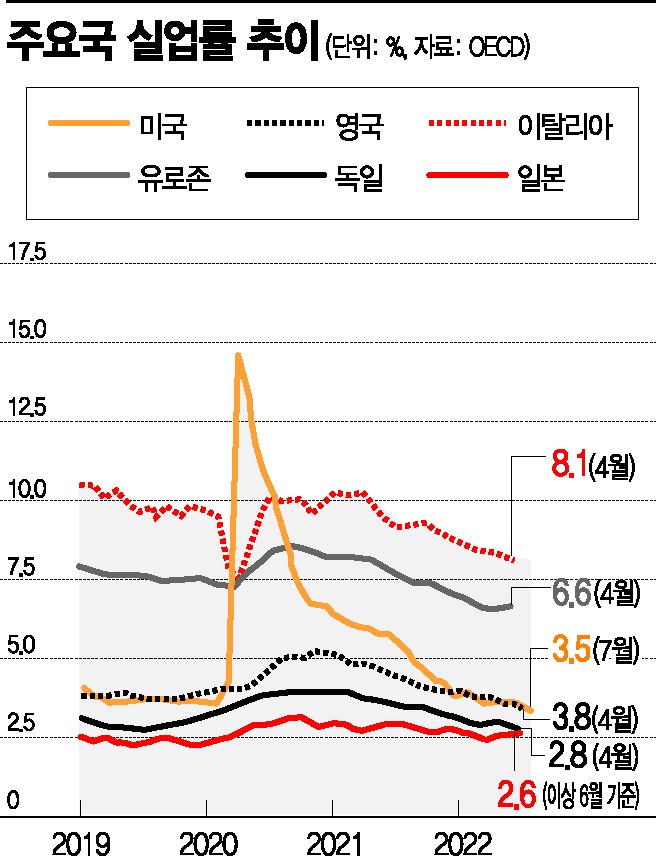
Economic experts analyze that the decline in the labor force due to aging is the reason unemployment rates remain low despite low growth. If the number of job seekers decreases due to a shrinking labor force, the unemployment rate, which is based on job-seeking activity, can remain low even in a low-growth phase.
In fact, the U.S. labor force has decreased by about 500,000 compared to February 2020, just before the COVID-19 pandemic. During the same period, Germany and the United Kingdom saw decreases of 350,000 and 550,000, respectively.
Moreover, the influx of foreign workers to fill labor shortages was limited due to COVID-19. In New Zealand, the number of foreigners entering on work visas in the year up to June 2019 was 240,000, but as of June 2021, during the pandemic, only 5,000 foreigners entered on work visas in a year.
In the U.S., the number of immigrants had already significantly decreased since 2017 during former President Donald Trump's administration. The net immigration inflow was 1 million in 2015-2016 but dropped to 250,000 in 2020-2021.
Japan serves as a clear example of low unemployment maintained during a low-growth phase. Japan is a super-aged society with nearly 30% of its population elderly. Over the past 30 years, Japan’s average economic growth rate was only 0.8%, indicating prolonged low growth, yet the unemployment rate never exceeded 5.5%. Since 2010, the unemployment rate has steadily declined and currently stands at just 2.6%.
Meanwhile, WSJ explained that as central banks including the Fed simultaneously raise benchmark interest rates and tighten liquidity, companies may reduce investments, potentially ending the current labor market boom soon.
© The Asia Business Daily(www.asiae.co.kr). All rights reserved.
![From Hostess to Organ Seller to High Society... The Grotesque Scam of a "Human Counterfeit" Shaking the Korean Psyche [Slate]](https://cwcontent.asiae.co.kr/asiaresize/183/2026021902243444107_1771435474.jpg)

















