US Adds 530,000 Jobs in July, Exceeding Expectations
Reduced Recession Concerns Boost Fed Tightening Outlook
If Another Giant Step Taken, US-Korea Interest Rate Gap Widens
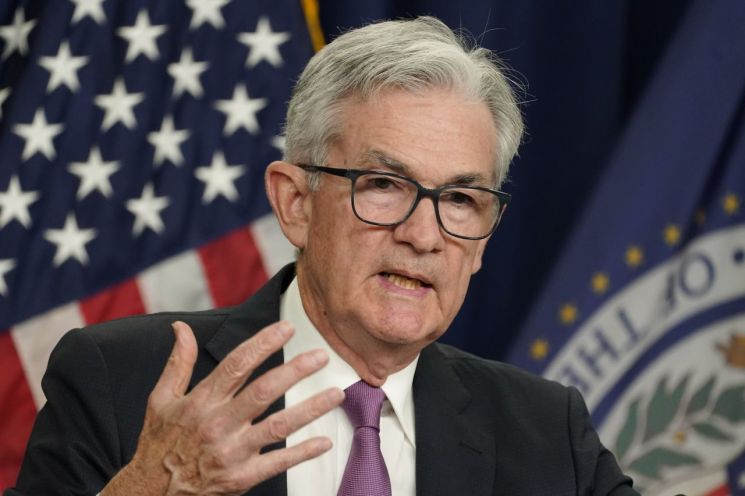 Jerome Powell, Chairman of the U.S. Federal Reserve (Fed), is holding a press conference after concluding the Federal Open Market Committee (FOMC) regular meeting at the Federal Reserve headquarters in Washington DC on the 27th of last month (local time). [Image source=Yonhap News]
The U.S. labor market remains strong, reinforcing the analysis that the Federal Reserve (Fed) will continue its aggressive monetary tightening. Initially, many in the market expected the Fed to raise interest rates by 0.5 percentage points in September, but with the U.S. economy proving resilient, there is now speculation that the Fed could implement a third consecutive 'giant step' (a 0.75 percentage point increase in the benchmark interest rate). With the Korea-U.S. interest rate differential already inverted, the Bank of Korea (BOK) is expected to face increased deliberation when deciding the size of its rate hike on the 25th.
On the 5th (local time), U.S. President Joe Biden, in a statement regarding the Labor Department's employment and unemployment statistics, highlighted that 642,000 manufacturing jobs have been created since he took office, emphasizing that "more people are working now than at any other time in U.S. history."
This underscores the strength of the U.S. grassroots economy amid growing concerns of a recession triggered by the Fed's rapid interest rate hikes to combat soaring inflation.
The U.S. Labor Department reported in its July employment situation report that nonfarm payrolls increased by 528,000 last month. This figure is more than double the 250,000 jobs forecasted by experts surveyed by Bloomberg News, completely shattering market expectations that employment would slow and a recession would begin. Following the U.S. Commerce Department's announcement on the 28th of last month that second-quarter GDP growth was -0.9%, markets had anticipated a softening of Fed tightening, leading to stock market gains and a weaker dollar.
The unexpected strength of the U.S. labor market also suggests that the Fed may raise interest rates further to control inflation. This means the Fed could focus on price stability without worrying about a recession and implement a significant rate hike at the upcoming Federal Open Market Committee (FOMC) meeting next month. Major foreign media outlets such as The Wall Street Journal (WSJ) analyzed on the same day that "the central bank is increasingly likely to conclude that it must raise rates to a higher level and keep them there longer to cool the overheated economy."
Recently, key Fed officials have also made hawkish remarks. Cleveland Fed President Loretta Mester said at an event hosted by the Pittsburgh Economic Club on the 4th (local time) that "the Fed should focus on preventing inflation for the time being and raise rates to 4%." San Francisco Fed President Mary Daly also expressed confusion in an interview about bond market movements that weigh the possibility of a rate cut in the first half of next year.
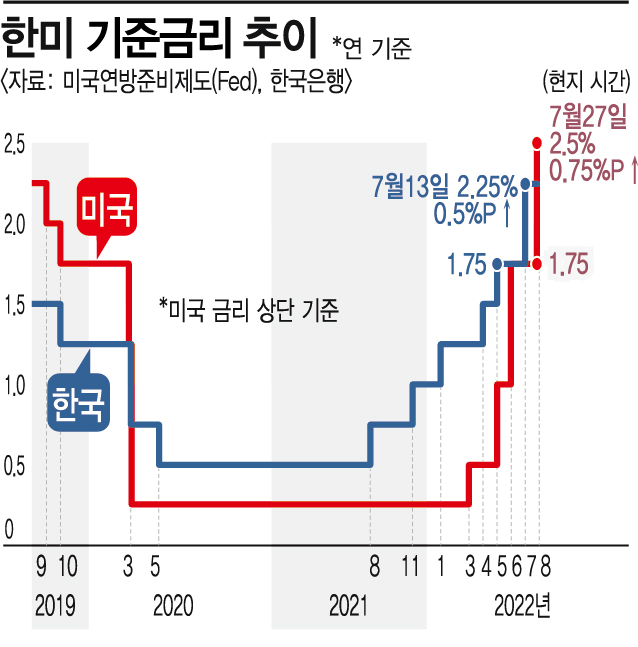
If the U.S. continues its aggressive tightening, the burden on the South Korean economy will inevitably increase. The Fed recently raised its benchmark interest rate by 0.75 percentage points from 1.50-1.75% to 2.25-2.50%, causing the U.S. rate to surpass South Korea's benchmark rate (2.25%), resulting in an inversion. While the BOK and the government emphasize, citing past cases, that the impact of the Korea-U.S. rate inversion on the Korean financial market is limited, if the gap widens further, the possibility of side effects such as capital outflows cannot be completely ruled out.
In particular, the BOK has announced its intention to gradually raise interest rates for the time being. At the National Assembly's Planning and Finance Committee full session on the 1st, BOK Governor Lee Chang-yong stated that "it is desirable to raise the benchmark interest rate by 0.25 percentage points to ease inflationary pressures," dismissing the possibility of a 'big step' (a 0.50 percentage point increase). Governor Lee mentioned that a big step could be taken if inflation trends deviate from expectations, but he set the timing for such a decision as 'October,' making a 0.25 percentage point hike this month highly likely.
If the BOK raises the benchmark interest rate by 0.25 percentage points as expected at the Monetary Policy Committee meeting on the 25th, the Korea-U.S. benchmark rates will be equalized at 2.50%. However, if the U.S. takes a giant step next month, the interest rate gap between the two countries will widen again to 0.5 percentage points.
© The Asia Business Daily(www.asiae.co.kr). All rights reserved.


















