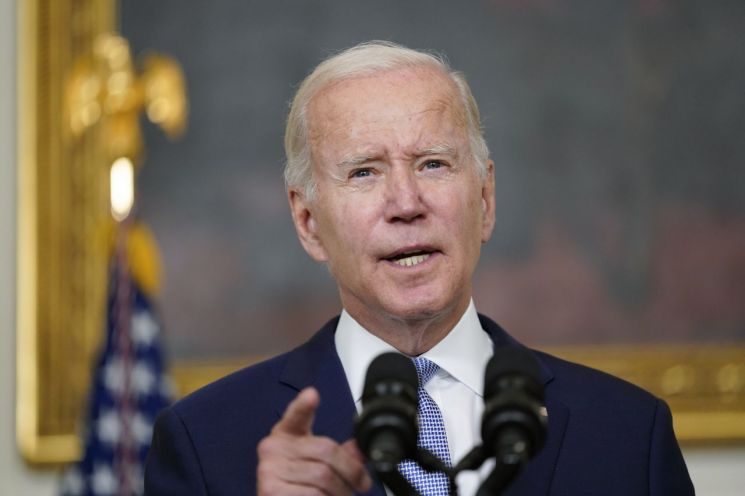
 US President Joe Biden held a press conference on the Inflation Reduction Act at the White House in Washington, DC, on the 28th of last month (local time).
 [Image source=Yonhap News]
[Asia Economy Reporter Kim Daehyun] Hundreds of American economists have expressed opposition, stating that the 'Inflation Reduction Act' promoted by President Joe Biden could have adverse effects.
According to Fox Business on the 4th (local time), they conveyed this view in a letter sent to the leadership of the U.S. Congress's House and Senate. Contrary to the Democratic Party's claims, they believe the related bill will rather fuel inflation and impose a burden on the U.S. economy.
Signatories include Vernon Smith, co-recipient of the 2002 Nobel Prize in Economics, Kevin Hassett, former chairman of the Council of Economic Advisers (CEA), and Jim Miller, former director of the Office of Management and Budget (OMB). While agreeing on the urgent need to address inflation, the scholars warned that this bill would have the opposite effect.
The bill aims to combat climate change through evaluations of electric vehicles and eco-friendly energy, and to reduce drug prices and energy costs. It also requires large corporations to pay more federal taxes.
The U.S. administration emphasizes that if this bill, which includes approximately $430 billion (562.44 trillion won) in government spending, passes, it will reduce the burden on middle-class families suffering from inflation.
However, the scholars pointed out that "it will play no role in reducing inflation and instead will perpetuate fiscal policy errors that have contributed to the current difficult economic situation." They also expressed concerns that "the government spending contained in the bill will immediately add inflationary pressure through demand stimulation" and from the supply side, "tax increases will hinder investment." They further argued that the provisions related to prescription drugs act as 'price controls,' which would stifle innovation in the healthcare sector.
Facing record inflation and the upcoming midterm elections in November, President Biden and the Democratic Party are making an all-out effort to pass the bill. However, the Republican Party is not actively supporting the bill's passage.
Generally, for a bill introduced in the Senate to pass, 60 votes out of 100 are required, but the Senate Budget Committee chair can exercise reconciliation powers to pass it with a simple majority. Currently, the U.S. Senate is evenly split with 50 seats each for the Democrats and Republicans, and in the event of a tie, the Vice President, who is the ex officio Senate President, casts the deciding vote. After passing the Senate, if the bill passes the House where the Democrats hold the majority, it will be enacted upon President Biden's signature.
© The Asia Business Daily(www.asiae.co.kr). All rights reserved.

















