[Asia Economy Reporter Park Sun-mi] As the United States is increasing its containment measures against China by considering restrictions on semiconductor equipment exports to China, the situation has become difficult for Korean semiconductor companies that have semiconductor manufacturing plants in China.
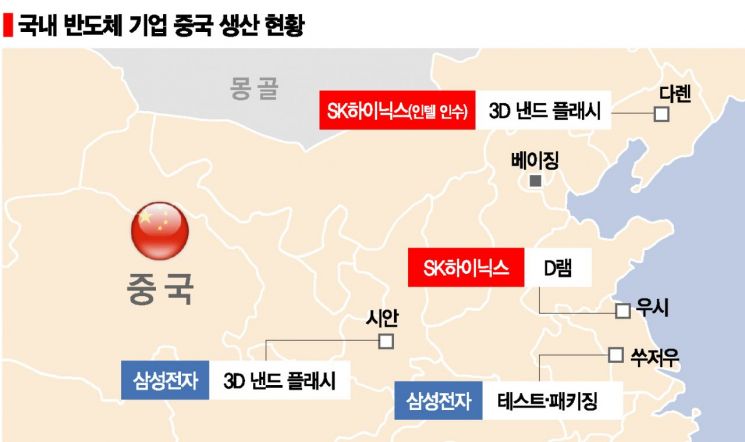
On the 7th, the semiconductor industry believes that even if the U.S. implements measures to regulate the production of system semiconductors with processes of 28nm (nanometers) or below in China, the immediate impact on Samsung and SK Hynix, which currently operate semiconductor plants in Chinese cities such as Xi'an and Wuxi, will likely be limited. This is because Samsung Electronics and SK Hynix’s Chinese plants focus on memory semiconductors and back-end processes rather than system semiconductors, placing them outside the direct scope of the regulations.
However, there is growing tension as news spreads that the U.S. government is considering restricting exports of American semiconductor manufacturing equipment necessary for producing NAND flash memory with 128 layers or more to Chinese memory semiconductor companies such as Yangtze Memory Technologies Co. (YMTC), potentially raising barriers to semiconductor equipment exports.
In a report, KB Securities stated, "Even if the ban on U.S.-made NAND equipment exports to China is confirmed, the impact on Samsung Electronics and SK Hynix will be limited." It explained, "Considering the prolonged U.S.-China semiconductor dispute, Samsung Electronics and SK Hynix, which currently operate NAND production plants in Xi'an and Dalian, are likely to expand additional NAND production capacity in South Korea or regions outside China."
At the same time, the report noted, "Since the U.S. Semiconductor Support Act and the CHIPS 4 Alliance include provisions restricting investments from China and other unfriendly countries over the next decade, which appear to be aimed at containing China, Samsung Electronics and SK Hynix inevitably face complex calculations considering geopolitical realities and increased costs from building local plants in the U.S."
In fact, there are growing concerns within the industry that if U.S. semiconductor regulations on China are prolonged, domestic companies will face significant burdens.
This is because the scope of the exception clause for "Legacy chips" specified in the semiconductor law’s guardrails is ambiguous, and there is no guarantee that the regulation will not expand to cover more semiconductor products. Kim Yang-peng, a senior researcher at the Korea Institute for Industrial Economics and Trade, said, "Among the various U.S. regulations on China, the strengthened restrictions on equipment imports will have the greatest impact on our companies with Chinese facilities." He added, "Once companies receive subsidies specified in the U.S. Semiconductor Act, they will be classified as restricted from investing in China for the next 10 years, which could hinder the advancement of their Chinese facilities."
A semiconductor industry official said, "Since the U.S. focus is on blocking China’s development of advanced semiconductor processes, we must keep in mind the possibility of expanding the scope of regulations in the future." He added, "Even if only system semiconductors with processes of 28nm or below are currently targeted, the scope could be expanded to include memory semiconductors and back-end processes of similar levels."
There is also advice that South Korea urgently needs to prepare an external industrial technology strategy to leverage the global industrial landscape upheaval caused by the unfolding new Cold War between the U.S. and China as an opportunity for strategic industry advancement.
The Korea Institute for Industrial Economics and Trade, in its report titled "Policy Implications of the U.S. CHIPS and Science Act," stated, "Although the Korean government has announced a strategy to become a semiconductor superpower and is strengthening semiconductor strategies such as the National Advanced Strategic Industry Special Act, it is urgent to quantitatively expand and qualitatively enhance support policies to keep pace with major countries offering massive direct subsidies and exceptional tax benefits." The report advised, "Special policy efforts should be made to provide timely support and resolve investment difficulties (such as regulations and local government permits)."
© The Asia Business Daily(www.asiae.co.kr). All rights reserved.

![Clutching a Stolen Dior Bag, Saying "I Hate Being Poor but Real"... The Grotesque Con of a "Human Knockoff" [Slate]](https://cwcontent.asiae.co.kr/asiaresize/183/2026021902243444107_1771435474.jpg)














