Calls for Resignation Emerge Amid Worsening Public Opinion
Various Interpretations Over Policy Source
Education Ministry Officials Remain 'Silent'
"Long-term Tasks Pushed as Short-term"
Neglect of Education, Non-expert Leadership
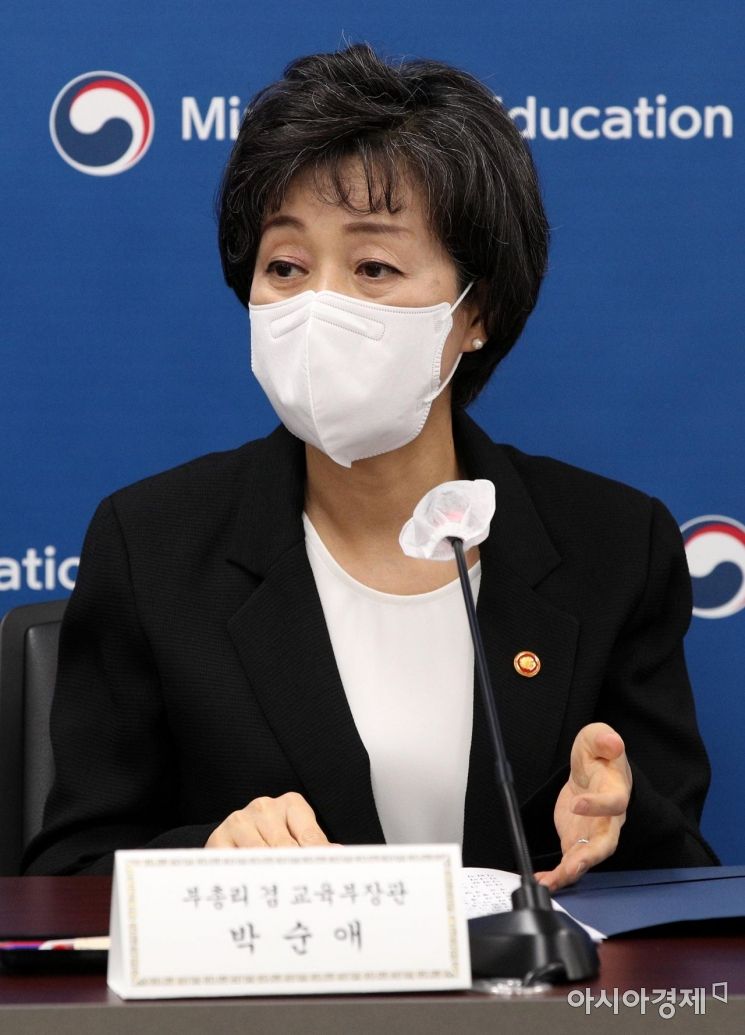 Deputy Prime Minister and Minister of Education Park Soon-ae is speaking at a meeting with parent organizations regarding the lowering of the school entry age held at the Government Seoul Office in Jongno-gu, Seoul on the 2nd. Photo by Hyunmin Kim kimhyun81@
[Asia Economy Reporter Han Jinju] The Ministry of Education's policy of 'starting school at age 5' remains a mystery. Various interpretations have emerged regarding its origin, involving the Ministry of Education, Deputy Prime Minister and Minister of Education Park Soon-ae, and a possible third party. Within a week of the policy announcement, even the Presidential Office stepped in to manage public opinion, and calls for the minister's resignation surfaced.
Ministry of Education officials have generally remained tight-lipped about the source. A Ministry official said on the 5th, "There is no way we proposed this. We have nothing to say (mouths but no words)." As opposition to the school system reform plan intensified, Deputy Prime Minister Park belatedly sought public opinion, but it was insufficient to reverse the situation. On the 4th, she consistently remained silent, even bypassing reporters' questions, which added weight to the resignation calls.
The issue began when the proposal, previously mentioned as a lower priority and long-term task alongside the integration of kindergartens and childcare centers (Yubotonghap), caught Deputy Prime Minister Park's attention. The Ministry of Education has previously proposed lowering the school starting age during the administrations of Roh Moo-hyun, Lee Myung-bak, and Park Geun-hye but failed. They understand the impact of the matter better than anyone. An education sector official explained, "During the preparation of the Ministry's work report, the policy to lower the school starting age was mentioned as one of the long-term tasks along with Yubotonghap, but Deputy Prime Minister Park elevated it to a short-term task."
Deputy Prime Minister Park was determined. The Ministry's work report schedule was nearly delayed by over a week, but Park requested it be held just before the president's vacation, reflecting her intention to push the policy forward swiftly. At a pre-briefing on the 29th of last month, Park said, "(Regarding the school system reform) the demand survey will start in September, and to do so, the survey design must be completed by August. Our issue is urgent, so I requested the work report be held as scheduled." A Ministry official who met right after the briefing said, "It does not mean the policy will be implemented immediately; social discussion is necessary. The Deputy Prime Minister spoke strongly."
The Ministry did not conduct even minimal prior opinion gathering before announcing the work report. The process of consulting experts was also skipped. Neither the minister nor the vice minister are education experts. Deputy Prime Minister Park is a public administration scholar, and Vice Minister Jang Sang-yoon is a bureaucrat from the Office for Government Policy Coordination. Given that the 'education neglect theory' arose since the transition team period, many view the policy confusion as a predictable outcome. At the pre-briefing, Park said, "Until now, opinion gathering centered on experts and providers was the main channel, but under the changed paradigm, the core of the Yoon Seok-yeol administration is a policy shift from the perspective of the people and consumers."
Right after the launch of the Yoon Seok-yeol administration, the Ministry of Education was mentioned as a target for reform concerning semiconductor talent development, creating an environment where Ministry officials found it difficult to speak frankly. One official said, "Because they are conservative bureaucrats, they might resist reform, which could have caused them to be restrained," but also added, "Since Ministry officials could have anticipated the backlash, it is hard to avoid criticism for not informing accurately." Additionally, the fact that the presidential work report was conducted solely by the minister is analyzed by government circles as a factor that made it difficult to convey various concerns surrounding the school system reform.
Experts urge starting discussions from the original point of strengthening early childhood education. Professor Song Ki-chang of the Department of Education at Sookmyung Women's University explained, "We should discuss Yubotonghap first, not the school system reform. After Yubotonghap, we should eliminate educational disparities between daycare centers and kindergartens and promote compulsory kindergarten education."
Professor Bae Sang-hoon of the Department of Education at Sungkyunkwan University said, "It is desirable to explore various options for making early childhood education public and compulsory education," adding, "Since many OECD countries implement compulsory early childhood education, policies should be managed with a long-term perspective considering talent development, social phenomena such as low birth rates and aging, and economic costs."
© The Asia Business Daily(www.asiae.co.kr). All rights reserved.

















