125 Billion KRW Deficit in Q2 This Year... Five Consecutive Quarters of Losses
Operating Surplus Reported in Securities Registration Statement and Investment Prospectus at Listing
[Asia Economy Reporter Ji Yeon-jin] Kakao Pay has continued to post losses since its listing. Although it entered the stock market spectacularly after turning a profit just before its initial public offering (IPO) last year, its growth potential was recognized, but there are criticisms that this was a ‘one-time profit’ for fundraising purposes.
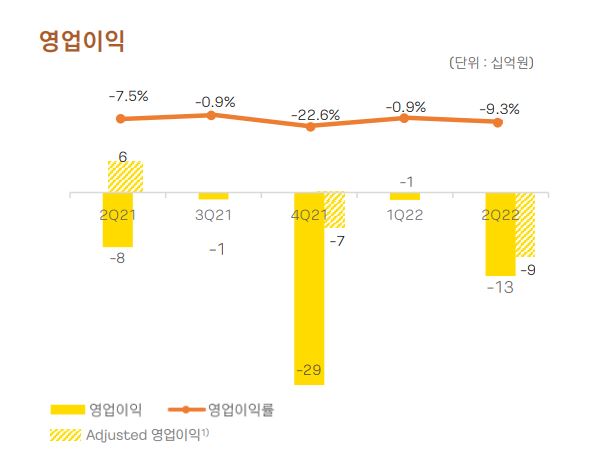
According to Kakao Pay on the 5th, the company recorded an operating loss of 12.5 billion KRW in the second quarter of this year, continuing its deficit. This marks five consecutive quarters of losses since the second quarter of last year. Kakao Pay stated in the securities report submitted to the Financial Supervisory Service in July last year for its listing that it achieved an operating profit of 10.4 billion KRW in the first quarter of last year. This was a turnaround from an operating loss of 3.1 billion KRW in the first quarter of 2020. Operating losses in 2018 and 2019 were 65.3 billion KRW and 17.9 billion KRW, respectively. Later, in the investment prospectus submitted in October last year, an operating profit of 2.6 billion KRW was recorded for the first half of last year. According to the investment prospectus, profitability appeared to be improving steadily. However, according to Kakao Pay’s recent earnings report, operating profit of 10.7 billion KRW in the first quarter of last year, just before listing, turned into an 8.1 billion KRW loss in the second quarter. The investment prospectus recorded an operating profit of 2.6 billion KRW for the first half by combining these two quarters.
At the time of Kakao Pay’s listing last year, there was controversy over the inflated public offering price, which led the Financial Supervisory Service to request a correction of the securities registration statement. The company set the public offering price based on the corporate values of four global companies, including the U.S. retail lending platform Rocket Companies, but there were criticisms that the comparison with these companies was inappropriate. Kim In, a researcher at BNK Investment & Securities, said at the time, “The average ROE (Return on Equity) of the four comparable companies in 2020 was very high at 30.7%, so the average PBR (Price-to-Book Ratio) is also receiving a premium at 7.3 times,” adding, “Kakao Bank’s ROE is 4.1%, and it is difficult to expect an ROE significantly exceeding 10% in the future, so it is hard to understand the assignment of a high PBR.”
However, Kakao Pay made a dazzling debut on the stock market amid last year’s public offering investment frenzy, gathering more than 58 trillion KRW in subscription deposits. Since the listing, the stock price has plunged amid the so-called ‘listing eat-and-run controversy,’ where executives sold all their shares, and the current stock price has fallen 70.62% from last year’s peak (248,500 KRW).
© The Asia Business Daily(www.asiae.co.kr). All rights reserved.
![Clutching a Stolen Dior Bag, Saying "I Hate Being Poor but Real"... The Grotesque Con of a "Human Knockoff" [Slate]](https://cwcontent.asiae.co.kr/asiaresize/183/2026021902243444107_1771435474.jpg)











