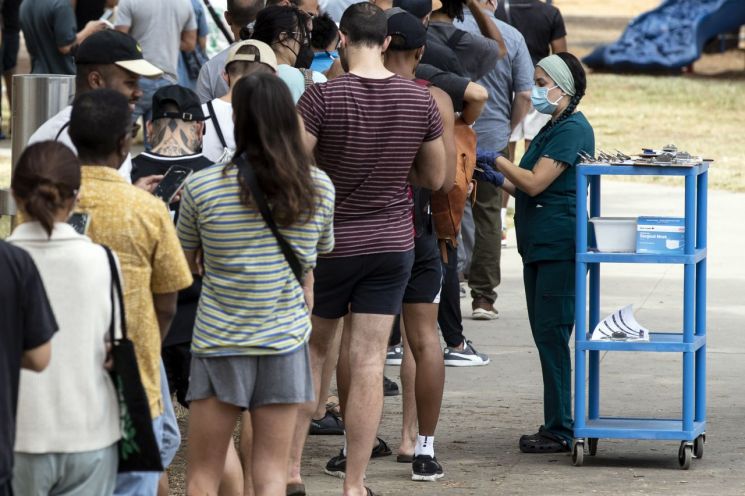
[Asia Economy New York=Special Correspondent Joselgina] The U.S. administration under Joe Biden declared a public health emergency on the 4th (local time) in response to the recent spread of monkeypox.
According to local media such as the economic outlet CNBC, Health and Human Services Secretary Xavier Becerra stated during a press call that day, "Considering all circumstances, I announce the declaration of a public health emergency." He emphasized, "We are prepared to respond to this virus," and "Americans must take monkeypox seriously and act responsibly to eradicate it."
This move aims to strengthen the federal government's response amid the rapid spread of monkeypox within the United States. According to the U.S. Centers for Disease Control and Prevention (CDC), the number of Americans infected with monkeypox is estimated to have surpassed 6,600. Confirmed cases have been reported across 48 states, Washington D.C., and the U.S. territory of Puerto Rico. The actual number of infections is believed to be much higher than the official data.
Accordingly, the federal government will be able to secure funds and other resources to combat the virus, which causes fever, body aches, chills, and fatigue. Additional measures such as deploying extra personnel necessary for disease control can also be implemented. It is expected to accelerate vaccine distribution and other effects.
This emergency declaration draws particular attention as it comes amid criticism that the Biden administration has not adequately secured monkeypox vaccines. Currently, the U.S. government has procured 1.1 million doses of the Jynneos vaccine, enough for about 550,000 people (two doses each). This has led to vaccine shortages, especially in regions where state governments such as California and New York have declared their own emergencies.
Some warn that if a swift response is not taken, monkeypox could spread similarly to the COVID-19 pandemic.
Earlier, the World Health Organization (WHO) declared monkeypox an international public health emergency on the 23rd of last month. Since then, some experts in the U.S. have urged the federal government to hasten its response, including declaring a public health emergency. Lawrence Gostin, a public health law professor at Georgetown University, pointed out, "Declaring an emergency is important but a delayed measure."
© The Asia Business Daily(www.asiae.co.kr). All rights reserved.
![Clutching a Stolen Dior Bag, Saying "I Hate Being Poor but Real"... The Grotesque Con of a "Human Knockoff" [Slate]](https://cwcontent.asiae.co.kr/asiaresize/183/2026021902243444107_1771435474.jpg)











