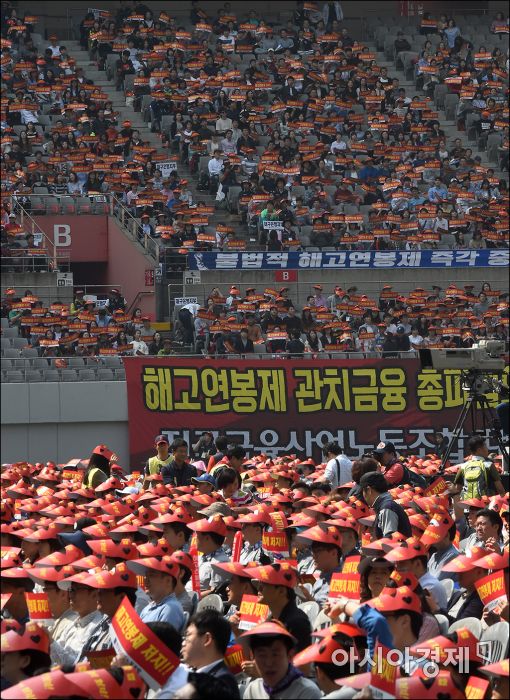
 On September 23, 2016, at the World Cup Stadium in Sangam-dong, Seoul, the Financial Labor Union held a general strike declaration ceremony to oppose the performance-based pay system. Photo by Asia Economy DB
The National Financial Industry Labor Union (Financial Union) has announced a general strike scheduled for the 16th of next month, demanding a salary increase of over 6%. The Financial Union will hold a strike vote starting on the 19th. If carried out, it will be the first general strike in six years since the 2016 strike against the performance-based pay system under the Park Geun-hye administration.
According to the financial sector on the 5th, the general strike leadership, including Chairman Park Hong-bae, has been touring regions nationwide since the 1st to discuss the strike schedule and key issues. The Financial Union comprises 39 branches nationwide, including major commercial banks such as Kookmin and Shinhan, as well as policy banks and regional banks.
According to the Financial Union, labor-management wage negotiations broke down on the 6th of last month, and despite going through mediation by the Central Labor Relations Commission, no agreement was reached, leading to a decision to suspend mediation. The Financial Union demanded a 6.1% wage increase, while the employers proposed 1.4%, and the gap remained unresolved. Chairman Park emphasized, "Dialogue is the best method, but issues such as fair compensation, expanding new hires, improving the wage peak system which has no effect on retirement age extension, opposing the relocation of policy banks to provinces, and reinstating dismissed executives are not matters to be resolved through dialogue."
In the past, the Financial Union has conducted three general strikes. In 2000, the union launched a general strike involving 24 workplaces and about 65,000 participants, opposing government-led forced mergers and demanding the enactment of a special law to abolish government-controlled finance. This strike ended within a day after an agreement between the government and the Financial Union.
In 2012, a general strike was approved with a 91.3% approval rate but was not actually carried out. However, two years later, another strike occurred. On September 3, 2014, the union staged a general strike, again demanding the abolition of government-controlled finance, blocking parachute appointments, opposing government intervention in labor relations, and improving employment stability and working conditions. A second general strike was announced for September 30 but was canceled. The most recent strike was in 2016, when approximately 35,000 to 40,000 people gathered at the World Cup Stadium in Mapo-gu, Seoul, demanding the abolition of the performance-based pay system. The strike ended after partial agreements with the employers.
The Financial Union is strongly committed to this upcoming general strike. After completing regional rallies by early next month, they are expected to proceed with the strike in earnest. However, even if the strike occurs, they plan to minimize damage to branch operations. Since non-face-to-face work has become more active after COVID-19, it is expected that business disruption will not be significant. A Financial Union official stated, "Although specific policies have not yet been decided, an appropriate number of staff will remain at the branches."
There is also a sense that negative public opinion is being considered. Given that the average salary in the banking sector exceeds 100 million won and recent incidents such as embezzlement by a Woori Bank employee and abnormal foreign currency remittance transactions have drawn social criticism, this must be taken into account. A representative from a commercial bank said, "Strikes in the financial sector have always been viewed unfavorably by the public, and with authorities such as the Financial Supervisory Service closely monitoring banks recently, concerns are indeed present." Another commercial bank official added, "Bank employees are also aware of the negative public opinion," and "there is a possibility that the vote may be rejected."
© The Asia Business Daily(www.asiae.co.kr). All rights reserved.
![Clutching a Stolen Dior Bag, Saying "I Hate Being Poor but Real"... The Grotesque Con of a "Human Knockoff" [Slate]](https://cwcontent.asiae.co.kr/asiaresize/183/2026021902243444107_1771435474.jpg)















