Successful Continuous Realization of 'Phloque State' That Changes Optical Properties at Will
Professor Jo Gil-yeong of POSTECH Awarded 'Scientist of the Month'
 A scene from the movie "Terminator Genisys," which depicts a battle between machines and humans. Many people still fear that machines could pose a threat to the future of humanity.
[Asia Economy Reporter Kim Bong-su] The classic sci-fi movie "Terminator 2" features a liquid metal robot called the "T-1000." It can freely change its shape, pass through metallic substances, and transform into objects of similar mass. Could such imagination in movies become reality?
Recently, physicists have been focusing on research into the 'Floquet state,' where shining light on a material can freely transform it from a conductor to a semiconductor, and from a semiconductor to a metal. Amid this, a Korean research team has succeeded in continuously realizing the dream material 'Floquet state,' which allows free control over the electrical, optical, and quantum mechanical properties of materials.
 Professor Jo Gil-young, Pohang University of Science and Technology
The Ministry of Science and ICT and the National Research Foundation of Korea announced on the 3rd that Professor Cho Gil-young of the Department of Physics at Pohang University of Science and Technology (POSTECH) has been selected as the recipient of the Science and Technology Person of the Month Award for August.
Professor Cho's research team succeeded in continuously realizing the Floquet state, which can freely change the electrical, optical, and quantum mechanical properties of solid materials using light. They were recognized for laying the groundwork for the advancement of quantum technology and the development of new materials.
In academia, there was a hypothesis that shining light on materials, rather than using heat or pressure, could create a Floquet state?a quantum mechanically coupled state between electrons inside the material and light?which was first observed in 2013. Since then, many researchers have attempted to realize the Floquet state, but until now, the realized Floquet states lasted only about 250 femtoseconds (1 femtosecond = one quadrillionth of a second). Consequently, research on the characteristics and applications of the Floquet state remained insufficient, with only its existence confirmed.
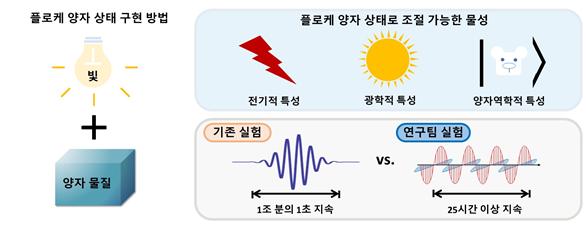
Professor Cho developed a new experimental method to realize a stable Floquet state and succeeded in sustaining the Floquet state for more than 25 hours, far exceeding previous durations. By utilizing superconducting-graphene device technology capable of measuring the subtle signals of the Floquet state, they implemented the Floquet state using relatively weak microwaves, solving the heat generation problem caused by light. They also confirmed that by adjusting the intensity of microwaves, the electronic structure of graphene can be manipulated. The related research results were published in the international journal Nature on March 16, 2022.
Professor Cho Gil-young stated, "This research is significant as it is the world's first success in continuously realizing the Floquet state semi-permanently," adding, "We plan to systematically study changes in the Floquet state according to variations in light polarization and frequency, expand Floquet research, and pursue the realization of completely new concepts of nonequilibrium quantum states."
© The Asia Business Daily(www.asiae.co.kr). All rights reserved.

















