'38.8% of the Population' Have COVID-19 Infection History
Cough, Fatigue, Headache Symptoms After Recovery... Concerns Over 'Long COVID'
Government to Launch Large-Scale COVID-19 Aftereffect Survey by End of August
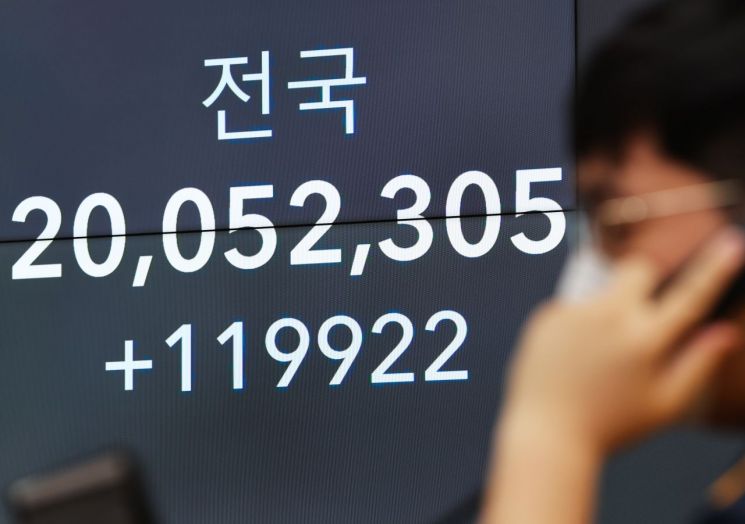 On the morning of the 3rd, the number of new COVID-19 cases reached 119,922, surpassing a cumulative total of 20 million. The number of confirmed cases is displayed on the monitor in the Disaster and Safety Situation Room at Seongnam City Hall, Gyeonggi Province.
 [Photo by Yonhap News]
[Asia Economy Reporter Yoon Seul-gi] The cumulative number of COVID-19 cases has surpassed 20 million. It has been about 2 years and 7 months since the first confirmed case was reported in South Korea. The problem is that as the number of confirmed cases increases, so does the number of people complaining of long-term aftereffects of COVID-19, known as 'Long COVID.' The government is emphasizing the importance of the 4th vaccination dose to prevent aftereffects and plans to launch a large-scale study on COVID-19 aftereffects by the end of August.
According to the Central Disease Control Headquarters (CDCH) on the 3rd, the number of confirmed COVID-19 cases as of midnight was 119,922. This marks the second consecutive day with cases in the 110,000 range, and the number of new cases is the highest in 110 days.
The cumulative number of confirmed cases stands at 20,052,305. After surpassing 10 million on March 22, it doubled to 20 million in about four months, meaning 38.8% of the total population (51.63 million) has a history of COVID-19 infection.
According to the CDCH announcement the previous day, the infection reproduction number (Rt) for the 4th week of July (July 24?30) was 1.29. Although it decreased by 0.25 from the previous week (1.54), it remains above 1, indicating that the spread is likely to continue. The infection reproduction number quantifies how many people one infected person transmits the virus to; a value above 1 indicates epidemic spread, while below 1 indicates containment.
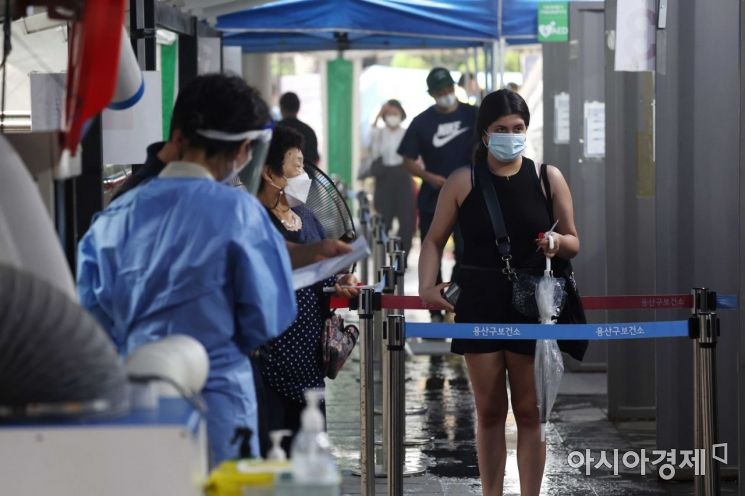 On the 3rd, 119,922 new COVID-19 cases were reported domestically, bringing the total number of confirmed cases to over 20 million. Citizens are getting tested at the screening clinic of Yongsan-gu Public Health Center in Seoul on this day. Photo by Moon Honam munonam@
As the COVID-19 pandemic repeats and the cumulative number of confirmed cases rises sharply, concerns about 'Long COVID' are also growing. A university student, Lee Mo (21), who was infected during the Omicron variant surge in March, said, "I coughed continuously for almost over a month, to the point where people around me noticed," adding, "Even a little exercise made me short of breath, and drinking cold beverages worsened my cough." According to data from the Health Insurance Review & Assessment Service in January, 19.1% (4,139 out of 21,615) of confirmed COVID-19 patients visited medical institutions due to aftereffects.
As people worldwide report Long COVID symptoms, countries are recognizing the seriousness of the condition. The World Health Organization (WHO) defines Long COVID as a condition where one or more symptoms appear within three months of COVID-19 onset and persist for at least two months. Symptoms include muscle pain, headaches, dizziness, sore throat, breathing difficulties, and abnormalities in taste and smell.
In the UK, research has shown that more than 100 symptoms related to Long COVID can occur. According to a research team at the University of Birmingham, a comparative analysis of clinical practice research data (CPRD) involving 486,149 adult COVID-19 patients and 1,944,580 non-infected individuals identified 115 individual symptoms and 33 complex symptoms. Long-term COVID aftereffects included fatigue, muscle and joint pain, shortness of breath, headaches, chest pain, cough, changes in smell and taste, diarrhea, as well as symptoms like hair loss and decreased sexual function.
Long COVID symptoms sometimes lasted more than 12 weeks. According to the research team's findings, 2.7% of the UK population experienced aftereffects lasting more than 4 weeks following COVID-19 infection, and among them, 70% had symptoms persisting beyond 12 weeks.
The situation is similar in the United States, where cumulative confirmed cases have exceeded 90 million. According to the US public radio NPR on the 31st of last month, about 4 million Americans are experiencing difficulties such as losing their jobs due to COVID-19 aftereffects.
As the number of patients suffering from Long COVID increases, South Korea is also set to begin a large-scale government-led study on COVID-19 aftereffects. The National Institute of Health announced on the 21st of last month that the announcement for selecting the lead research institution for a large-scale COVID-19 aftereffects survey has been completed, and the selection evaluation process is underway. They plan to sign an agreement with the lead research institution and start the study by the end of August.
The institute plans to observe and conduct in-depth research on a large cohort of COVID-19 syndrome patients, including children and adolescents, both in the short and long term, to clarify the patterns and causes of Long COVID and establish treatment guidelines.
The health authorities are also urging the public to receive the 4th vaccine dose to prevent aftereffects. On the 26th of last month, Baek Kyung-ran, Commissioner of the Korea Disease Control and Prevention Agency, stated at a briefing, "Vaccination has been confirmed through large-scale national data to reduce not only the risk of hospitalization or death but also the risk of complications after infection," emphasizing, "Based on this, please receive the primary or additional vaccinations according to the existing recommended vaccination guidelines."
© The Asia Business Daily(www.asiae.co.kr). All rights reserved.
![Clutching a Stolen Dior Bag, Saying "I Hate Being Poor but Real"... The Grotesque Con of a "Human Knockoff" [Slate]](https://cwcontent.asiae.co.kr/asiaresize/183/2026021902243444107_1771435474.jpg)

















