Total Installed Units 73,945... Increasing Annually
Units Installed per 1㎢: Nowon 61 vs Seongdong 209
Cost Issues Are the Biggest Cause
Nowon-gu Crime Prevention CCTV Installation Budget 60 Million KRW vs Gangnam-gu 1.3 Billion KRW
The number of closed-circuit televisions (CCTV) installed for crime prevention shows significant disparities across Seoul's autonomous districts. The enormous costs involved in installation and the separated systems have limited the increase in CCTV installations. Experts have called for increasing CCTV coverage with a focus on eliminating blind spots.
According to Seoul City on the 3rd, the total number of crime prevention CCTVs in Seoul was counted at 73,965 units as of last year. In 2019, there were 58,551 units, which increased to 67,270 units in 2020. This represents a double-digit growth rate of 15% and 10% annually since 2019.
The gap in the number of crime prevention CCTVs among autonomous districts has yet to be resolved. The district with the most crime prevention CCTVs is Gangnam-gu, with 6,143 units installed. Following Gangnam-gu are Guro-gu (3,842 units), Eunpyeong-gu (3,822 units), and Seongbuk-gu (3,815 units), ranking high. On the other hand, the district with the fewest installations is Jongno-gu, with a total of 1,573 units. Dobong-gu (1,684 units), Jung-gu (1,911 units), and Nowon-gu (2,171 units) also have relatively fewer crime prevention CCTVs installed. However, in terms of growth rate compared to 2019, Dobong-gu recorded the highest at 102%. In 2019, Dobong-gu was the only district with fewer than 1,000 crime prevention CCTVs.
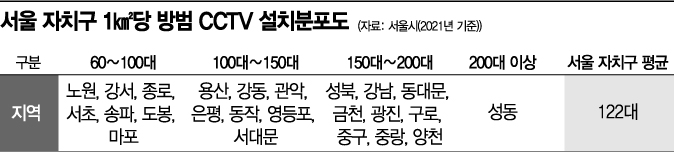
The number of crime prevention CCTVs per square kilometer, which can estimate the actual surveillance coverage, also showed a large gap between districts. As of last year, the number of crime prevention CCTVs per 1㎢ across Seoul was 122 units, but many districts fell short of this. The lowest was Nowon-gu, with 61 units. Following were Gangseo-gu (64 units), Jongno-gu (66 units), Seocho-gu (73 units), and Songpa-gu (74 units). In comparison, Seongdong-gu had three times more, with 209 units installed than Nowon-gu. Yangcheon-gu (195 units), Jungnang-gu (194 units), Jung-gu (192 units), and Gwangjin-gu (182 units) also ranked high.
Districts below the Seoul average of 122 units... Ultimately a budget issue
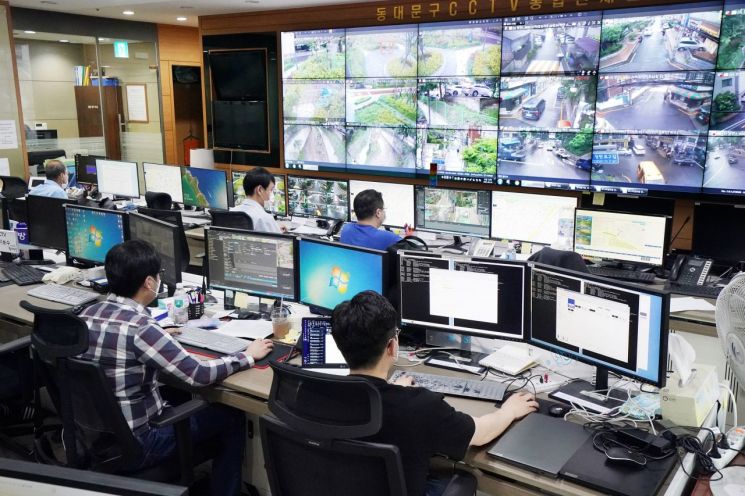
The statistics on the number of crime prevention CCTVs per unit area are also influenced by green areas such as mountains and green belts within the districts. However, district officials unanimously pointed to budget issues as the biggest cause. The budget for installing one crime prevention CCTV is about 20 million KRW. This includes not only the cost of the equipment but also installation and labor costs. A Nowon-gu office official lamented, "The budget allocated for installing crime prevention CCTVs this year is a total of 60 million KRW. Even this is an increase from the previous 28 million KRW." This contrasts with Gangnam-gu office, which allocated 1.3 billion KRW this year for the largest number of CCTVs. A Gangnam-gu office official explained, "We have allocated a large budget again this year to eliminate blind spots."
Costs related to system integration work have also hindered the increase of crime prevention CCTVs. Currently, the autonomous districts in Seoul do not control CCTVs from a single place but have them separated among departments such as Disaster Safety, Parking Management, and Water Control. Districts explained that a significant budget is required to consolidate these into one system. A Songpa-gu office official said, "We are currently carrying out a CCTV system integration project," adding, "Because we have been focusing on this project, we have not been able to increase the installation of crime prevention CCTVs."
Conflicting research results on CCTV effectiveness... "Installation should focus on blind spots"
Analyses of CCTV effectiveness vary. In 2015, the Ministry of Public Safety and Security and the National Police Agency compared crime occurrence before (first half of 2013) and after (first half of 2015) CCTV installation, reporting that the number of five major crimes (murder, robbery, rape and sexual assault, theft, and violence) decreased by about 26.6%. However, recently, Professor Hwang Euigap and his team from the Department of Police Administration at Kyonggi University published a paper titled "A Study on the Crime Prevention Effect of CCTV through GIS Spatial Analysis: Focusing on 25 Autonomous Districts in Seoul," which found that violent crimes such as rape, sexual assault, and theft actually increased in districts where CCTV installations increased. They emphasized, "It is necessary to examine whether installations were made in appropriate locations rather than simply expanding coverage."
Professor Kim Dowoo from the Department of Police Science at Gyeongnam University said, "Crime prevention CCTVs help police investigations and reassure local residents," adding, "However, blind spots such as hiking trails still exist, so crime prevention CCTVs should be increased focusing on these areas."
© The Asia Business Daily(www.asiae.co.kr). All rights reserved.
![Clutching a Stolen Dior Bag, Saying "I Hate Being Poor but Real"... The Grotesque Con of a "Human Knockoff" [Slate]](https://cwcontent.asiae.co.kr/asiaresize/183/2026021902243444107_1771435474.jpg)

















