[Asia Economy Reporter Junho Hwang] On the 2nd, the stock market closed lower, weighed down by the renewed US-China conflict as a new negative factor.
KOSPI Sees Heavy Selling by Institutions
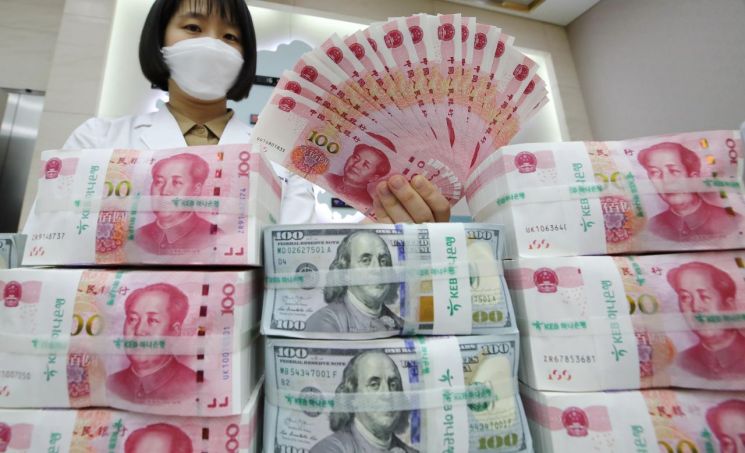
On that day, the KOSPI closed at 2,439.62, down 12.63 points (-0.52%) from the previous day. Although foreigners and individuals were buying stocks, the index fell as institutions concentrated on selling. Individuals and foreigners net bought 292 billion KRW and 294.2 billion KRW respectively, while institutions net sold 595.4 billion KRW. In particular, financial investment firms sold heavily (-357.9 billion KRW), and SK Securities stated that foreign futures selling appeared to have triggered the financial investment firms' selling.
Among all stocks, more declined than rose. A total of 615 stocks fell, while 240 stocks rose. Most of the large-cap stocks also closed lower. Among them, Samsung Biologics (-1.37%), LG Chem (-0.49%), and Samsung SDI (-1.89%), which had recorded significant gains the previous day, gave up most of their gains and closed lower.
On the other hand, Samsung Electronics, the perennial market leader, closed slightly higher. It ended at 61,700 KRW, up 0.65% from the previous day. This is analyzed as a result of foreign funds flowing into Samsung Electronics.
By sector, gains were seen in food and beverage, transportation equipment, non-metallic minerals, construction, and electrical and electronics sectors. Among these, the food and beverage sector saw overall gains in stocks such as Sempio Foods, Sajo Daerim, Nongshim, Samyang Foods, and Hite Jinro. This rise is attributed to expectations that food and beverage companies, which had preemptively raised prices amid stable grain prices, will see expanded earnings.
Only one stock, 'Seongan,' hit the daily upper limit on the KOSPI that day. Seongan recorded the upper limit for the second consecutive day but gave up some gains in the afternoon, closing at 984 KRW, up 4.02% from the previous close.
On that day, Seongan announced that it decided to issue a paid-in capital increase, convertible bonds (CB), and bonds with warrants (BW) to raise large-scale operating funds. It decided on a third-party allotment paid-in capital increase worth 10 billion KRW and 7 billion KRW (to Daehotechnoledge and Lee Sanghee, respectively) to raise operating funds. Additionally, Seongan announced the issuance of the first tranche of 20 billion KRW and the second tranche of 25 billion KRW of anonymous, unsecured private placement convertible bonds. The recipients of the issuance are Lee Sanghee and Chae Deokhee, respectively.
The KOSDAQ closed at 804.34, down 0.40% from the previous session. Individuals net bought 152.2 billion KRW, while foreigners and institutions net sold 99.8 billion KRW and 49.8 billion KRW, respectively.
Among all stocks, 968 declined. Among the large-cap stocks, EcoPro BM, Celltrion Healthcare, L&F, Pearl Abyss, and Celltrion Pharm showed weakness and closed lower. Notably, HLB closed at 42,800 KRW, up 3.26% from the previous day, after the HLB Shareholders' Alliance and the Korea Stock Investment Federation announced advertisements celebrating HLB's clinical success and criticizing short selling, signaling a direct response.
On that day, only Yuil Robotics, Castel Bajac, and Aspllo recorded the daily upper limit on the KOSDAQ.
The exchange rate closed at 1,304.70 KRW, up 0.05% from the previous day.
Growing Preference for Safe-Haven Assets
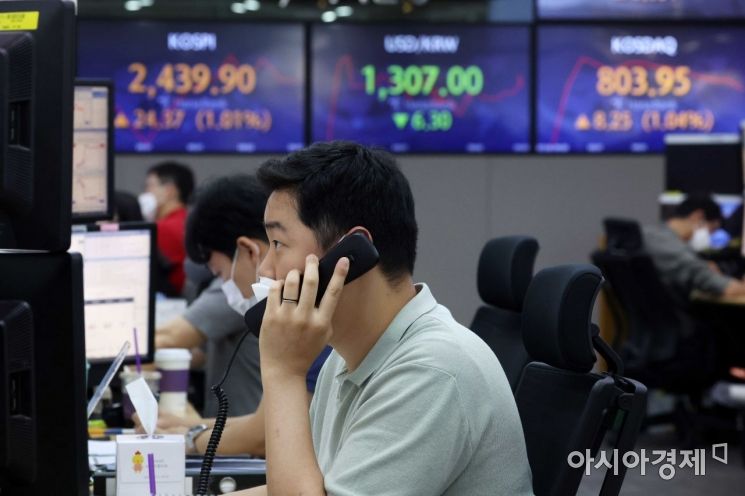 On the 28th, the KOSPI index opened at 2,437.57, up 0.91% (22.04 points) from the previous trading day, as dealers were working in the Hana Bank dealing room in Euljiro, Seoul. The won-dollar exchange rate started at 1,306 won, down 7.3 won. Photo by Moon Honam munonam@
The stock market on that day is analyzed as being depressed due to the renewed US-China conflict, which dampened investor sentiment. The new negative factor is expected to continue pressuring the market for some time.
Sangyoung Seo, a researcher at Mirae Asset Securities, said, "Overall investment sentiment in the stock market has become extremely subdued," adding, "Especially as the economic slowdown is becoming a reality, the intensification of US-China conflict has expanded concerns about a recession."
US House Speaker Nancy Pelosi announced a visit to Taiwan, to which the Chinese government responded by planning military exercises in the Taiwan Strait. Additionally, Chinese fighter jets entered near Taiwan, and restrictions on aircraft operations near Taiwan were announced. As a result, US Treasury yields fell, the Japanese yen strengthened, gold prices rose, and international oil prices declined, increasing preference for safe-haven assets.
The Shanghai Composite Index in China was down 1.83% at 3,200.33 compared to the previous day, and the Shenzhen Composite Index was down 2.20% at 2,154.12. Japan's Nikkei 225 also fell 1.42%.
© The Asia Business Daily(www.asiae.co.kr). All rights reserved.
![Clutching a Stolen Dior Bag, Saying "I Hate Being Poor but Real"... The Grotesque Con of a "Human Knockoff" [Slate]](https://cwcontent.asiae.co.kr/asiaresize/183/2026021902243444107_1771435474.jpg)

















