Prices of Agricultural and Marine Products Up 7% in One Year... Industrial Products and Services Lead Inflation
Dining Out Prices Highest in 30 Years... Electricity, Gas, and Water Rates Up 15.7%, Largest Increase Since Survey Began
Chuseok Livelihood Stabilization Measures to Be Announced This Month... Annual Inflation Rate Expected to Exceed 5%
[Asia Economy Sejong=Reporters Kwon Haeyoung and Mun Jewon] The consumer price trend for July announced by the government on the 2nd shows that prices are soaring to levels similar to those during the International Monetary Fund (IMF) foreign exchange crisis. Although the rising trend in oil prices, which had been pushing up consumer prices, has somewhat eased, the early heatwave and the rainy season caused vegetable prices to surge, raising food prices, and dining-out prices also hit the highest level in about 30 years. Public service fees such as electricity, gas, and water charges also rose one after another. Not only oil prices but also various factors stimulating inflation are scattered everywhere. This is why the government still judges that the inflation peak has not yet been reached. The government expects the inflation rate to peak around September to October, when the Chuseok holiday comes earlier than usual, and plans to put all efforts into stabilizing food prices by announcing Chuseok livelihood stabilization measures within this month.
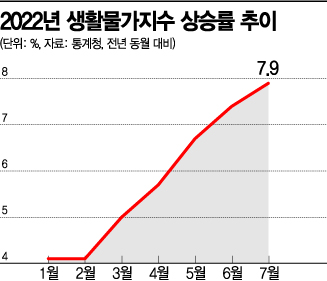
◆Expansion of price increases in agricultural, livestock, and fishery products... Industrial products and services also rise=Looking at last month's consumer price trends, agricultural, livestock, and fishery products rose 7.1% compared to a year ago, marking the largest increase since December last year (7.8%). Due to the severe deterioration of crop conditions caused by the heatwave and rainy season, vegetables such as cabbage (72.7%), cucumber (73.0%), lettuce (63.1%), green onion (48.5%), and spinach (70.6%) surged by 25.9%. Livestock products such as pork (9.9%) and imported beef (24.7%) rose by 6.5%, and fishery products increased by 3.5%. Agricultural, livestock, and fishery product prices, which had fallen to a 0.4% increase in March this year, are expanding again. Accordingly, the fresh food index rose 13.0%, and the living cost index jumped 7.9%, compounded by the impact of processed food price increases.
Overall, industrial products and services led the inflation. Of last month's 6.3% inflation rate, industrial products and services contributed 3.11 percentage points and 2.13 percentage points, respectively. Industrial products rose 8.9%, with petroleum products (35.1%) such as diesel (47.0%), gasoline (25.5%), kerosene (80.0%), and liquefied petroleum gas (LPG) for automobiles (21.4%) surging due to rising international oil prices. Processed foods (8.2%) such as bread (12.6%) and functional cosmetics (14.4%) also increased. However, amid the decline in international oil prices and the trend of reducing fuel taxes, the increase in petroleum prices slowed for the first time this year compared to the previous month (39.6%).
The rise in service prices is also notable. In particular, dining-out prices rose by 8.4%, the highest increase in 29 years and 9 months since October 1992 (8.8%). Personal services also showed the largest increase (6.0%) since August 1994 (6.6%), with insurance service fees (14.8%), apartment management fees (4.2%), and chicken (11.4%) rising. Electricity, gas, and water charges rose 15.7%, marking the largest increase since the survey began in January 2010.
Oh Woonseon, Director of Economic Trend Statistics at Statistics Korea, explained, "Prices of industrial products such as petroleum products and personal services such as dining out continued to rise sharply, while agricultural, livestock, and fishery products and electricity, gas, and water charges also increased." He added, "However, as the surge in international oil prices has somewhat eased, the rise in petroleum and livestock product prices has slowed." He further noted, "The slowdown in livestock product price increases is believed to be partly due to policy effects such as tariff reductions."
◆"Inflation peak expected in September-October... Annual inflation rate in the 5% range"=The government expects food prices to rise further next month, ahead of the early Chuseok holiday. At the National Assembly's Planning and Finance Committee briefing yesterday, Deputy Prime Minister and Minister of Economy and Finance Choo Kyung-ho said, "Unless there are additional unexpected external factors, I predict that the inflation peak will be around September to October." Accordingly, the government plans to announce Chuseok livelihood stabilization measures this month, focusing on stabilizing food prices and reducing essential living expenses, and is currently reviewing items for additional tariff allocations.
The government expects the inflation rate to peak in the high 6% range in September-October and record an annual inflation rate in the 5% range. The decline in international oil prices and raw material and grain prices, which have driven inflation so far, is seen as a positive sign. Director Oh said, "The high inflation rate was due to external uncertainties such as international oil prices, but recently these factors have shown signs of easing, and there will also be a base effect compared to the relatively high prices in August-September last year." He added, "If there is no instability in agricultural, livestock, and fishery product prices due to weather conditions ahead of Chuseok, the upward trend is not expected to expand significantly." He forecasted, "The annual inflation rate is likely to exceed 5%."
The Bank of Korea, which is focusing more on price stabilization than economic stimulus, is also on alert. The Bank held a 'Price Situation Review Meeting' chaired by Deputy Governor Lee Hwansuk to check recent price trends and future outlook. Deputy Governor Lee said, "Consumer prices are expected to continue rising above 6% for some time due to high inflation expectations, sustained high oil prices, and increased demand-side price pressures." However, the Bank noted that the inflation volatility could increase depending on the developments of the Ukraine crisis, trends in international raw material prices such as oil, and summer weather conditions such as typhoons and heatwaves.
© The Asia Business Daily(www.asiae.co.kr). All rights reserved.

















