"Fundamental Causes Like Climate Change and Energy Crisis Remain Unresolved"
[Asia Economy Reporter Yu Je-hoon] Although wheat prices, which surged due to the Ukraine-Russia war, have stabilized and fallen to early-year levels, there is a possibility of another sharp rise due to climate change and energy shortages, the New York Times reported on the 1st (local time).
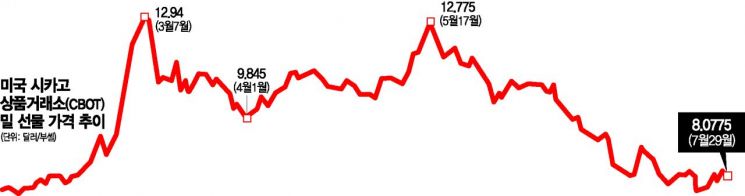
According to the report, as of the 29th of last month, wheat prices traded on the Chicago Board of Trade (CBOT) were about $8 per bushel. This is similar to the level at the beginning of the year ($7.70 per bushel).
International wheat prices began to surge sharply immediately after Russia's invasion of Ukraine at the end of February, reaching around $13 per bushel, and maintained a high double-digit level until mid-June. However, as some countries withdrew their willingness to purchase wheat due to the price surge, demand decreased, and supply increased with the winter wheat harvest, leading to price stabilization.
In particular, the agreement on grain exports involving Ukraine, Russia, the United Nations (UN), and T?rkiye regarding the export of 20 million tons of wheat trapped in Black Sea ports was identified as a major factor stabilizing wheat prices. However, experts believe that wheat prices are likely to rise again. This is because climate change, as well as the war, has a significant impact on international grain prices.
For example, in Canada, about three-quarters of the national farmland suffered from drought as of the end of July last year, resulting in a production decrease of about 40% compared to the previous year. Although Canada’s wheat production is expected to recover this year, Europe is suffering from heatwaves, and India banned wheat exports in May. Tracy Allen, a strategist at JP Morgan Chase, said, "(Grain) prices will continue to rise, and consumers will feel this in the prices of products they buy on supermarket shelves."
Not only grain prices but also transportation costs, fuel prices, and fertilizer prices are rising sharply, which is problematic. Russia, the world's largest fertilizer producer, has reduced natural gas supplies to Europe, which is not only raising fuel prices but also driving up the prices of nitrogen-based fertilizers.
© The Asia Business Daily(www.asiae.co.kr). All rights reserved.
![Clutching a Stolen Dior Bag, Saying "I Hate Being Poor but Real"... The Grotesque Con of a "Human Knockoff" [Slate]](https://cwcontent.asiae.co.kr/asiaresize/183/2026021902243444107_1771435474.jpg)
















