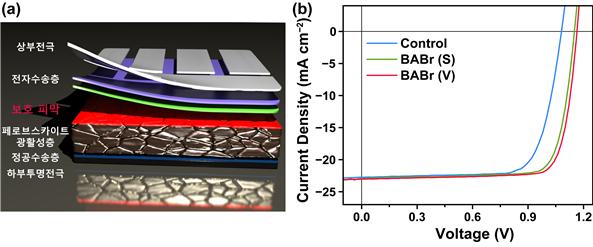
 The structure and performance of perovskite cells with a newly developed protective coating applied.
[Asia Economy Yeongnam Reporting Headquarters Reporter Hwang Dooyul] The highest efficiency 'Perovskite Solar Cell' made using a thin-film deposition process has been developed.
The thin-film deposition process is advantageous for mass production of cells, raising expectations for the commercialization of perovskite solar cells.
A research team led by Professor Park Hyesung of the Department of Materials Science and Engineering at UNIST succeeded in manufacturing high-efficiency and long-lasting perovskite solar cells using a vacuum thin-film deposition process.
Vacuum thin-film deposition is a technique that evaporates raw materials in a vacuum state and coats them thinly on a substrate, already widely used in manufacturing large OLED TVs and other applications.
The developed perovskite solar cell recorded a solar-to-electric conversion efficiency of 21.4%. This is the highest level among perovskite solar cells manufactured by vacuum thin-film deposition processes.
Additionally, even without an encapsulation process that wraps the entire cell with protective material, the cell maintained over 60% of its initial efficiency after operating for 1000 hours at 60-70% humidity, demonstrating excellent durability.
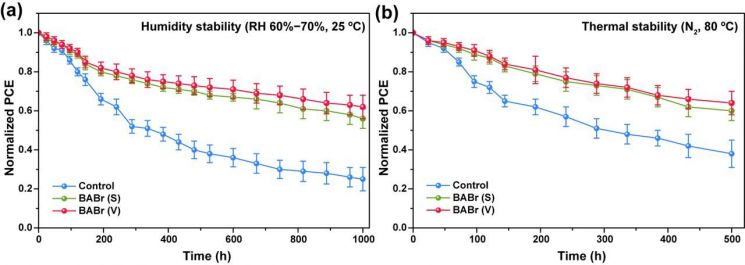
First author Researcher Choi Yunseong said, “Thanks to the protective film deposited on the perovskite material,” adding, “The protective film provides excellent protection against moisture and thermal stress while, unlike existing protective films, it does not reduce cell efficiency.”
Perovskite solar cells protect the moisture- and heat-sensitive perovskite by forming a thin passivation layer directly on the perovskite material.
However, the previously known ‘Ruddlesden-Popper’ structured film, which was known for its excellent protective function, had irregular internal particle arrangements that lowered electricity generation efficiency. Due to the disordered particle arrangement, charge carriers (electrons) could not properly flow to the electrode.
The research team solved this problem by synthesizing a protective film with aligned internal atomic orientation. They used a technique to control process variables such as thin-film formation speed during deposition.
The perovskite solar cells coated with the protective film showed excellent performance not only in moisture resistance but also in thermal durability tests.
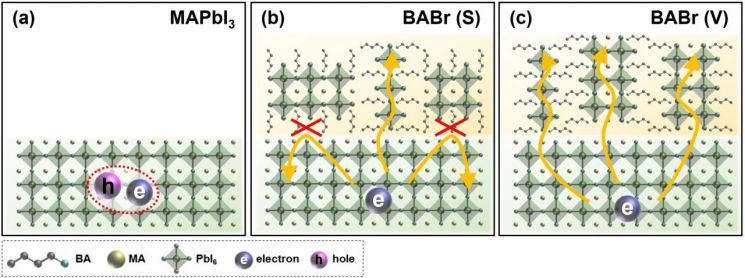 Comparison example images of the structure of the synthesized protective film (right) and the existing protective film or the case without a film.
Professor Park Hyesung said, “Thin-film deposition is a manufacturing method very advantageous for producing perovskite solar cells at commercially viable large sizes,” and added, “It is very promising that the efficiency of perovskite solar cells made by this method has exceeded 20%.”
Professor Park also added, “The vacuum deposition-based protective film technology developed in this study can be applied not only to perovskite solar cells but also to tandem solar cells, perovskite-based light-emitting diodes, and photodetectors.”
The research results were published online on June 21 in the international energy journal Energy & Environmental Science (Impact Factor: 39.714) and are scheduled for formal publication.
The research was conducted with support from the National Research Foundation of Korea, Korea Institute of Energy Technology Evaluation and Planning, and Korea Institute of Science and Technology.

© The Asia Business Daily(www.asiae.co.kr). All rights reserved.
![Clutching a Stolen Dior Bag, Saying "I Hate Being Poor but Real"... The Grotesque Con of a "Human Knockoff" [Slate]](https://cwcontent.asiae.co.kr/asiaresize/183/2026021902243444107_1771435474.jpg)


















